


- Trending
- Comments
- Latest

An attacker who secretly seized control of the USPD stablecoin protocol during its September deployment drained approximately $1 million worth of staked Ethereum this week after lying dormant for nearly three months.
The breach, confirmed by USPD on December 5, involved the unauthorized minting of 98 million USPD tokens and the theft of roughly 232 stETH.
The attacker had front-run the protocol’s initialization in September, gaining admin rights and installing a hidden proxy implementation that evaded detection by auditors and block explorers until the December exploit.
USPD disclosed that the Uspd protocol exploit stemmed from an attacker who quietly gained control of the protocol’s proxy admin rights during deployment months earlier. Although the protocol emphasized that its audited smart contract logic was intact, the vulnerability emerged during what it described as a “CPIMP” attack, a tactic that targets the narrow deployment window of proxy contracts.
According to USPD, the attacker front-ran the initialization code on Sept. 16 using a Multicall3 transaction. Acting before the deployment script finalized, the attacker seized admin access and installed a hidden proxy implementation. To conceal this embedded version, the attacker manipulated event data, spoofed storage slots, and ensured block explorers displayed the benign audited contract.
The camouflage allowed the attacker to maintain control for months, eventually upgrading the proxy and executing the mint-and-drain event that triggered the Uspd protocol exploit.
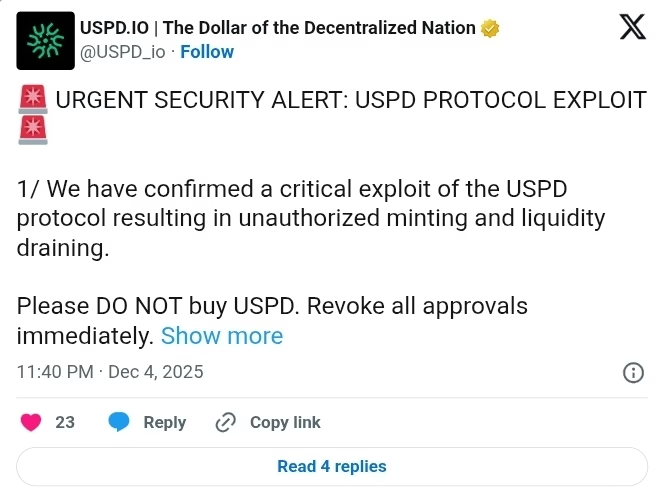
In an urgent statement posted on X (formerly Twitter), USPD warned:
“Please DO NOT buy USPD. Revoke all approvals immediately.” — USPD.io, security alert
USPD stressed that firms such as Nethermind and Resonance had audited the code, and internal behavior matched expected outputs—reinforcing the argument that the Uspd protocol exploit was not a smart-contract logic failure but a deployment-phase compromise.
USPD says it is now collaborating with law enforcement agencies, exchanges, and independent security researchers to trace the stolen funds. The team has offered a return-and-immunity arrangement that would classify the act as white-hat recovery if the attacker returns 90% of the assets.
The team said the Uspd protocol exploit represents a targeted compromise rather than a codebase flaw:
“Our audited smart contract logic was not the source of the failure,” — USPD team, disclosure statement
Security analysts note that the Uspd protocol exploit highlights growing sophistication in DeFi-focused attacks. Proxy contracts, admin keys, and deployment scripts have become increasingly favored entry points for adversaries seeking to bypass normally hardened logic layers.
The Uspd protocol exploit adds to a sharp rise in December’s attack totals. With losses already exceeding $100 million this month, the event strengthens the case for adopting hardened deployment frameworks and decentralized multi-party computation arrangements to reduce the risk of single-point control failures.
The Uspd protocol exploit joins a series of major breaches that have shaken user confidence and intensified calls for stronger policy oversight. South Korea’s Upbit exchange confirmed a $30 million breach linked to the Lazarus Group earlier in the week, with investigators saying attackers impersonated internal administrators. Yearn Finance also suffered a major incident involving its legacy yETH token contract, where attackers minted trillions of tokens in a single transaction, draining roughly $9 million in value.
As the sector works to address vulnerabilities, analysts suggest that the Uspd protocol exploit may become a case study in how hidden proxy manipulation can evade audits and remain dormant for long periods.
Despite rising losses, industry voices stress that better security standards, improved deployment practices, and stronger regulatory clarity could help restore confidence among crypto investors, policy makers, and the general public. For now, however, the Uspd protocol exploit serves as the most recent reminder of the risks inherent in decentralized systems that rely heavily on trust-minimized but vulnerable deployment processes.



Copyright © 2025 - The Bit Gazette.