





- Trending
- Comments
- Latest

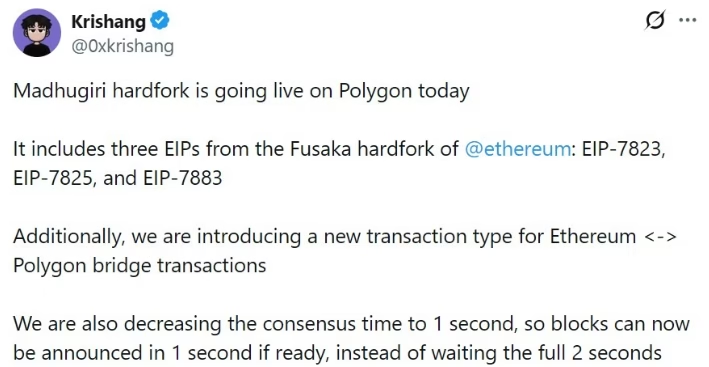
Polygon activated the Madhugiri hard fork on Monday, cutting block consensus time to one second and targeting a 33% increase in throughput.
The upgrade integrates three Ethereum improvement proposals designed to make network operations more efficient and support growing demand for stablecoins and tokenized real-world assets.
The update integrates three Fusaka Ethereum Improvement Proposals which are : EIP-7823, EIP-7825 and EIP-7883, these are designed to make heavy mathematical operations more efficient and gas predictable. As part of the Madhugiri hard fork, these EIPs help prevent single transactions from consuming excessive computation and improving overall network stability.
The Madhugiri hard fork also introduces a new transaction type for Ethereum to Polygon bridge traffic and adds a flexible framework that will make future throughput increases easier to activate. Polygon previously noted that scaling adjustments could be implemented by “flipping a few switches,” a capability now supported by the Madhugiri hard fork.
Shah emphasized that consensus time has now dropped to one second enabling faster block announcements and smoother user experience. This enhancement further cements the Madhugiri hard fork as a foundational upgrade for Polygon’s next phase of growth.
The Madhugiri hard fork is especially important as Polygon prepares for an expected surge in stablecoin and real world asset adoption. Aishwary Gupta, Polygon Labs’ global head of payments and RWAs, has forecast a “stablecoin supercycle,” projecting that more than 100,000 stablecoins could come to market within the next five years.
Gupta highlighted the need for transparency, utility and measurable accountability principles reinforced by infrastructure upgrades like the Madhugiri hard fork.
Greater transparency, Gupta argued, will unlock trillions in institutional capital once RWAs can be reliably audited, settled and traded on-chain.
The Madhugiri hard fork arrives shortly after Polygon implemented its most complex upgrade to date, Heimdall 2.0, which reduced finality times from up to two minutes to around five seconds.
However, a bug on Sept. 10 caused delays of up to 15 minutes disrupting validator sync and various network tools. A subsequent hard fork restored full functionality and ensured stable finality.
With the Madhugiri hard fork now live, Polygon positions itself for the next wave of hightrust, high throughput use cases including institutional stablecoins, fintech integrations and tokenized RWAs strengthening its place in the evolving Web3 ecosystem.



Copyright © 2025 - The Bit Gazette.