

- Trending
- Comments
- Latest

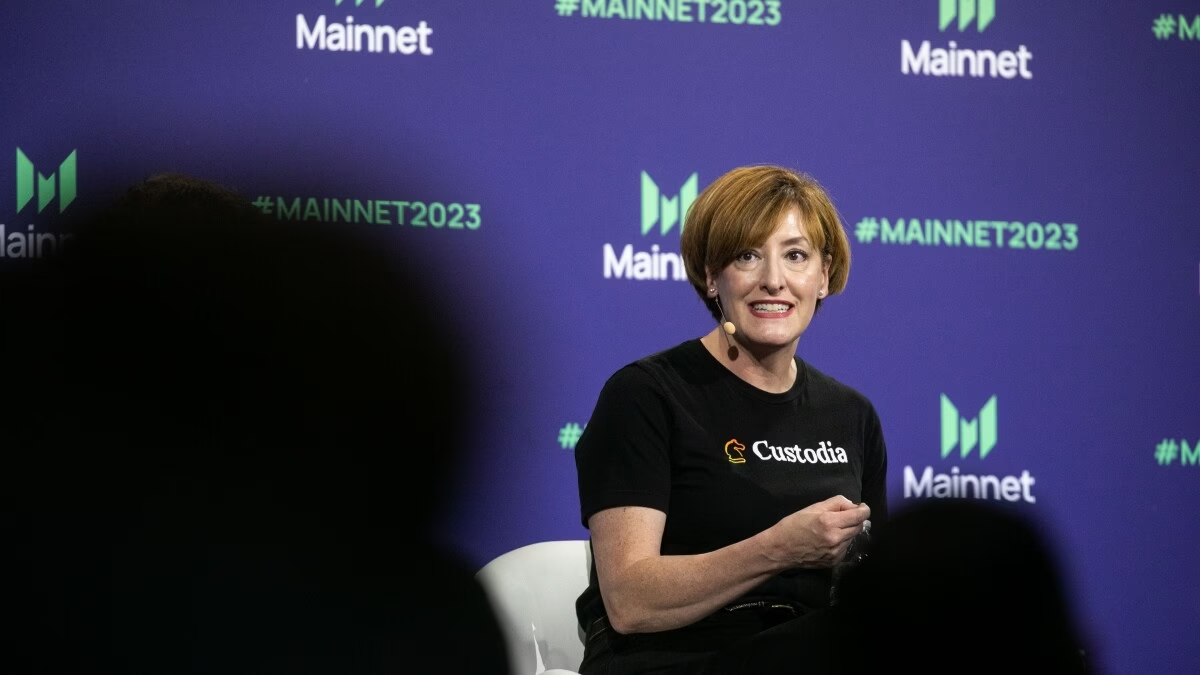
Custodia Bank on December 15 asked the full Tenth Circuit Court of Appeals to reconsider the Federal Reserve’s denial of its master account, escalating a five-year legal battle that challenges federal authority over state-chartered crypto banks.
Wyoming Crypto Bank petition filings submitted on December 15 request an en banc review, asking all active judges on the Tenth Circuit to reconsider an October panel ruling that upheld the Fed’s decision.
Custodia argues the panel misread federal law and endorsed a system that grants regional Federal Reserve Banks unchecked discretion over legally eligible state-chartered institutions.
At the heart of the Wyoming Crypto Bank petition is the Federal Reserve’s refusal to grant Custodia access to a master account—an essential gateway to core payment rails such as wire transfers and automated clearinghouse (ACH) services.
Without it, Custodia says its Wyoming-issued charter is effectively rendered meaningless.
Custodia contends the ruling conflicts directly with the Monetary Control Act (MCA), which states that Federal Reserve services shall be available to nonmember depository institutions.
The bank argues the Fed has transformed that mandate into what it calls an unconstitutional veto over state banking decisions.
When the Fed denies a master account to a state-chartered financial institution, it effectively vetoes a bank charter that State regulators have approved, Custodia wrote in its petition.
The Wyoming Crypto Bank petition also raises serious federalism concerns.
Wyoming chartered Custodia in 2020 as a Special Purpose Depository Institution (SPDI), a regulatory framework specifically designed to attract digital asset firms while minimizing systemic risk through 100% reserve backing and a prohibition on lending.
Custodia argues the Fed’s rejection undermines Wyoming’s carefully constructed regulatory regime and erodes states’ constitutional authority to charter banks.
The petition warns that allowing the Fed such power could discourage innovation-driven state banking models nationwide.
Beyond federalism, the Wyoming Crypto Bank petition pushes into constitutional territory.
Custodia’s legal team argues that if regional Federal Reserve Bank presidents possess unreviewable discretion over master accounts, they effectively function as “Officers of the United States” without proper constitutional appointment.
Federal Reserve Bank presidents are selected by private bank directors and approved by the Board of Governors.
Custodia says that structure violates the Appointments Clause if those officials wield significant executive authority.
The petition highlights a growing divide within the Tenth Circuit itself.
Judge Timothy Tymkovich’s dissent in Custodia’s case aligns with Judge Robert Bacharach’s earlier opinion in Fourth Corner Credit Union v. Federal Reserve Bank of Kansas City, creating a 2-2 split among circuit judges.
Tymkovich warned that the Fed’s interpretation grants “unreviewable discretion” that contradicts the plain language of the MCA and raises “thorny questions” under Article II of the Constitution.
The Wyoming Crypto Bank petition also points to contradictions within the Federal Reserve’s own process.
The Kansas City Fed denied Custodia’s application in January 2023 after a 27-month review, citing risks tied to “crypto-asset activities.”
Yet internal documents show Fed staff initially found Custodia’s capital levels “adequate” and praised its leadership as “impressive.” Custodia says the decision only shifted after intervention by the Board of Governors.
Federal Reserve Governor Christopher Waller later acknowledged publicly that the Fed has sufficient supervisory tools to manage risk without blanket denials.
In an October interview, Waller said the Fed can “tailor” master account structures to fit a bank’s specific risk profile.
The Wyoming Crypto Bank petition arrives as regulators face mounting scrutiny over crypto debanking.
In December, the Office of the Comptroller of the Currency revealed that all nine of the largest U.S. banks imposed “inappropriate” restrictions on lawful businesses, including digital asset firms, between 2020 and 2023.
Institutions such as JPMorgan Chase, Bank of America, Citibank, and Wells Fargo maintained internal policies that escalated or restricted entire sectors, reinforcing claims of systemic exclusion.
If the full Tenth Circuit agrees to hear the Wyoming Crypto Bank petition, the outcome could redefine the balance of power between state banking regulators and the Federal Reserve—setting a precedent that reaches far beyond Custodia and Wyoming.
For the crypto industry, the case may determine whether compliance-focused digital asset banks can ever gain equal footing within the U.S. financial system.



Copyright © 2025 - The Bit Gazette.