


- Trending
- Comments
- Latest

More than 125 cryptocurrency companies urged Congress on Wednesday to preserve language in the GENIUS Act that allows platforms to offer stablecoin rewards, warning that renewed efforts to restrict such programs would undermine a bipartisan compromise and favor traditional banks.
In a letter sent on December 18 to Senate Banking Committee Chair Tim Scott and Ranking Member Elizabeth Warren, industry leaders including Ripple, Coinbase and Stripe said attempts to reinterpret the GENIUS Act would go beyond what Congress originally approved and inject new uncertainty into digital payments markets.
The appeal comes as Congress weighs how to regulate stablecoins—digital tokens typically pegged to the U.S. dollar—amid growing adoption by consumers and businesses.
Industry groups argue that reopening settled provisions risks slowing innovation at a time when policymakers are seeking clarity and competitiveness in financial technology.
At the center of the dispute is the GENIUS Act’s treatment of incentives linked to stablecoins.
The legislation bars stablecoin issuers from paying interest or yield directly to token holders but explicitly allows platforms and intermediaries to offer lawful rewards and incentives. According to the signatories, that distinction was deliberate and formed the basis of bipartisan agreement.
The Blockchain Association, which coordinated the letter, warned that renewed efforts to tighten rules around incentives amount to an indirect Stablecoin reward ban that Congress had already rejected.
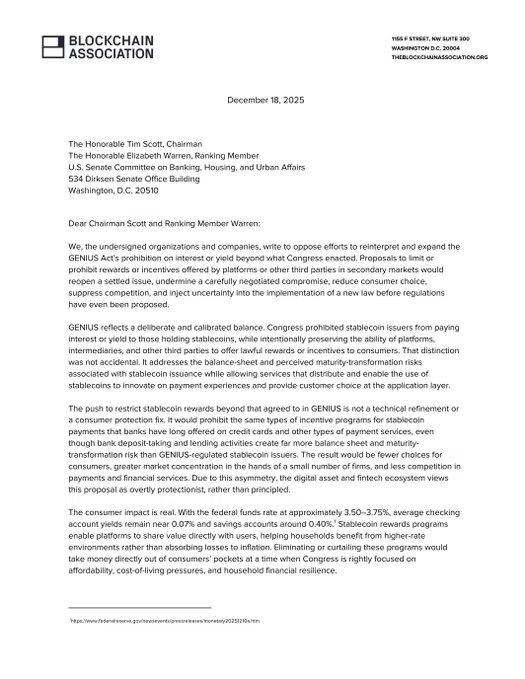
The group said such changes would tilt the playing field toward large financial institutions while disadvantaging newer technology firms that rely on incentives to attract users in competitive markets.
Industry representatives stressed that the compromise struck in the GENIUS Act was designed to balance consumer protection with innovation, and that reopening it could unsettle businesses that have already structured products around the existing framework.
Signatories to the letter also challenged claims that reward programs pose risks to the traditional banking system. In a social media post accompanying the letter, the Blockchain Association said, “There is no evidence these programs harm community banks,” adding that there is likewise no data showing stablecoins have caused bank deposit outflows.
The association argued that incentives are standard practice across payments and financial services, from credit card points to promotional cash-back offers.
Framing platform rewards as a Stablecoin reward ban, it said, mischaracterizes a common competitive tool and could entrench incumbents by limiting alternatives for consumers.
More than 125 entities signed the letter, including Coinbase, Ripple, Kraken, Gemini, PayPal, Stripe, Algorand, Injective and venture firm a16z Crypto, alongside policy organizations and state-level advocacy groups.
Several signatories noted that existing law already permits such incentives and that they play a role in encouraging adoption and innovation in digital payments.
The letter also pointed to broader economic conditions, noting that many traditional checking and savings accounts offer minimal returns in the current interest rate environment.
Against that backdrop, platform-based reward programs allow companies to pass value back to users, particularly as households face rising living costs. Industry groups warned that imposing a stricter Stablecoin reward ban would remove one of the few consumer-facing benefits available in the digital asset space.
Tyler Winklevoss, co-founder of crypto exchange Gemini, echoed those concerns in a separate statement, saying some banking interests were pushing to block platforms from offering stablecoin rewards. He argued that the matter had already been resolved in the GENIUS Act and cautioned that reversing course would damage U.S. competitiveness.
“Changing the rule would hurt innovation,” Winklevoss said, framing the issue as a test of whether lawmakers would stand by prior agreements.
The Blockchain Association said preserving the legislation as written is essential to maintaining consumer choice, competition and long-term regulatory clarity. From the industry’s perspective, reopening the question risks creating a de facto Stablecoin reward ban that lawmakers never explicitly endorsed.
Lawmakers have not publicly indicated whether they plan to revise the provision. For crypto investors and policymakers, the outcome will signal how stablecoin regulation is likely to evolve—and whether Congress is prepared to revisit compromises that the industry believes are already settled.
As debate continues, companies warn that uncertainty surrounding a potential Stablecoin reward ban could slow investment and innovation in one of the fastest-growing segments of digital finance.



Copyright © 2025 - The Bit Gazette.