


- Trending
- Comments
- Latest

On a continent where crypto adoption has often raced ahead of regulation, Ghana has chosen a different ending to a familiar story. In December 2025, after years of informal usage, policy debate and regulatory hesitation, Ghana passed a sweeping law that formally brings cryptocurrency markets into the legal economy.
For millions of users and dozens of service providers, the shift was immediate: crypto activity moved from tolerated ambiguity to explicit legal recognition.
That moment stands in sharp contrast to the United States, where crypto regulation remains defined less by statute than by court cases, agency statements and enforcement actions.
While Washington continues to debate how digital assets should fit into existing financial law, Accra has already answered the core questions: who regulates crypto, who can operate, and under what rules. The result is a framework that, in key respects, now offers more certainty than anything the U.S. has formally proposed.

This divergence matters because regulatory clarity increasingly determines where crypto businesses build, where capital flows and how safely users can participate.
Ghana’s framework highlights a growing global shift: smaller and emerging markets are no longer waiting for U.S. leadership on crypto policy — they are writing their own rules.
Ghana’s Virtual Asset Service Providers (VASP) Act, 2025 establishes a comprehensive legal regime for cryptocurrency trading, custody, issuance and brokerage. It places oversight jointly under the Bank of Ghana and the Securities and Exchange Commission, with clearly defined mandates and licensing requirements.
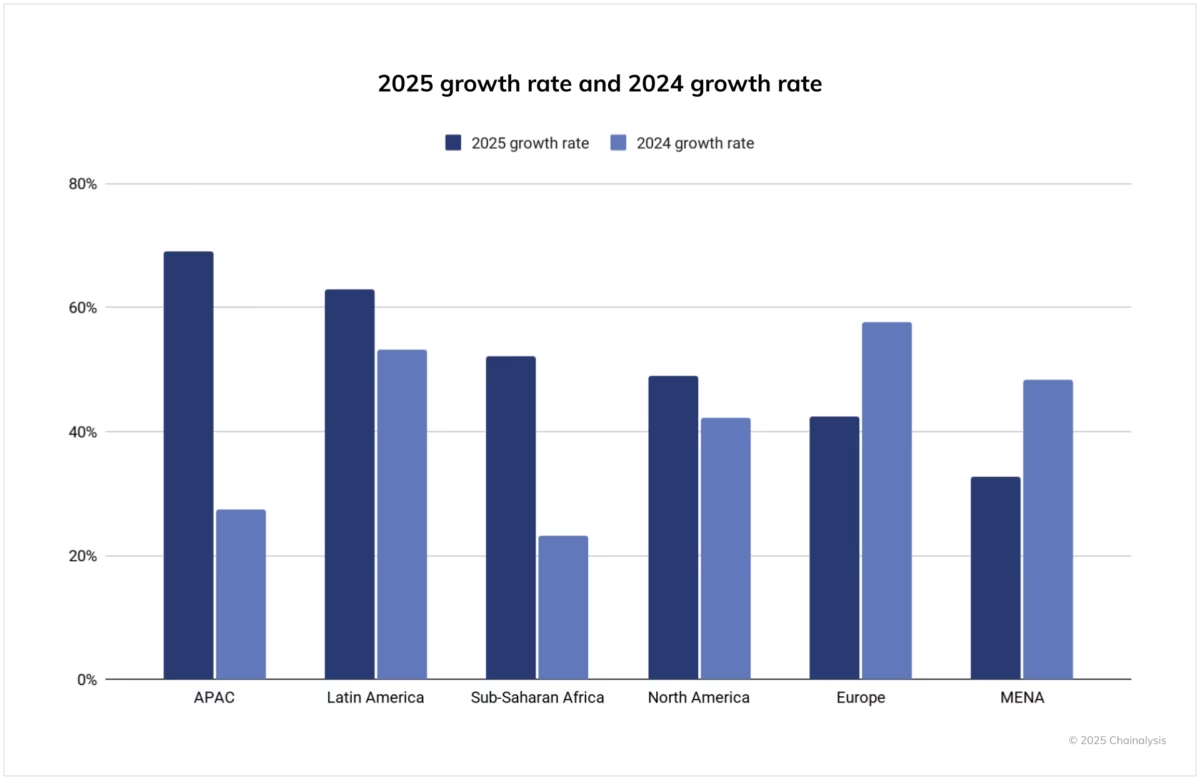
The timing is critical. According to Chainalysis, Sub-Saharan Africa remains one of the fastest-growing regions for grassroots crypto adoption, driven by remittances, currency volatility and mobile-first financial behavior. Ghana consistently ranks among the region’s most active crypto markets by transaction volume and user participation.
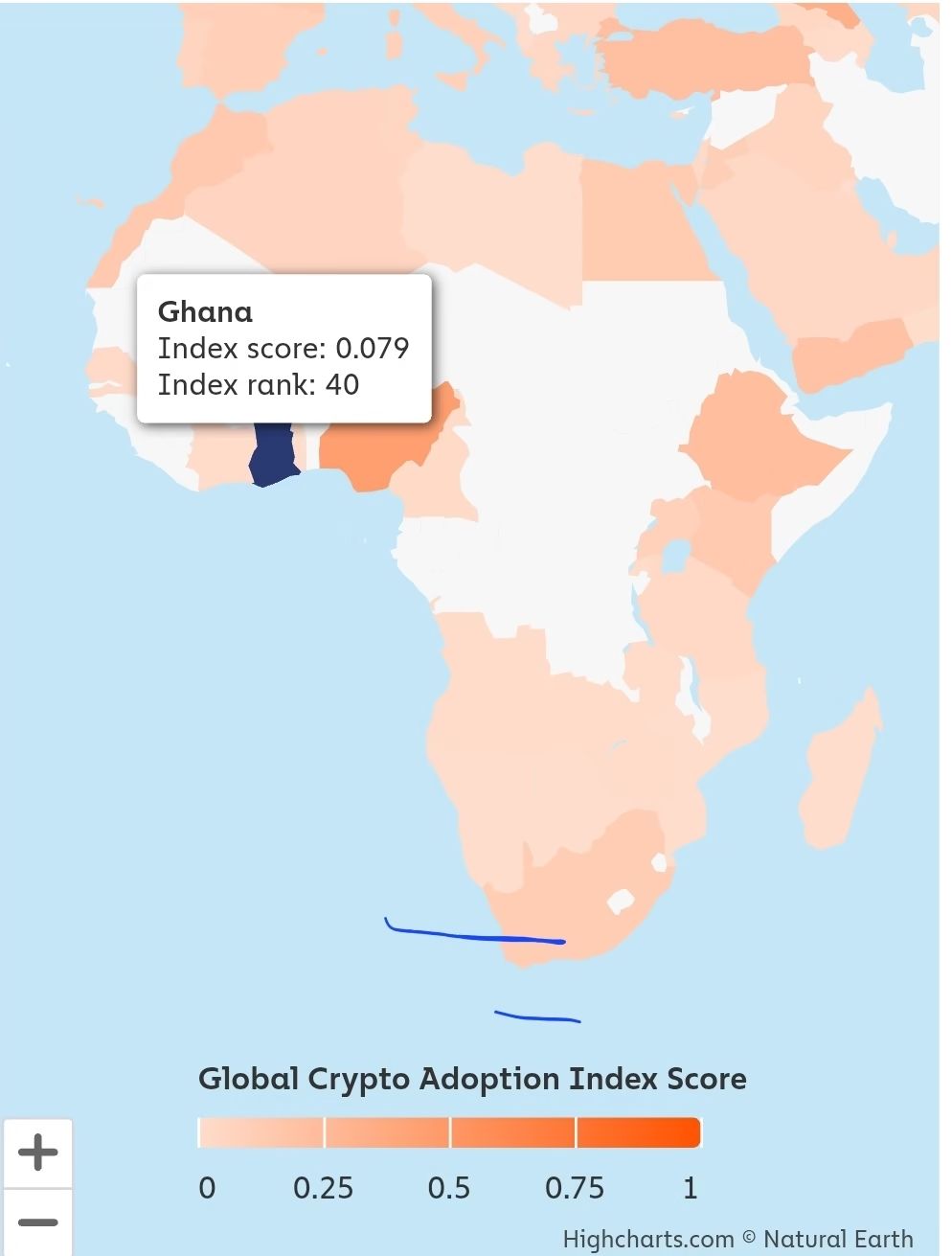
Until now, that activity operated largely outside formal law. The new framework brings it into the open, creating legal protections for users and predictable compliance obligations for firms — a combination that many U.S. market participants still lack.
At the core of Ghana’s law is a licensing system that clearly defines who may operate in the crypto economy. Exchanges, wallet providers, custodians, token issuers and brokers must register as VASPs and obtain approval from the appropriate regulator.
The Bank of Ghana oversees payment-related and custody functions, while the SEC supervises investment-oriented activities and token offerings. Both agencies are mandated to enforce anti-money-laundering and counter-terrorist-financing standards aligned with Financial Action Task Force guidelines.
This structure resolves a fundamental question that remains contested in the U.S.: which regulator is in charge. Ghana’s law does not eliminate risk, but it eliminates uncertainty about authority — a distinction with major consequences for compliance and enforcement.
Estimates from regional payment providers and blockchain analytics firms suggest that roughly 3 million Ghanaians — close to one in ten adults — have used cryptocurrency for payments, savings or cross-border transfers.
On-chain data reviewed by Chainalysis shows billions of dollars in cumulative transaction value flowing through Ghana-linked wallets over recent years, much of it driven by peer-to-peer trading and remittances. Prior to regulation, users relied on informal dispute resolution and platform trust rather than legal protections.
By legalizing crypto trading and defining user rights, Ghana’s government has effectively acknowledged that digital assets are already part of the financial system — and that regulation is safer than denial.
In the United States, crypto regulation remains fragmented across agencies and jurisdictions. The Securities and Exchange Commission, Commodity Futures Trading Commission, Treasury Department and state regulators all assert overlapping authority, often without a unifying federal statute tailored to digital assets.
While Congress advanced several crypto-related bills in 2025 — including stablecoin legislation and market-structure proposals — none yet provides a single, comprehensive framework governing spot crypto markets nationwide. As a result, many rules are effectively defined through enforcement actions and court rulings.
This approach creates uncertainty for firms attempting to comply in good faith. A token or service may be deemed lawful in one context and illegal in another, depending on interpretation rather than statute.
For crypto businesses, regulatory clarity is not a philosophical issue — it is an operational one. Licensing regimes allow firms to plan, raise capital, hire staff and integrate with banks. Uncertainty discourages long-term investment.
Ghana’s framework offers a predictable path to legality. Firms know what licenses are required, what standards must be met and which regulator to engage. By contrast, U.S. companies often must navigate federal agencies, state money-transmission laws and evolving court precedents simultaneously.
Several African and international crypto firms have already signaled interest in expanding Ghana operations following the law’s passage, citing clearer compliance expectations and reduced legal risk.
Ghana’s regulators have framed the law as a risk-management tool rather than an endorsement of speculative trading. The VASP Act emphasizes consumer protection, capital requirements, custody safeguards and transaction monitoring.
This approach reflects lessons learned from global crypto failures, including exchange collapses and fraud schemes. By imposing supervision early, Ghana aims to prevent systemic risks while allowing innovation to continue within defined boundaries.
Consumer advocates note that formal regulation also enables enforcement against bad actors — something that was difficult when crypto activity existed outside legal recognition.
One of the most consequential aspects of Ghana’s framework is its simplicity. Rather than attempting to force digital assets entirely into pre-existing legal categories, the law creates a dedicated regulatory perimeter for virtual assets.
In the U.S., debate continues over whether most tokens are securities, commodities or something else entirely. That classification fight has delayed rulemaking and fueled litigation. Ghana sidesteps much of that conflict by focusing on activities — custody, exchange, issuance — rather than philosophical definitions.
This functional approach is increasingly favored by international regulators seeking pragmatic oversight rather than legal absolutism.
For everyday users in Ghana, regulation offers legal recognition and recourse. Licensed platforms must meet minimum standards, reducing exposure to outright scams and operational failures.
For institutions, including banks and payment firms, the law removes barriers to engagement. Regulated crypto businesses can more easily access banking services, enabling fiat on-ramps and off-ramps that were previously restricted due to compliance concerns.
In the U.S., by contrast, banks remain cautious about crypto partnerships, citing regulatory uncertainty and supervisory risk.
Ghana’s move reflects a broader trend. Emerging markets with high crypto usage are increasingly taking regulatory leadership, while advanced economies debate classification and jurisdiction.
Countries such as the United Arab Emirates and Brazil have already demonstrated how clear crypto frameworks can attract capital and talent. Ghana now joins that group at a regional level, potentially shaping West Africa’s digital-asset landscape.
For U.S. policymakers, the message is clear: regulatory leadership is no longer guaranteed by market size alone.
The success of Ghana’s framework will depend on implementation. Regulators are expected to issue detailed guidelines in 2026 covering capital requirements, custody standards and reporting obligations.
Execution will determine whether the law fosters trust or becomes a compliance bottleneck. Still, the legislative foundation is now in place — something many larger markets have yet to achieve.
Ghana’s crypto law does not suggest that smaller markets face fewer risks. Instead, it demonstrates that decisive legislation can reduce those risks more effectively than prolonged ambiguity.
For the United States, the comparison is uncomfortable but instructive. While U.S. agencies continue to refine interpretations, other jurisdictions are codifying rules. In an industry defined by speed and borderless capital, certainty is becoming a competitive asset.
The lesson from Ghana is not that one framework fits all — but that clarity, even imperfect clarity, may be better than endless debate.



Copyright © 2025 - The Bit Gazette.