







- Trending
- Comments
- Latest


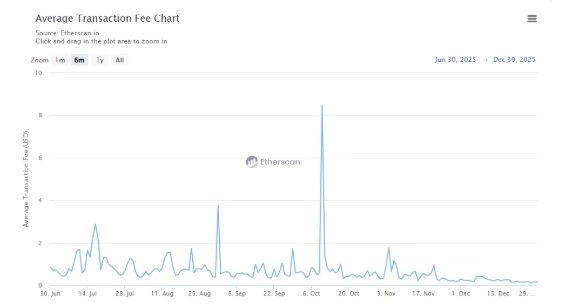
Ethereum’s mainnet processed a record 2.2 million transactions in a single day this week while average transaction fees plunged to just $0.17—a dramatic reversal from May 2022 when fees peaked above $200.
The milestone, recorded Tuesday according to Etherscan data, signals that recent protocol upgrades are enabling the network to handle surging activity without the congestion and cost spikes that defined previous market cycles.
Since then, steady protocol upgrades and changing usage patterns have pushed fees sharply lower even as activity on the network has continued to grow.
Fees have been on a consistent downward trend since Oct. 10, when Ethereum L1 transactions averaged around $8.48 during a major market liquidation event that sent prices across the crypto sector sharply lower. The continued drop in costs suggests the network is handling higher throughput more efficiently.
Historically, elevated costs on Ethereum L1 transactions pushed users toward cheaper alternatives such as layer-2 networks. However, the latest data indicates a renewed return to the base layer with rising on-chain activity signaling stronger demand for Ethereum’s mainnet.
Developers also appear to be doubling down on Ethereum L1 transactions as a settlement layer. Data from Token Terminal shows that the number of new smart contracts created and published on the Ethereum blockchain reached a record 8.7 million in the fourth quarter highlighting sustained builder interest.
The growth in Ethereum L1 transactions comes amid significant protocol changes rolled out in 2025. The Pectra upgrade in May focused on validator improvements greater staking flexibility, and groundwork for future scalability features.
Later, the Fusaka upgrade raised the network’s gas limit from 45 million to 60 million directly expanding the capacity available for Ethereum L1 transactions in each block.
In February, more than 50% of validators signaled support for increasing the gas limit, boosting overall throughput, data handling, and network efficiency.
Alongside these upgrades, Ethereum’s staking queue flipped to favor deposits for the first time in six months. Nearly twice as much ETH is now lined up to be staked compared with ETH queued for exit a shift often interpreted as growing confidence in the long term outlook for Ethereum L1 transactions and the broader network.



Copyright © 2025 - The Bit Gazette.

