




- Trending
- Comments
- Latest

Nigeria activated a comprehensive crypto surveillance system on January 1, 2026, requiring all exchanges—domestic and foreign—to report users’ trading activity directly to tax authorities, effectively ending anonymous cryptocurrency trading in Africa’s largest digital asset market.
As of January 1, 2026, two major laws now work together to monitor every crypto transaction: the Nigeria Tax Administration Act (NTAA) 2025 and the OECD’s Crypto-Asset Reporting Framework (CARF). Together, they create what amounts to the end of anonymous crypto trading in Nigeria.
This explainer breaks down exactly how the new system works, what you’ll pay, and how enforcement mechanisms have changed.
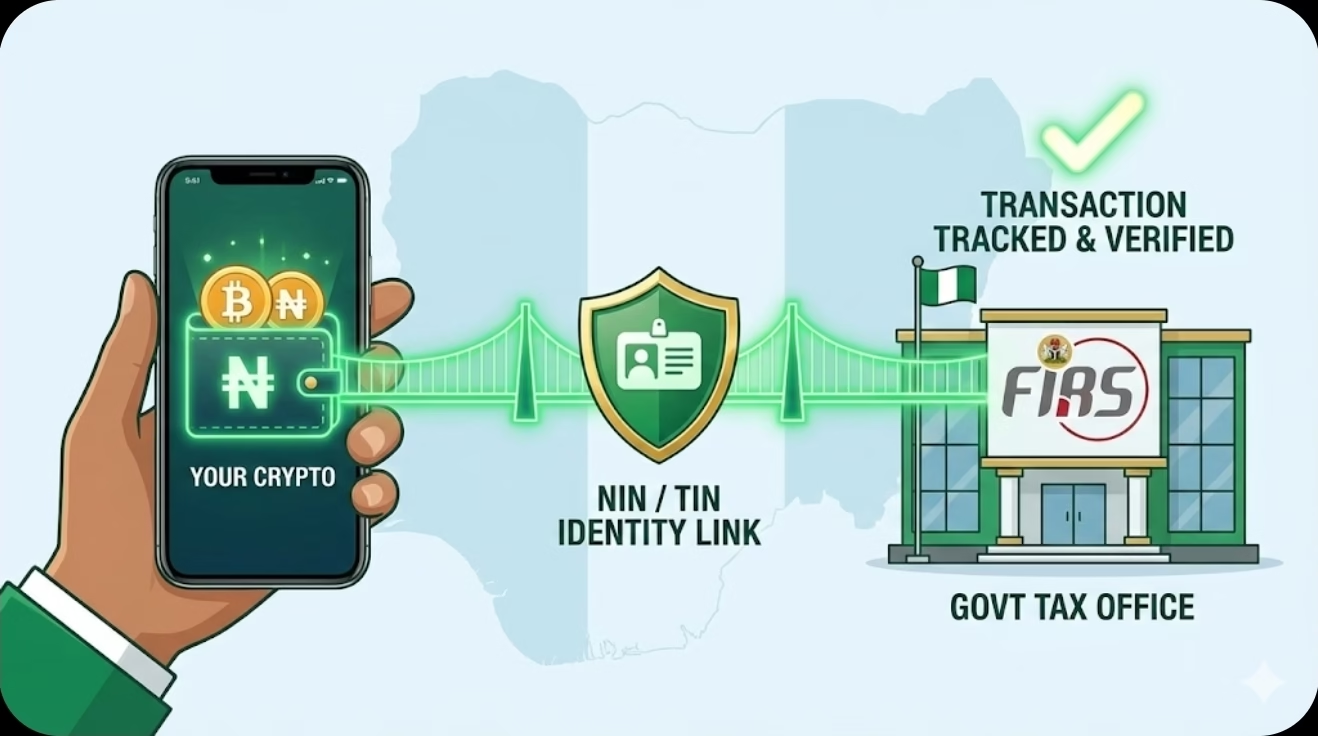
The new regime operates through a “data triangle”—the law’s term for the connection between users, exchanges, and tax authorities.
Previously, cryptocurrency exchanges in Nigeria collected identity documents only for basic security checks. That information remained private unless law enforcement specifically requested it during an investigation.
Now, exchanges function as tax collection agents for the government. Every platform operating in Nigeria—whether local or foreign—must submit monthly reports to the Federal Inland Revenue Service (FIRS) containing detailed information about your trading activity.
What exchanges must report every month:
If your exchange account isn’t linked to both your TIN and NIN, the platform is now required to restrict your withdrawals until you provide this information.
The NTAA 2025 doesn’t give exchanges a choice about reporting.
Any Virtual Asset Service Provider (VASP) that fails to submit monthly user data faces an immediate fine of ₦10 million. For every additional month they don’t comply, they pay another ₦1 million. The Securities and Exchange Commission can also revoke their operating license entirely.
This is why major platforms operating in Nigeria have already begun requiring TIN/NIN verification. The financial penalty for not complying is too severe to ignore.
Nigerian crypto users now face two separate taxes on their trading activity. Understanding the difference between them is critical because they work differently.
This is the larger of the two taxes and applies to your trading profits, not your total trading volume.
The 2023 Finance Act previously suggested a flat 10% capital gains tax on crypto. The 2026 regime has reclassified crypto trading profits as “chargeable gains,” making them subject to Nigeria’s progressive Personal Income Tax system, which caps at 25% for high earners.
Here’s how it’s calculated:
You buy Bitcoin for ₦10 million. Six months later, you sell it for ₦15 million.
Note: The actual rate depends on your total annual income and tax bracket. Rates range from 7% to 25%.
The critical rule: You only pay this tax when you sell—meaning when you convert crypto to naira or stablecoins. Simply holding cryptocurrency (what traders call “HODLing”) does not trigger a tax event.
If you bought Ethereum two years ago and haven’t sold it, you owe nothing yet. The tax only becomes due when you realize the profit by selling.
This is a consumption tax on the service of trading, separate from the profit tax.
The 7.5% Value Added Tax applies to the trading fee charged by your exchange, not to your total investment or profit.
Here’s how it works in practice:
You buy ₦100,000 worth of Solana. Your exchange charges a 0.1% trading fee.
Major exchanges like KuCoin have already automated this deduction. You’ll see it itemized on your transaction receipts.
Many Nigerian traders believe they can avoid this system by using international exchanges like Bybit, Coinbase, or KuCoin that don’t have physical offices in Nigeria. This strategy no longer works.
Nigeria has adopted the Crypto-Asset Reporting Framework, an international treaty coordinated by the OECD that took effect January 1, 2026. CARF is specifically designed to close this loophole.
Here’s exactly how CARF tracks you:
For example;
Ahmed, a Nigerian trader, uses Bybit (registered in Dubai). When Ahmed opens his account using his Nigerian phone number and passport, Bybit flags him as a Nigerian tax resident.
At year-end, Bybit compiles Ahmed’s trading data and reports it to the UAE tax authority, which automatically forwards it to FIRS under CARF. By March 2027, FIRS has a complete record of Ahmed’s 2026 Bybit activity.
Data collection under CARF began in January 2026. The first automatic information exchange between countries will occur in early 2027, covering all your 2026 trading activity.
This means FIRS will receive historical trading data from foreign exchanges next year, even if you’ve never directly interacted with Nigerian authorities.
Understanding what the law actually does—versus what people think it does—is essential for compliance.
Reality: P2P trades happen on centralized platforms like Binance, Noones, and others. When you create a sell order through P2P, the exchange records that transaction volume and reports it to FIRS linked to your NIN. The platform knows you converted crypto to naira, even if the payment happened outside the platform.
Reality: CARF mandates that foreign exchanges identify and report Nigerian users to FIRS through automatic international data sharing. The exchange’s physical location is irrelevant.
Reality: Income tax applies only to realized profits—the difference between what you paid for an asset and what you sold it for. VAT applies only to trading fees. Your unrealized holdings are not taxed.
Reality: Your National Identity Number (NIN) now functions as your tax identifier. If any exchange has your NIN, FIRS can connect your trading activity to your tax file.
Reality: Exchanges are now programmed to restrict withdrawals for accounts without verified TIN/NIN. You won’t be able to move your funds off the platform without compliance.
The new regime places the burden of proof on users when tax bills arrive. If FIRS sends you a tax assessment in 2027 based on data from exchanges, you’ll need documentation to prove your actual profit.
Download your complete trade history immediately. Every major exchange allows you to export transaction records as CSV files. Download these for every platform you’ve used and store them securely. This is your only proof of what you actually paid for assets.
Track your cost basis for every purchase. Cost basis means the original price you paid for an asset. If you bought Bitcoin at ₦8 million and sold it at ₦12 million, your cost basis is ₦8 million and your taxable profit is ₦4 million.
Without documentation of your cost basis, FIRS may assume your entire sale amount is profit and tax it at 25%. If you sell ₦12 million of Bitcoin but can’t prove what you paid for it, they could tax the full ₦12 million instead of just your ₦4 million profit.
Expect automatic VAT deductions. More exchanges will begin auto-deducting the 7.5% VAT on trading fees to maintain compliance. Check your transaction receipts to verify these deductions are accurate.
Link your TIN/NIN now rather than when forced. Platforms will eventually require this information to allow withdrawals. Providing it proactively avoids having your funds frozen when exchanges enforce the requirement.
This represents the most aggressive fiscal policy Nigeria has ever implemented for cryptocurrency.
In 2021, the Central Bank of Nigeria banned financial institutions from facilitating crypto transactions, effectively trying to shut down the industry. That policy failed—Nigerians simply moved to P2P trading and foreign platforms.
The 2026 approach acknowledges that banning crypto is impossible. Instead, the government has chosen comprehensive surveillance and taxation as its strategy. The message is clear: crypto is legal, but anonymous crypto is not.
For Nigeria’s massive crypto community—the country consistently ranks among the world’s top adopters—this marks a fundamental shift.
FIRS has not yet released specific guidance on cost basis calculation or loss deductions, leaving many technical questions unresolved. Tax professionals advise that traders document all transactions now while awaiting clarification.



Copyright © 2025 - The Bit Gazette.