







- Trending
- Comments
- Latest


Spot bitcoin ETFs recorded $1.42 billion in net inflows last week, the strongest weekly performance in more than four months, signaling renewed institutional appetite after weeks of subdued demand.
The inflows were concentrated midweek, with Wednesday alone accounting for roughly $844 million, followed by $754 million on Tuesday.
While late-week volatility triggered a $395 million outflow on Friday, the cumulative Bitcoin ETF inflow still closed the week firmly positive, underscoring renewed appetite from regulated institutional channels.
Ether ETFs also posted gains, though on a smaller scale, with weekly inflows totaling approximately $479 million after late-week outflows trimmed earlier advances.
The structure of last week’s Bitcoin ETF inflow suggests a deliberate return of institutional buyers rather than retail-driven momentum.
Data shows that inflows were heavily front-loaded, with investors committing capital early in the week before stepping back as prices consolidated.
This pattern mirrors behavior seen in previous accumulation phases, when long-term allocators entered positions during periods of relative price stability.
The strongest daily inflows occurred as Bitcoin traded below recent highs, indicating that buyers may be positioning ahead of a broader directional move rather than chasing short-term price action.
Despite the late pullback, the weekly Bitcoin ETF inflow total represents a meaningful improvement from December, when flows were consistently negative.
Analysts note that the reversal comes at a time when broader macro uncertainty has eased slightly, allowing institutions to reassess digital asset exposure within diversified portfolios.
Vincent Liu, chief investment officer at Kronos Research, said the renewed Bitcoin ETF inflow points to long-only allocators cautiously re-entering the market through regulated products.
“ETF inflows point to long-only allocators re-entering via regulated channels,” — Vincent Liu, CIO, Kronos Research.
Liu added that on-chain indicators suggest selling pressure from large holders has eased compared with late December, reinforcing the supply-side argument.
According to blockchain data, net selling by so-called whales has declined, reducing distribution pressure at current price levels.
“ETF absorption alongside whale stabilization implies tightening effective supply and a more risk-on market environment,” — Vincent Liu, CIO, Kronos Research.
The combination of reduced whale selling and rising Bitcoin ETF inflow has revived the thesis that available spot supply is becoming increasingly constrained.
While volatility remains elevated, market participants say this dynamic could provide downside support during pullbacks, even if upward momentum remains uneven.
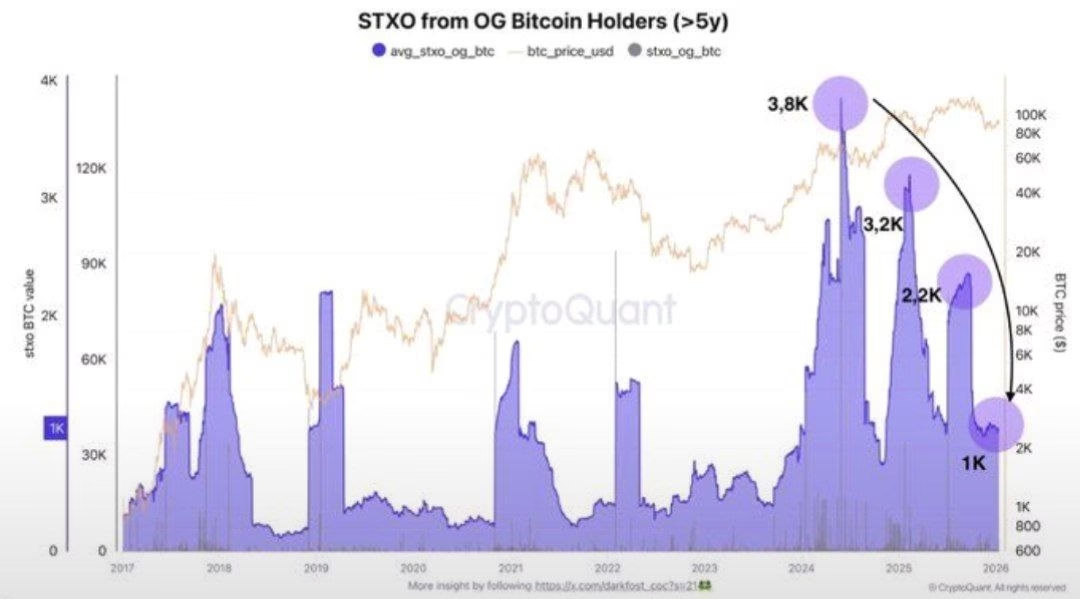
However, Liu cautioned that the trend is still developing and should not be mistaken for a confirmed structural shift.
“This is an early phase of the shift, rather than full confirmation,” — Vincent Liu, CIO, Kronos Research.
While the rebound in Bitcoin ETF inflow has drawn attention, some analysts warn that isolated weeks of strong demand may not be sufficient to sustain a broader rally.
Research published by Ecoinometrics’ Bitcoin macro analysis platform notes that recent ETF-driven price rebounds have often faded once inflows slow.
According to the analysis, Bitcoin typically requires several consecutive weeks of elevated Bitcoin ETF inflow to materially alter its medium-term trend.
Although positive daily flows can stabilize prices and reduce downside volatility, cumulative ETF flows remain negative over longer timeframes, limiting upside follow-through.
This view suggests that while the current inflow spike is encouraging, it must be sustained to offset lingering macro and liquidity headwinds.
Without continued institutional allocation, price gains driven by short bursts of ETF demand risk reversing once inflows normalize.
Still, the recent data highlights a notable shift in behavior. After weeks of caution, investors appear increasingly willing to deploy capital into Bitcoin exposure through regulated instruments, even amid ongoing regulatory uncertainty and global market volatility.
The broader takeaway from last week’s Bitcoin ETF inflow surge is not outright bullishness, but a recalibration of risk appetite. Institutions appear less defensive than in late December, yet still selective in timing and scale.
Ether ETF flows reinforce this cautious optimism. While Ether ETFs recorded nearly $480 million in weekly inflows, the late-week outflows suggest investors remain sensitive to short-term price swings and macro signals.
For now, analysts say the Bitcoin ETF inflow rebound represents a necessary but insufficient condition for a sustained bull phase.
If inflows persist into the coming weeks and coincide with continued reductions in large-holder selling, the market could begin forming a more durable base.
Until then, the latest figures serve as an early signal rather than a definitive turning point, offering investors a clearer view of where institutional conviction may be rebuilding beneath the surface.



Copyright © 2025 - The Bit Gazette.

