







- Trending
- Comments
- Latest

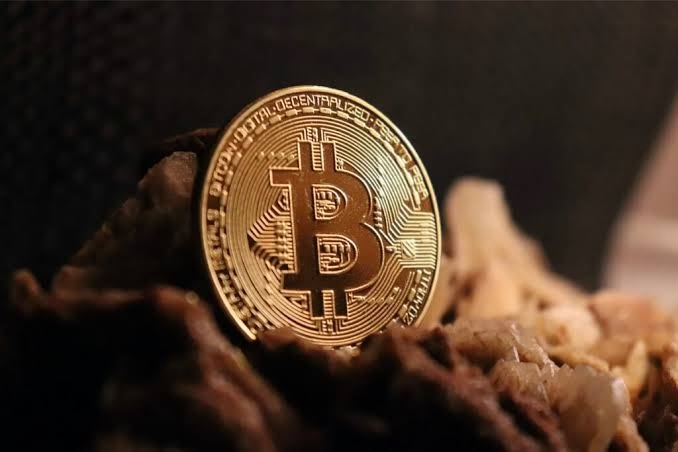
Bitcoin search interest fell roughly 50% year-over-year in 2025 even as prices surged past $120,000 and briefly touched a record $126,080, breaking a historic pattern where new all-time highs triggered explosive retail curiosity and speculative momentum.
Data from Google Trends and social media analytics show that Bitcoin search interest fell roughly 50% year-over-year, despite Bitcoin climbing above $120,000 and briefly touching a record peak of $126,080.
In previous market cycles, new price records typically triggered explosive growth in Bitcoin search interest, fueled by retail curiosity and speculative momentum. In 2025, however, that familiar pattern broke down.
Global online searches for “Bitcoin” steadily declined throughout the year, suggesting that rising prices alone are no longer enough to capture broad public attention.
The decline in Bitcoin search interest became more pronounced as Bitcoin pushed through major psychological price levels.
Even after BTC surged past $120,000, online engagement failed to rebound in any meaningful way.
Google Trends data shows that search activity continued to drift lower, reinforcing the idea that retail enthusiasm has cooled significantly.
Bitcoin developer Jameson Lopp highlighted similar trends on social media, pointing to a sharp contraction in Bitcoin-related discourse.
According to Lopp, posts on X containing the word “Bitcoin” dropped 32% from 2024 to 2025, totaling approximately 96 million posts for the year.
“Price keeps climbing, but the conversation keeps shrinking,” Lopp noted, underscoring the widening gap between market valuation and public participation.
Despite the broader downtrend, Bitcoin search interest did experience short-lived bursts around major political and macro events.
Attention briefly surged following the inauguration of U.S. President Donald Trump, the pardon of Silk Road founder Ross Ulbricht, and the announcement of a Strategic Bitcoin Reserve initiative.
However, none of these moments translated into sustained engagement. Even historically viral milestones such as Bitcoin Pizza Day and the breakout above $120,000 failed to ignite lasting increases in Bitcoin search interest, signaling fatigue among casual observers.
The disconnect became even clearer in October. When Bitcoin reached its peak near $126,080, social engagement remained unusually muted.
Days later, the market suffered a sharp correction, with more than $19 billion in leveraged crypto positions liquidated on October 10.
Analysts suggest the scale of the liquidation event further dampened sentiment, discouraging retail participation and accelerating the decline in Bitcoin search interest even as long-term price structure remained intact.
While public conversation thinned, Bitcoin’s most influential advocates remained highly active.
Media-tracking tools such as Perception show that foundational voices continued shaping the narrative even as broader attention faded.
Michael Saylor, executive chairman of MicroStrategy, ranked first with 1,268 Bitcoin-related posts, nearly 97% of which carried a positive or neutral tone.
Adam Back, CEO of Blockstream, followed closely with more than 11,450 updates, increasingly focused on quantum computing risks and protocol security.
Human Rights Foundation CSO Alex Gladstein also remained engaged, posting 9,445 Bitcoin-related messagescentered on financial freedom and human rights, even as Bitcoin search interest weakened across the broader market.
Despite declining Bitcoin search interest, on-chain and sentiment indicators suggest a complex emotional backdrop.
Data from Santiment shows that social sentiment turned more bearish in mid-January, even as Bitcoin rebounded from $90,320 to $97,540.
Meanwhile, the Crypto Fear & Greed Index hovered in “fear” and “extreme fear” territory through early 2026, highlighting persistent investor anxiety.
Still, CryptoQuant data offered a tentative bright spot, with the 30-day Fear & Greed Moving Average crossing above the 90-day average, signaling improving short-term sentiment despite lingering caution.
Historically, sustained bull markets have been fueled by rising Bitcoin search interest, signaling fresh capital and expanding public awareness.
The current divergence raises a critical question: is this a sign of maturation—or a warning of fragile momentum?
For now, Bitcoin continues to climb while attention lags behind, leaving analysts divided on whether fading Bitcoin search interest reflects healthy institutional dominance or a dangerous lack of retail conviction.



Copyright © 2025 - The Bit Gazette.

