







- Trending
- Comments
- Latest


Federal prosecutors have dropped their landmark insider trading case against former OpenSea product manager Nathaniel Chastain, ending the first major criminal prosecution involving digital asset trading after an appeals court overturned his conviction and ruled that NFT homepage data did not constitute ‘property’ under wire fraud laws.
The decision to forgo a retrial marks a significant retreat in the government’s effort to apply traditional securities laws to crypto markets.

US prosecutors informed the court that they had entered into a deferred prosecution agreement with Chastain, under which the government agreed to dismiss the charges once the agreement expires in about a month.
As part of the deal, Chastain agreed not to contest the forfeiture of 15.98 Ethereum, valued at roughly $47,000, which prosecutors said represented proceeds from the trades at the center of the Opensea insider trading case.
In a letter submitted to the court, Manhattan US Attorney Jay Clayton explained why prosecutors chose not to pursue a new trial.
“Deferring prosecution and declining to retry the case would best serve the interests of the United States,” — Jay Clayton, US Attorney, Southern District of New York.
Clayton noted that several factors influenced the decision, including the fact that Chastain had already served part of his original sentence. That sentence included three months in prison, a $50,000 fine, and additional financial penalties imposed after a jury convicted him in 2023 of wire fraud and money laundering.
Under the deferred prosecution agreement, Chastain will not be supervised by US Pretrial Services and may apply to recover the $50,000 fine and $200 special assessment he paid following his now-vacated conviction.
When prosecutors first brought the Opensea insider trading case, it drew intense scrutiny from both legal scholars and the crypto industry.
Authorities alleged that Chastain abused his position at OpenSea by purchasing non-fungible tokens (NFTs) he knew would soon be featured on the platform’s homepage, then selling them after the increased exposure drove prices higher.
At the time, the prosecution was widely described as the first insider trading case involving digital assets. It was frequently cited as a test of whether existing financial crime statutes could be applied to emerging crypto markets without new legislation.
That narrative shifted dramatically in July, when the US Court of Appeals for the Second Circuit overturned Chastain’s conviction.
The appeals court ruled that jurors were given flawed instructions and concluded that the internal OpenSea homepage placement data did not qualify as “property” with commercial value under federal wire fraud laws.
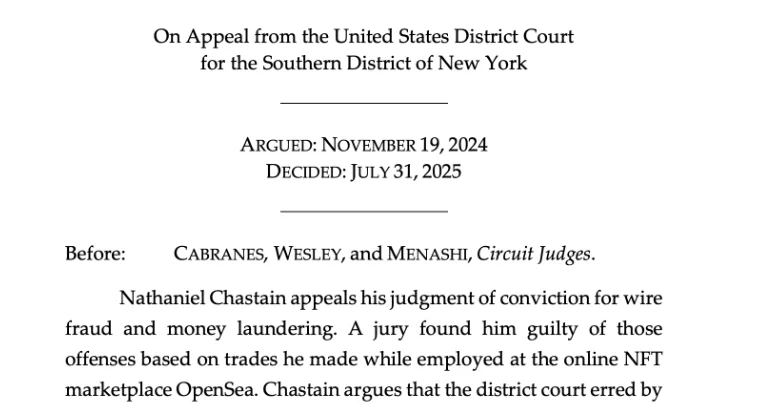
The ruling reshaped the legal foundation of the Opensea insider trading case, prompting prosecutors to reassess the likelihood of success at a retrial. Crypto advocates quickly pointed to the decision as evidence that clearer statutory definitions are needed to govern digital assets and platform-related information.
The end of the Opensea insider trading case coincides with a sharp decline in crypto-related enforcement actions by the SEC. According to a Cornerstone Research report, the agency initiated just 13 crypto-related enforcement actions in 2025, down from 33 in 2024 a reduction of roughly 60% and the lowest annual total since 2017.
The report attributes the shift partly to leadership changes at the SEC. Five of the 13 actions were initiated before former chair Gary Gensler stepped down in January, while eight were launched under the leadership of current chair Paul Atkins.
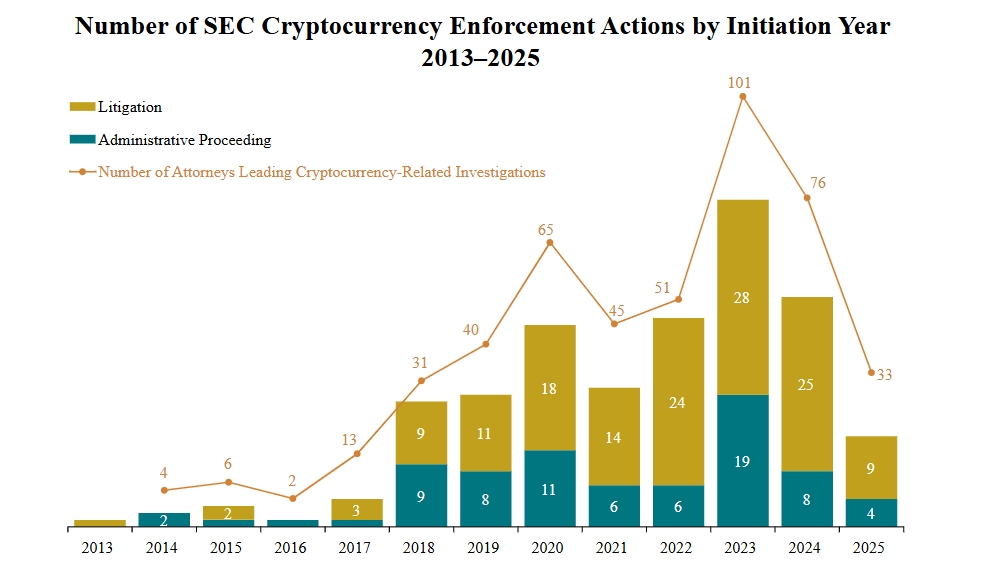
Those newer cases were largely focused on straightforward fraud allegations rather than broader theories tied to registration or market structure violations.
Robert Letson, a principal at Cornerstone Research, said the data reflects an evolution in regulatory strategy.
“Enforcement under Atkins reflects an evolution in the SEC’s oversight strategy for digital assets,” — Robert Letson, Principal, Cornerstone Research.
While enforcement activity slowed, resolutions continued. The SEC concluded 29 crypto-related cases in 2025, seven of which were dismissed under Atkins’ tenure.
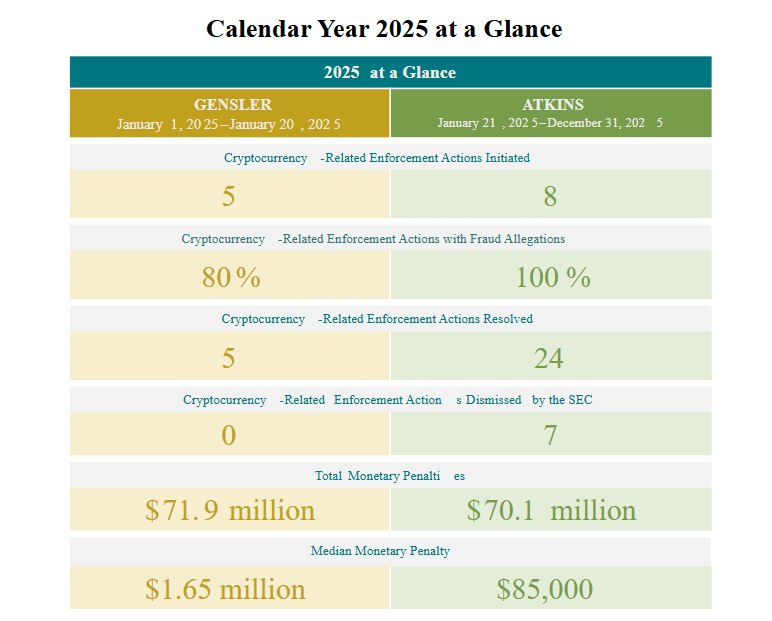
Financial penalties imposed on digital asset firms and individuals totaled $142 million for the year, representing less than 3% of the penalties levied in 2024.
Legal observers say the conclusion of the Opensea insider trading case, combined with reduced enforcement activity, suggests US regulators may increasingly rely on rulemaking, guidance, and negotiated standards rather than expansive courtroom battles.
For the crypto industry, the case’s end marks both the close of a landmark prosecution and a potential turning point in how digital asset markets are policed.



Copyright © 2025 - The Bit Gazette.

