
- Trending
- Comments
- Latest

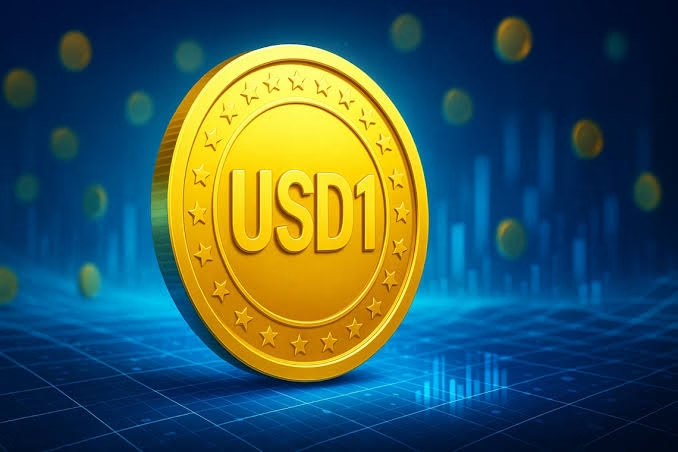
USD1, the stablecoin issued by Trump family-backed World Liberty Financial, has surpassed PayPal’s PYUSD by market capitalization just 10 months after launch.
The token now has a market cap of nearly $4.5 billion compared to PYUSD’s $3.76 billion, marking an unexpectedly rapid ascent fueled by exchange incentive programs, institutional settlement transactions, and strategic positioning as a real-world asset settlement layer.
“USD1 is now bigger than PayPal’s PYUSD,” Trump said in the post, referencing publicly available market data.
The rapid rise of the USD1 market cap has surprised many market participants given PayPal’s entrenched position in global payments.
PYUSD is issued by Paxos Trust Company and integrated directly into PayPal’s ecosystem, which spans hundreds of millions of users worldwide.
USD1, by contrast, launched less than a year ago under World Liberty Financial (WLFi), a crypto platform backed by the Trump family.
Despite its shorter operating history, USD1 benefited early from high-profile transactional use.
The stablecoin’s first major breakthrough came when it was used to settle a $2 billion MGX investment into Binance, a transaction that immediately boosted liquidity and visibility.

Since then, World Liberty Financial has focused on positioning USD1 as a settlement asset rather than a passive store of value, contributing to the steady rise in the USD1 market cap.
A key driver behind the expanding USD1 market cap has been its strategic alignment with major exchanges, particularly Binance.
In late 2025, Binance introduced a USD1 “booster program” that offered users annualized returns of up to 20% through flexible savings products.
These incentives emerged in response to regulatory constraints under the GENIUS Act, which was signed into law in July 2025.
The legislation prohibits stablecoin issuers from paying interest directly to holders, forcing yield opportunities to shift toward exchange-based reward structures.
As a result, exchange-sponsored programs became a primary capital inflow channel.
Market participants say this structure played a central role in accelerating the USD1 market cap, drawing both retail and institutional liquidity within a short timeframe.
At the same time, World Liberty Financial expanded USD1’s utility beyond trading and savings.
In January 2026, the firm began tokenizing real-world assets including oil, gas, and timber using USD1 as the primary settlement currency.
These transactions further embedded the stablecoin into on-chain commodity finance, reinforcing demand and circulation.
The growth of the USD1 market cap is unfolding alongside a broader expansion of Trump-affiliated crypto ventures.
Public disclosures and industry reports indicate that Trump-linked digital asset initiatives have generated more than $1 billion in proceeds since early 2025.
In addition to USD1, World Liberty Financial oversees the WLFI governance token, which currently carries a reported market capitalization of $4.7 billion.
The family has also entered Bitcoin mining through American Bitcoin, which recently disclosed holdings exceeding 5,000 BTC.
Earlier this month, American Bitcoin’s stock rose 14% following updated treasury disclosures.
Regulatory ambitions are also central to the strategy. On January 8, 2026, World Liberty Financial applied for a US national trust bank charter.
If approved by the Office of the Comptroller of the Currency (OCC), the firm would be able to issue and safeguard USD1 under federal banking oversight which is a move that could further institutionalize the USD1 market cap.
Beyond finance, WLFi announced a partnership with Spacecoin in January to support satellite-based decentralized banking infrastructure for underserved regions, signaling an effort to position USD1 as a global settlement layer.
The rise of the USD1 market cap highlights a broader shift in stablecoin dynamics, where distribution partnerships, regulatory arbitrage, and real-world settlement use increasingly outweigh brand recognition alone.
While PayPal’s PYUSD remains deeply integrated into consumer payments, USD1’s growth shows how capital-intensive incentives and institutional transactions can rapidly reshape market rankings.
The next test for USD1 may come as regulators evaluate World Liberty Financial’s banking ambitions and as competition intensifies among dollar-backed stablecoins seeking compliance, scale, and sustainability.
Attention now turns to the World Liberty Forum, scheduled for February 18, 2026, at Mar-a-Lago, where senior policymakers and financial executives including the CEO of Goldman Sachs and the Chairman of the CFTC are expected to speak.
The event is likely to place further spotlight on the USD1 market cap and its role in the evolving stablecoin landscape.



Copyright © 2025 - The Bit Gazette.