







- Trending
- Comments
- Latest


The Ethereum Foundation has created a dedicated post-quantum cryptography team and committed $2 million in research prizes as the network accelerates preparations for quantum computing threats that developers now consider urgent rather than theoretical.
The move, announced this week by Ethereum researcher Justin Drake, elevates quantum-resistant security from exploratory research to a core implementation priority, with the Foundation citing 2026 as a critical year for ecosystem preparation.
“After years of quiet R&D, EF management has officially declared PQ security a top strategic priority,” — Justin Drake, Ethereum researcher, in a post on X.
“It’s now 2026, timelines are accelerating. Time to go full PQ.”
Central to Ethereum’s post-quantum strategy is leanVM, a minimalist zero-knowledge proof virtual machine designed to support advanced cryptographic workflows with reduced complexity.
Drake described leanVM as a critical component in enabling quantum-resistant transactions at scale, particularly for signature aggregation and protocol-level cryptographic protections.
According to Drake, leanVM allows Ethereum developers to experiment with post-quantum cryptography in a controlled, modular environment without introducing excessive overhead to the base protocol.
This approach is intended to preserve Ethereum’s flexibility while preparing for cryptographic transitions that could otherwise be disruptive.
The Ethereum Foundation has not tied the post-quantum roadmap to a fixed upgrade timeline, but the emphasis on leanVM signals a preference for incremental integration rather than a single, high-risk overhaul.
This design philosophy aligns with Ethereum’s broader approach to protocol evolution following the transition to proof-of-stake.
As concerns about quantum attacks move from theoretical to practical planning, leanVM is increasingly viewed as a pathway to making quantum-resistant transactions compatible with existing smart contract and account abstraction frameworks.
To support the shift toward quantum-resistant transactions, the Ethereum Foundation is pairing organizational changes with funding and developer coordination.
Drake outlined several near-term initiatives aimed at preparing the broader ecosystem for post-quantum cryptography.
A biweekly developer session focused specifically on post-quantum transactions is scheduled to begin next month, led by Ethereum researcher Antonio Sanso.
These sessions will focus on user-facing protections, including protocol-level cryptographic tools, account abstraction pathways, and longer-term work on aggregating transaction signatures using leanVM.
The foundation is also committing capital to accelerate cryptographic research.
Drake announced a $1 million Poseidon Prize to strengthen the Poseidon hash function, alongside another $1 million Proximity Prize, both aimed at advancing cryptographic primitives relevant to quantum-resistant transactions.
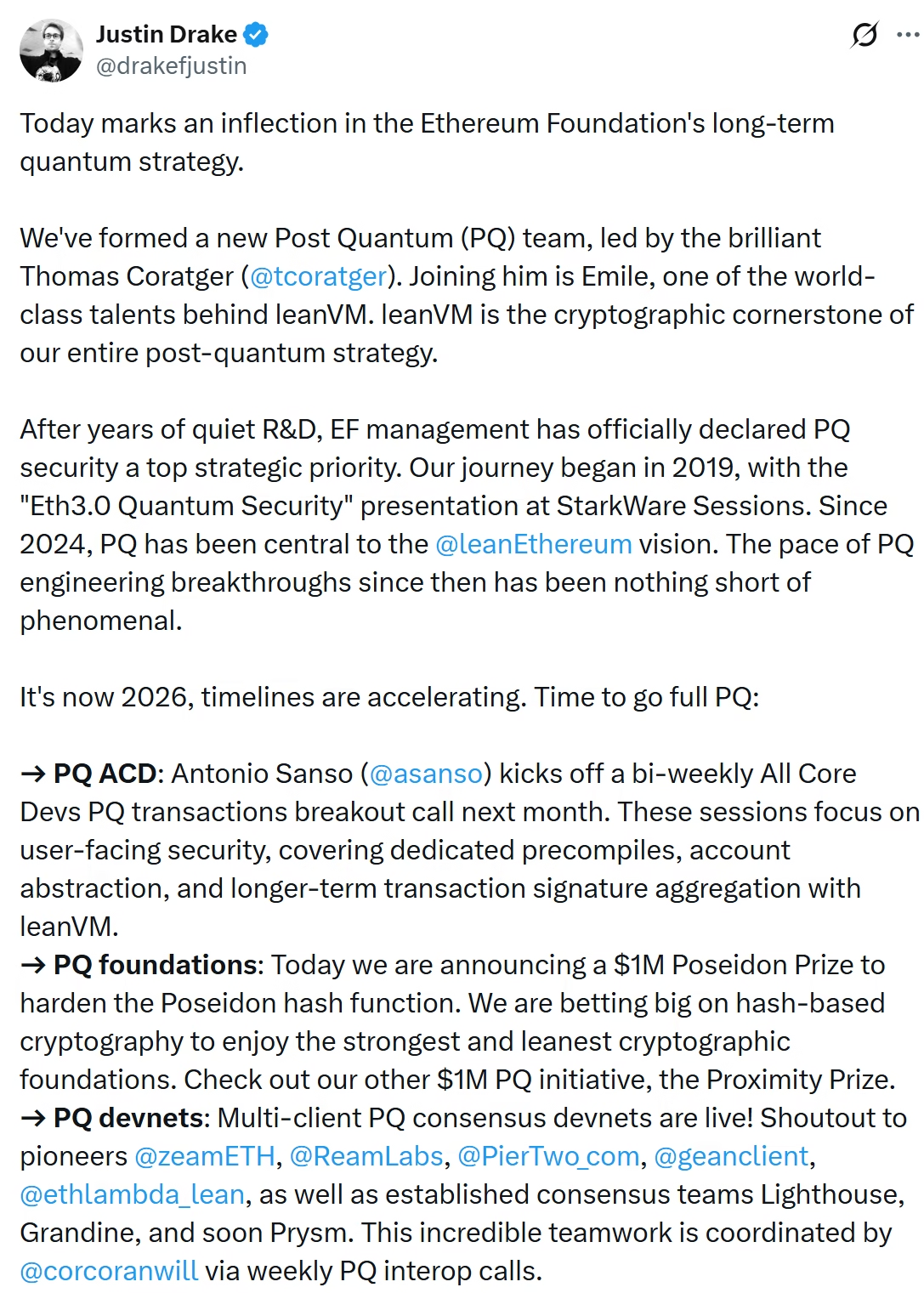
On the engineering side, Drake said multi-client post-quantum consensus development networks are already operational, with multiple teams coordinating through weekly interoperability calls.
This multi-client approach mirrors Ethereum’s broader decentralization strategy and reduces the risk of single-implementation failures during future upgrades.
In addition, the Ethereum Foundation plans to host a dedicated post-quantum event in October, followed by a post-quantum day in late March ahead of EthCC.
Educational materials, including enterprise-focused video content, are also in development to help institutions assess their exposure to quantum risks.
Ethereum’s renewed focus on quantum-resistant transactions comes as the wider crypto industry begins to address quantum threats more openly.
Earlier this week, Coinbase announced the formation of an independent advisory board to evaluate how advances in quantum computing could affect the cryptography securing major blockchain networks, including Ethereum and Bitcoin.
According to Coinbase, the board brings together experts from academia and industry specializing in quantum computing, cryptography, and blockchain security.
The group is expected to publish public research and guidance for developers, organizations, and users, with its first position paper scheduled for release in early 2027.
The exchange said the initiative is intended to provide clarity rather than alarm, reflecting the industry’s need to plan well ahead of any credible quantum threat.
While large-scale quantum attacks on public blockchains are not considered imminent, the long upgrade cycles of decentralized networks mean preparation must begin years in advance.
Ethereum’s emphasis on quantum-resistant transactions aligns with this broader industry shift from abstract risk acknowledgment to concrete mitigation planning.
For investors, developers, and enterprises building on Ethereum, the formation of a dedicated PQ team signals that post-quantum security is becoming a measurable component of protocol credibility.
As quantum computing capabilities advance unevenly across jurisdictions and institutions, Ethereum’s proactive stance may help reinforce confidence in the network’s long-term resilience.
By embedding quantum-resistant transactions into its roadmap now, the Ethereum Foundation is positioning the network to adapt before cryptographic disruption becomes unavoidable.



Copyright © 2025 - The Bit Gazette.

