

- Trending
- Comments
- Latest

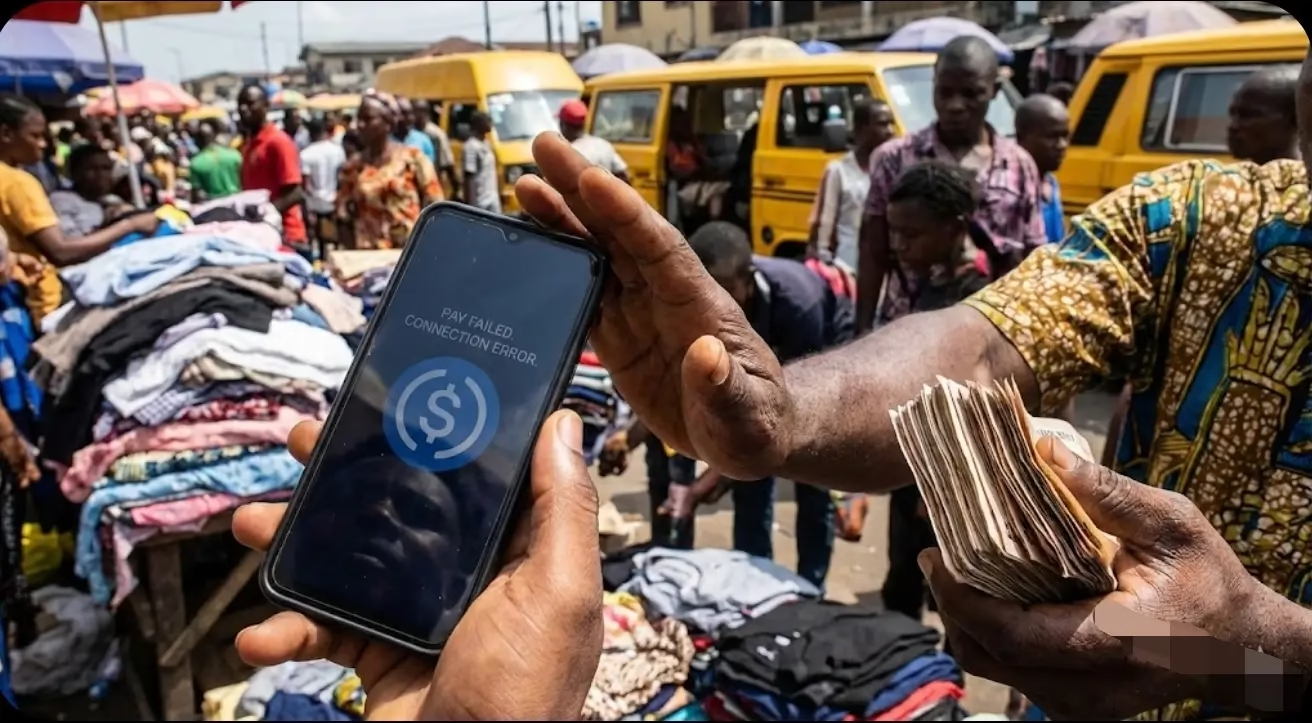
When IShowSpeed tried to buy a jersey at Balogun Market in Lagos last week, he asked the vendor a simple question: “Can I Venmo you?”
The answer came back from the crowd in a chant: “Cash! Cash!”
It was an awkward moment that exposed a fundamental truth about global payments: the digital tools Americans take for granted simply don’t work in most of the world. Speed, one of the internet’s biggest stars, couldn’t complete a $20 transaction without physical currency.
Within hours, social media rewrote what happened. Viral posts on LinkedIn and X claimed Speed had successfully paid using a stablecoin QR code, triumphant proof that crypto had arrived on the streets of Africa.
It never happened. Every video from the scene shows security guards distributing naira notes to manage the crowd. No blockchain. No digital wallets. Just cash.
The incident revealed something uncomfortable: cross-border digital payments remain broken in 2026.
Venmo works seamlessly within the United States because it sits on top of an established banking infrastructure. But it can’t bridge the gap between an American tourist and a Nigerian street vendor. The regulatory frameworks don’t align. The currency conversion mechanisms aren’t there. The partnerships don’t exist.
Speed learned what millions of people already know: asking “Can I Venmo you?” outside of a handful of wealthy countries is meaningless.
Nigeria actually has sophisticated mobile payment systems, USSD bank transfers, OPay, PalmPay, that process millions of transactions daily at minimal cost. The problem isn’t that Nigeria lacks digital payment infrastructure. The problem is that global systems don’t talk to each other.
And that’s exactly where crypto was supposed to help.
The fabricated stablecoin payment went viral because the crypto industry desperately wants proof of mainstream adoption.
We’ve spent years arguing that cryptocurrency will revolutionize payments, bank the unbanked, and create financial inclusion. But retail adoption remains elusive. Most people still can’t use crypto for everyday purchases, and the infrastructure to support it barely exists.
So when a story emerges of a famous American paying with USDC at an African market, in front of millions of viewers, no less, it becomes irresistible. It confirms what we want to believe: that the revolution has arrived.
But it hasn’t. And pretending it has only obscures the real work that needs to happen.
Crypto is being used in Nigeria, just not the way the viral story suggested.
It’s not happening at street markets. It’s happening in import businesses that can’t access foreign currency through banks. It’s happening with freelancers receiving payment from international clients. It’s happening with savers protecting themselves from a currency that lost 40% of its value in two years.
This is infrastructure-level adoption, invisible, practical, and far less glamorous than a celebrity scanning a QR code.
A textile importer uses USDT to pay suppliers in China because Nigerian banks can’t provide dollars quickly enough. A software developer receives wages in USDC because PayPal and Wise take excessive fees. A couple saves for a house in stablecoins because they don’t trust the naira.
These are real use cases solving real problems. But they don’t make for viral content.
The IShowSpeed incident should be a wake-up call, not a moment to invent false victories.
If crypto is going to fulfill its promise of accessible, borderless payments, the industry needs to build infrastructure that works where traditional systems fail.
That means focusing on:
The street vendor at Balogun Market doesn’t need crypto to sell jerseys to locals. Cash works fine for that. But cross-border transactions, remittances, and currency preservation—these are the problems crypto could actually solve.
We’re not there yet. Not even close.
A famous streamer couldn’t pay a vendor digitally because global payment infrastructure is still fragmented in 2026. Instead of acknowledging how much work remains, the internet invented a crypto success story that never happened.
The real story is less exciting but more important: crypto adoption is happening, but it’s slow, it’s infrastructure-focused, and it’s nowhere near ready for mainstream retail use.
If we want that to change, we need to stop celebrating fictional victories and start building the systems that make real ones possible.



Copyright © 2025 - The Bit Gazette.