



- Trending
- Comments
- Latest

Australian regulators are racing to close regulatory gaps in the country’s rapidly growing crypto sector, as Parliament debates legislation that would require digital asset exchanges and custody providers to obtain formal financial services licenses for the first time.
The push comes as crypto adoption in Australia surged to 31% in 2025, making it one of the world’s most crypto-engaged populations, while the Australian Securities and Investments Commission warned that innovation continues to outpace regulatory frameworks designed to protect investors.
In its Key Issues Outlook 2026, ASIC noted that innovation by participants unfamiliar with financial services rules is generating persistent risks across the crypto sector.
While some businesses operate legally outside existing frameworks determining which products or services should fall under Australia crypto regulation remains a government responsibility.
The warning comes as Australia’s crypto adoption rate rose to 31% in 2025, up from 28% in 2024 placing the nation among the most crypto engaged populations globally.
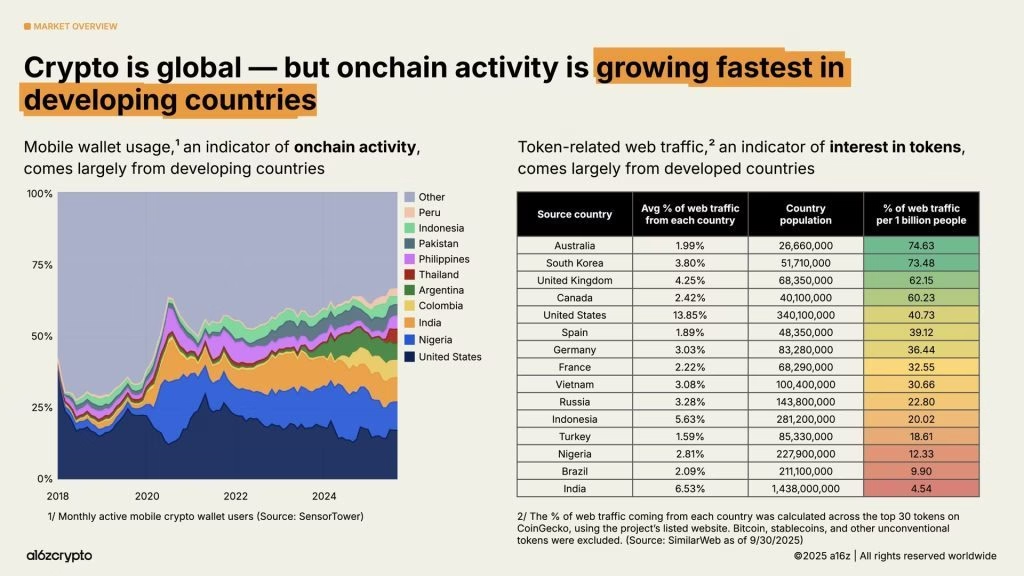
Self managed superannuation funds have increased crypto exposure sevenfold since 2021 to A$1.7 billion while major exchanges like Coinbase are developing retirement focused crypto accounts.
Despite this growth, regulatory fragmentation continues to challenge Australia crypto regulation. ASIC Chair Joe Longo warned in November that Australia risks becoming a “land of missed opportunity” unless blockchain driven tokenization is embraced.
“Australia faces a choice: innovate and lead, or risk falling behind.”
Longo said, citing J.P. Morgan’s plan to fully tokenize money market funds within two years.
To address gaps, Parliament is debating the Corporations Amendment (Digital Assets Framework) Bill 2025, introduced by Treasurer Jim Chalmers and Financial Services Minister Daniel Mulino.
The legislation requires crypto exchanges and custody providers to obtain Australian Financial Services (AFS) licenses subjecting them to ASIC oversight and potential penalties of up to 10% of annual turnover for non compliance.
The bill creates two license categories targeting digital asset platforms and tokenized custody providers focusing on companies controlling customer funds rather than technology infrastructure.
Licensed firms must meet ASIC standards for transactions, settlements, and custody, while smaller operators with less than A$10 million annual revenue are exempt.
Mulino highlighted the importance of Australia crypto regulation reforms: “Currently, companies can control unlimited client crypto with no legal financial protections in place.”
The government projects the framework could unlock A$24 billion in annual productivity gains while bolstering investor protections.
While permanent legislation progresses, ASIC introduced temporary exemptions to ease compliance during the regulatory transition.
Class relief finalized in December allows intermediaries to distribute certain stablecoins and wrapped tokens without separate licenses until mid 2028 provided records are maintained and Product Disclosure Statements are offered to retail investors.
The relief also covers omnibus custody structures commonly used in traditional finance but previously restricted in crypto.
These measures are designed to support responsible innovation while broader Australia crypto regulation reforms are implemented for tokenized payments and custody frameworks.
Additionally, ASIC adopted a sector wide no action stance until June 2026 giving companies time to review guidance, submit license applications or adjust operations.
Guidance INFO 225 confirms that many stablecoins, wrapped tokens, tokenized securities, and digital wallets fall under existing financial product rules thereby reinforcing the reach of Australia crypto regulation.
The growth of crypto adoption and innovation continues to strain regulatory boundaries. As Australians increasingly invest in digital assets and self managed super funds, the need for clear Australia crypto regulation becomes more urgent.
Fragmented global standards further complicate compliance and create potential gaps in consumer protections across jurisdictions.
Beyond crypto, ASIC identified nine additional critical risks for 2026 including rising retail exposure to private credit markets, operational failures by superannuation trustees, cyber attacks, and potential CHESS infrastructure outages.
Australia’s regulatory efforts aim to catch up with international peers while mitigating vulnerabilities that leave investors exposed to fraud, operational failures, and legal uncertainty.
Strengthening Australia crypto regulation remains central to safeguarding the market as innovation and adoption accelerate.



Copyright © 2025 - The Bit Gazette.