

- Trending
- Comments
- Latest

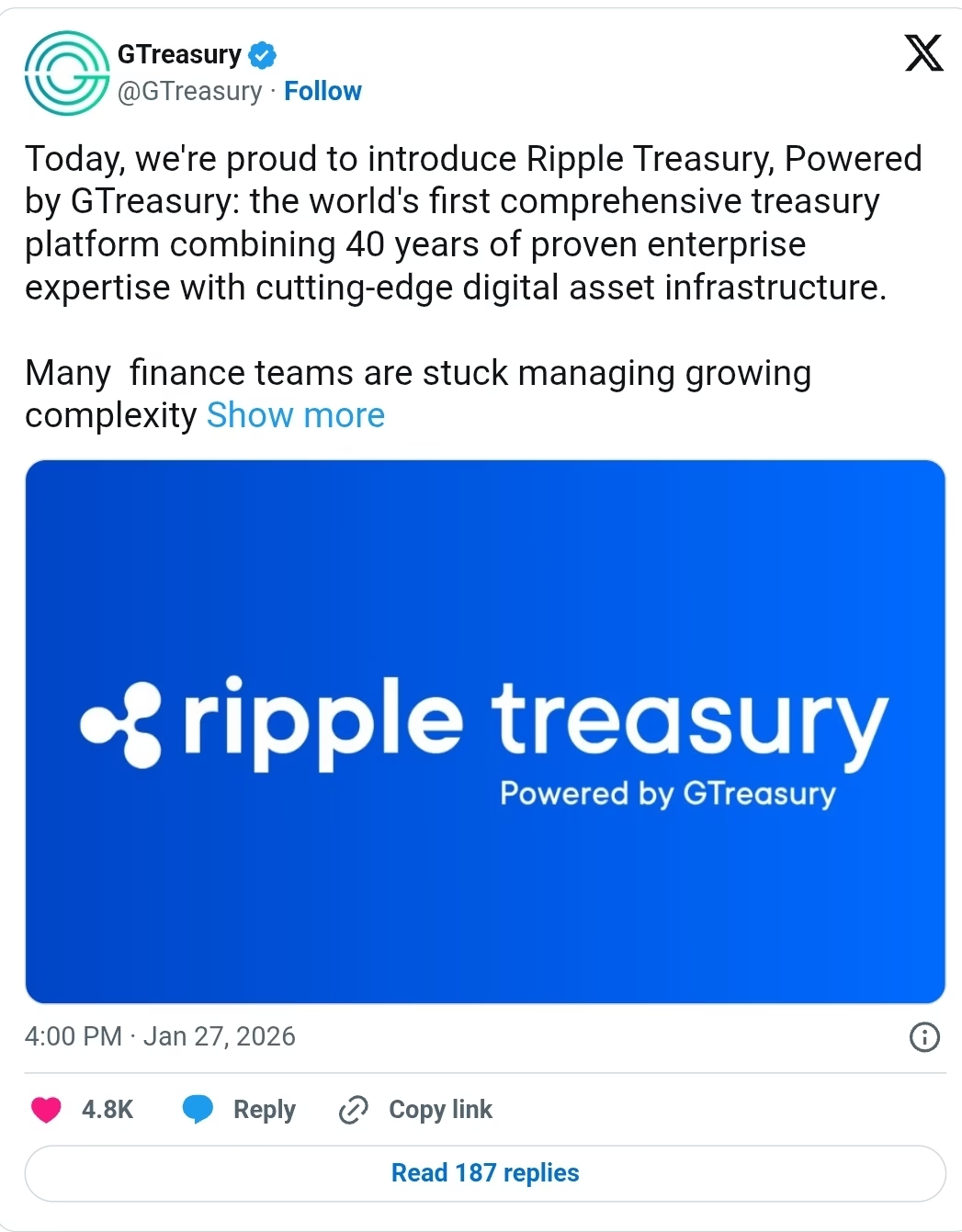
Ripple has unveiled Ripple treasury, a new enterprise platform designed to centralize cash management, digital assets, liquidity, and cross-border payments within a single dashboard. The launch, announced on January 28, 2026, targets corporations grappling with fragmented treasury systems and rising costs tied to global payments and foreign exchange.
At its core, Ripple treasury aims to simplify how large organizations manage money across borders and asset classes. Built in partnership with GTreasury, the platform brings together traditional fiat balances and cryptocurrencies, allowing finance teams to monitor, move, and optimize capital in real time.
According to Ripple, the platform is built to address a long-standing pain point in corporate finance: disconnected systems for cash, crypto, and international settlements. By unifying these functions, the company says enterprises can gain clearer visibility into their financial positions while reducing operational friction.
“Manage traditional money and digital assets together, creating a seamless financial ecosystem,” — Ripple, in its Ripple treasury platform overview.
The key proposition behind Ripple treasury is consolidation. Enterprises using the platform can manage fiat currencies and digital assets side by side, eliminating the need for multiple treasury tools. This unified view is intended to support faster decision-making and tighter liquidity control.
Another central feature is instant cross-border settlement. Ripple says the platform enables real-time international payments, cutting down on delays and reducing foreign exchange costs that often accompany traditional correspondent banking systems.
“Settle cross-border transactions instantly, significantly reducing foreign exchange costs,” — Ripple, platform launch statement.
The dashboard also removes the need for pre-funding accounts in multiple jurisdictions, a practice that often ties up working capital. By freeing these funds, companies can redeploy cash more efficiently or pursue yield opportunities around the clock.
In addition, Ripple treasury integrates tools for 24/7 yield optimization, allowing idle funds to be actively managed rather than sitting unused. The platform is also positioned as future-ready, with support for tokenized assets and programmable payments as these instruments gain traction in global finance.
The platform is powered by GTreasury, which brings more than four decades of treasury management experience to the partnership. Ripple’s blockchain infrastructure underpins the system, combining traditional finance expertise with distributed ledger technology.
Ripple said it has reinvested all of its earnings into development, doubling its engineering capacity within 90 days. As part of this push, the company integrated Solvexia to enhance reconciliation processes and rolled out upgraded AI-driven tools for cash forecasting, analytics, and risk management.
“Unified visibility across all assets enables smarter decision-making,” — Ripple, in outlining the expected business impact of Ripple treasury.
Beyond the platform itself, Ripple continues to expand its enterprise footprint. The company recently partnered with DXC Technology to deliver digital asset custody and real-time cross-border payment solutions to major banks worldwide.
It has also renewed its custody partnership with Garanti BBVA Crypto in Turkey, ensuring secure storage and transfers of XRP, Bitcoin, and Ethereum.
These moves underscore Ripple’s broader strategy: embedding blockchain infrastructure into mainstream enterprise finance. With Ripple treasury, the company is positioning XRP and its underlying technology as more than a payments solution, extending its relevance into global corporate treasury operations.
For corporate treasurers, Ripple treasury represents a shift toward integrated, real-time financial management. The platform promises continuous liquidity oversight, reduced settlement times, and lower operational costs—benefits that are increasingly critical as businesses operate across multiple markets and currencies.
The launch also signals a maturation of blockchain use cases. Rather than focusing solely on retail payments or speculative trading, Ripple is pushing distributed ledger technology into back-office finance, where efficiency gains can translate directly into balance-sheet improvements.
As enterprises prepare for a future that includes tokenized assets and programmable money, Ripple treasury positions itself as a bridge between today’s financial systems and tomorrow’s digital infrastructure. By unifying cash, crypto, and payments, Ripple is making a case for blockchain as a practical, enterprise-grade tool.
In that sense, Ripple treasury is not just a new product but a strategic statement. It reflects Ripple’s ambition to redefine how global companies manage capital instantly, transparently, and without the traditional barriers that have long defined cross-border finance.



Copyright © 2025 - The Bit Gazette.