


- Trending
- Comments
- Latest

Gold’s market capitalization surged by approximately $1.5 trillion on Wednesday following a 4.4% price jump that pushed the precious metal above $5,500 per troy ounce—a single-day gain nearly equivalent to Bitcoin’s entire $1.75 trillion valuation.
The rally, which lifted gold’s total market value to roughly $34 trillion, highlighted a widening divergence between traditional safe-haven assets and digital currencies as investors fled to established stores of value amid heightened economic uncertainty.
The rally in precious metals has not been limited to gold. Silver has also surged, gaining 21.5% over the past week and reaching a market capitalization of approximately $6.6 trillion.
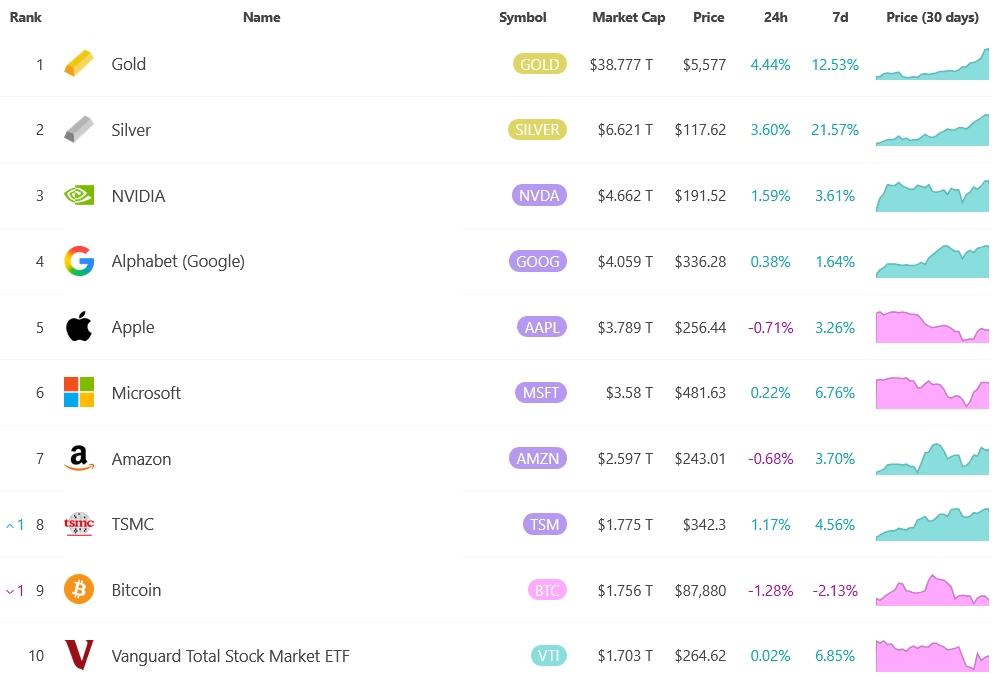
That rise has further widened the gap between precious metals and risk assets, with silver now holding a larger market cap than Nvidia, the world’s most valuable publicly traded company.
Market participants have increasingly framed the metals rally as part of the so-called “debasement trade,” a strategy that favors hard assets during periods of fiscal expansion, rising debt, and currency erosion.
In that context, the expanding Gold market cap reflects renewed confidence in gold’s role as a store of value.
By contrast, Bitcoin has struggled to reclaim momentum since early October, when a sharp downturn triggered more than $19 billion in liquidations across crypto markets.
Prior to that crash, investors had increasingly positioned Bitcoin alongside gold as a hedge against monetary debasement.
The recent divergence suggests that conviction in Bitcoin’s safe-haven narrative has weakened, at least in the short term.
Over a five-year horizon, the gap is even more pronounced. Gold has risen 185.3% over that period, compared with Bitcoin’s 164% gain.
While both assets remain well above their historical levels, the sustained growth in the Gold market cap underscores how traditional hedges are currently commanding greater investor trust.
Despite Bitcoin’s underperformance relative to the Gold market cap, institutional investors appear far from abandoning the asset. A Coinbase survey released this week found that 71% of 75 institutional respondents believe Bitcoin is undervalued when trading between $85,000 and $95,000.
“Most respondents view current Bitcoin prices as undervalued relative to long-term fundamentals,” — Coinbase Institutional, survey summary statement.
The survey also highlighted resilience in institutional positioning. Roughly 80% of respondents said they would either maintain or increase their crypto exposure if prices were to fall another 10%, signaling continued long-term conviction despite short-term volatility.
This perspective suggests that while gold is currently absorbing a larger share of defensive capital reflected in the rapidly expanding Gold market cap, Bitcoin remains firmly on institutional radar as a strategic asset rather than a tactical trade.
From a portfolio construction standpoint, some investors argue that Bitcoin’s lagging performance may itself represent an opportunity, particularly if macro conditions stabilize or liquidity conditions improve later in the year.
The divergence between gold and Bitcoin is also visible in sentiment indicators. The Crypto Fear & Greed Index, which tracks sentiment across Bitcoin and the broader digital asset market, currently stands at 26 out of 100, placing crypto firmly in the “fear” category.
Meanwhile, JM Bullion’s Fear & Greed Index for gold sits at 99 out of 100, reflecting “extreme greed” and exceptionally strong bullish sentiment toward precious metals.
“Extreme readings typically indicate overwhelming investor confidence in gold’s near-term outlook,” — JM Bullion, Fear & Greed Index methodology note.
This sharp contrast underscores how investor psychology has tilted decisively toward traditional stores of value.
The swelling Gold market cap reflects not just price appreciation, but a broader shift in capital allocation as market participants prioritize perceived stability over growth-oriented risk.
For crypto investors, the current environment presents a paradox. While gold’s dominance and the expanding Gold market cap highlight defensive positioning, institutional survey data suggests Bitcoin’s long-term thesis remains intact.
Whether Bitcoin can reassert itself as a debasement hedge alongside gold may depend on broader macro developments, including inflation trends, monetary policy signals, and global risk appetite.
For now, however, the message from markets is clear: in the battle for safe-haven flows, the Gold market cap is winning while Bitcoin waits for confidence to return.



Copyright © 2025 - The Bit Gazette.