


- Trending
- Comments
- Latest

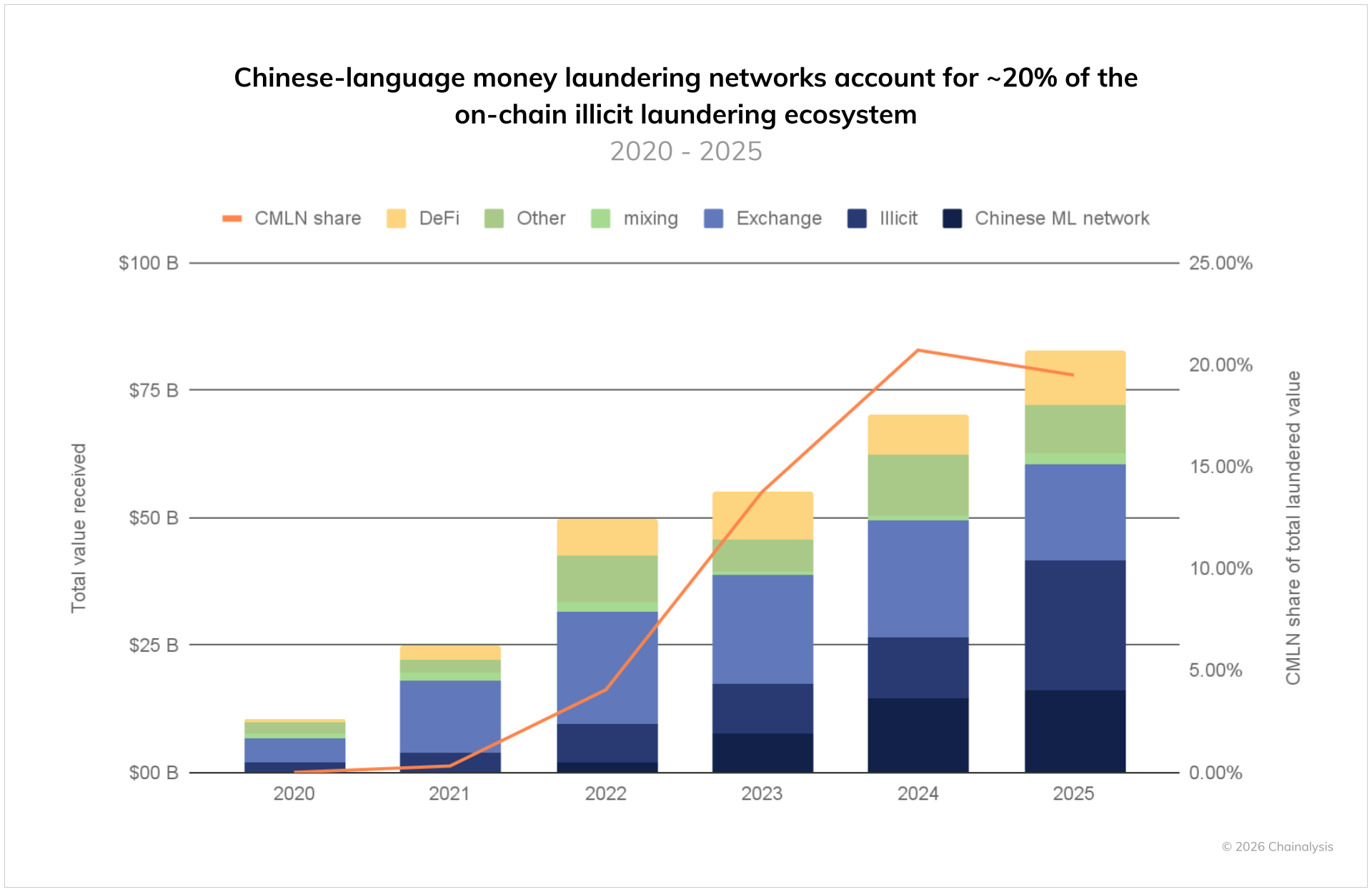
Chinese-language organized crime groups moved an estimated $16.1 billion in illicit funds through cryptocurrency transactions in 2025, accounting for roughly one-fifth of global crypto crime, according to a new report by blockchain analytics firm Chainalysis.
The findings, released Tuesday, show how Chinese crypto laundering networks leveraged Telegram-based platforms, stablecoins and cross-border operations in Southeast Asia to evade enforcement as China tightened domestic controls.
The Chainalysis report estimates that the global illicit cryptocurrency economy reached more than $82 billion in 2025, with Chinese crypto laundering networks emerging as one of its most powerful components. These networks, referred to as Chinese-language money laundering networks (CMLNs), moved the equivalent of $44 million per day throughout the year.
According to the report, these groups primarily operate via encrypted channels and chat groups on Telegram, where they openly advertise laundering services. Posts frequently include photographs of large amounts of cash and public testimonials designed to demonstrate liquidity and reliability.
Chainalysis describes many of these channels as “guarantee” platforms, informal escrow-style marketplaces that connect criminals, launderers and brokers. While the platforms do not directly control transactions, they act as the main coordination layer through which Chinese crypto laundering deals are negotiated and executed.
“These platforms are the connective tissue of the ecosystem,” Chainalysis noted, adding that without them, large-scale coordination would be far more difficult.
Beyond financial crime, the report links Chinese crypto laundering activity to broader forms of transnational crime. Andrew Fierman, Head of National Security Intelligence at Chainalysis, said the same Telegram platforms are used to facilitate human trafficking and the sale of Starlink satellite dishes used in Southeast Asian scam centers.
“We have seen everything from North Korean money and DPRK-related hacks going through, to a whole host of other illicit activity,” — Andrew Fierman, Head of National Security Intelligence, Chainalysis.
Fierman added that clients range from organized crime syndicates to sanctioned state actors, underscoring the geopolitical risks posed by these networks.
Mark Button, a criminology professor at the University of Portsmouth, said such structures mirror laundering networks he has studied in other regions.
“These are very large, well-resourced organizations. This is not like a few criminals operating out of a back room flat,” — Mark Button, Criminology Professor, University of Portsmouth.
Button noted that Telegram’s role as a low-friction coordination tool has made it a global medium for illicit commerce, including Chinese crypto laundering, due to its reach and limited oversight.
The report identifies six core laundering techniques used by these networks, many of which rely on digital assets to move funds quickly and discreetly. Cryptocurrencies appeal to criminal actors because of their liquidity, ease of transfer and relative anonymity, Fierman explained.
Stablecoins such as Tether’s USDT and Circle’s USDC play a central role in Chinese crypto laundering operations. Their price stability, compared with volatile assets like Bitcoin and Ethereum, reduces transaction risk and cost.
“If you are involved in illicit activity, the last thing you want to be doing is losing more money,” — Andrew Fierman, Head of National Security Intelligence, Chainalysis.
“You already have to pay money for the laundering process… the last thing you want is for there to be a really bad week on Bitcoin and lose another 10% of your money.”
Chainalysis noted that many laundering routes combine crypto transfers with traditional methods, including casinos and apparently legitimate businesses that inflate revenues to mask illicit proceeds.
While these networks communicate primarily in Mandarin, many transactions originate outside mainland China. Chainalysis highlighted Cambodia and Myanmar as key operational hubs, particularly cities linked to large-scale scam centers.
According to a 2024 report by the United Nations Office on Drugs and Crime, Southeast Asia has seen rapid growth in licensed and unlicensed casinos tied to organized crime since at least 2022. Button said casinos remain “a classic means to launder any criminal proceeds,” often used alongside Chinese crypto laundering pipelines.
China’s strict stance on money laundering and its 2021 ban on cryptocurrency trading have pushed criminal groups offshore. Button said weaker regulation and corruption in parts of Southeast Asia allow these networks to operate with fewer constraints.
“China has actually been very good at cracking down on these kinds of scams, because they generally don’t like organized crime,” — Mark Button, Criminology Professor, University of Portsmouth.
However, enforcement remains difficult. On Thursday, China’s state media Xinhua reported the execution of 11 members of a Myanmar-based scam syndicate, underscoring Beijing’s hardline response. Despite such measures, Chainalysis warned that Chinese crypto laundering networks continue to adapt.
“This is how illicit actors operate,” Fierman said. “They evolve, and once one gets detected, they hop to another avenue.”



Copyright © 2025 - The Bit Gazette.