


- Trending
- Comments
- Latest

Newly unsealed court documents from Jeffrey Epstein-related litigation named MicroStrategy co-founder Michael Saylor in connection with a 2010 charity dinner, triggering brief social media speculation last week that failed to dislodge the stock’s tight correlation with Bitcoin price movements.
The records contain no allegations of wrongdoing but briefly pressured shares before trading normalized in line with broader crypto market volatility.
The most widely circulated excerpt from the Michael Saylor epstein files comes from a 2010 email written by publicist Peggy Siegal, which was filed as part of the court record and later released under judicial order.
In the message, Siegal described Saylor’s demeanor at the event in unflattering terms but made no claim of wrongdoing.
“Michael Saylor donated $25,000,” Siegal wrote, adding that he was “completely impossible to talk to,” according to the unsealed exhibit included in the court filings New York Supreme Court unsealed records.
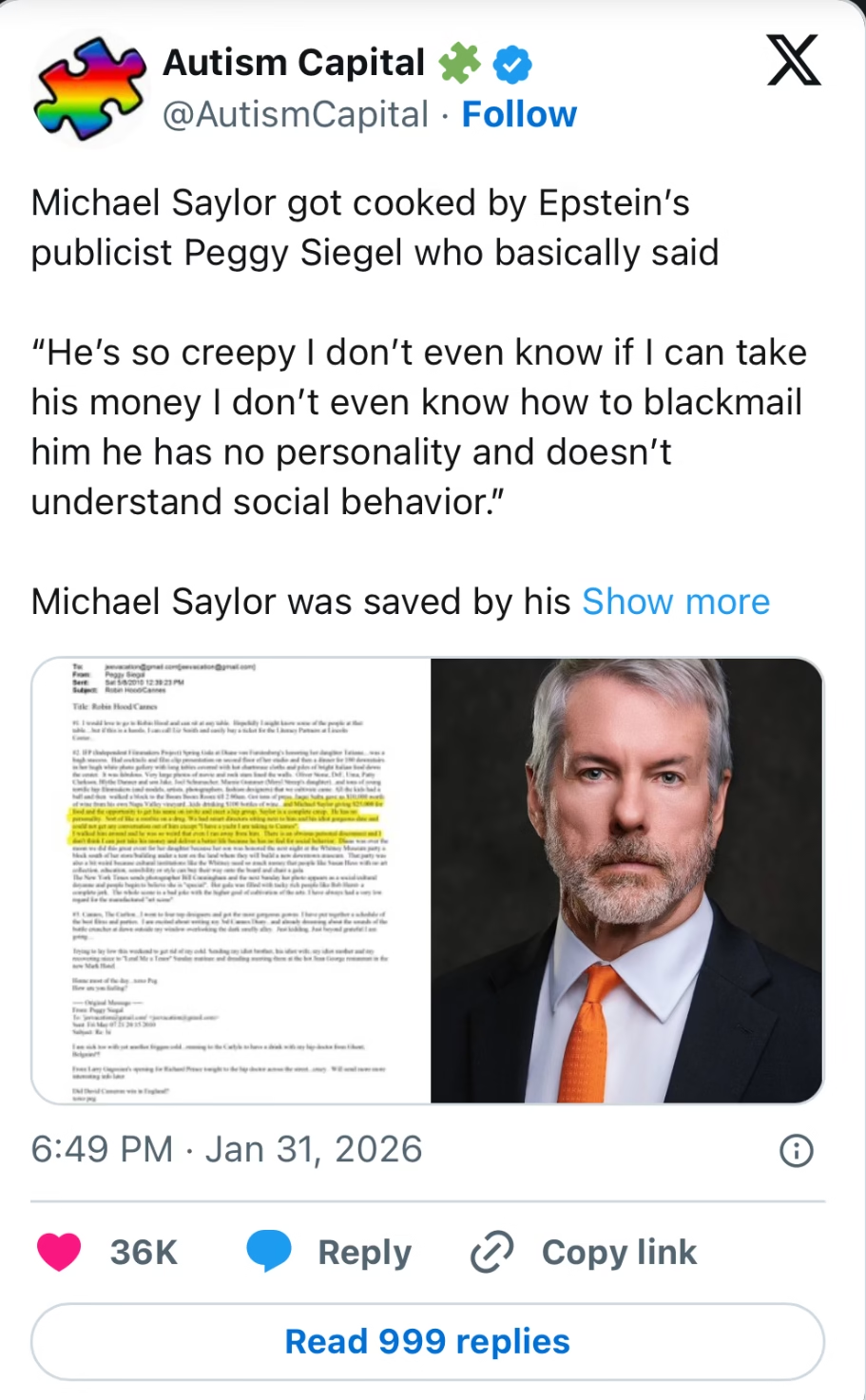
Importantly, the Michael Saylor epstein files do not allege criminal behavior, business ties to Epstein, travel to Epstein-owned properties, or any crypto-related activity.
Legal experts following the unsealing process have repeatedly stressed that inclusion in the document set does not imply misconduct, a point underscored by the court itself when authorizing the release of third-party names.
Despite the social media frenzy surrounding the Michael Saylor epstein files, trading data suggests investors ultimately treated the episode as headline noise rather than a fundamental shift in MicroStrategy’s outlook.
Shares of MicroStrategy (MSTR) closed the week volatile but broadly in line with Bitcoin’s movement, reinforcing the firm’s role as a leveraged proxy for the asset.
MicroStrategy holds one of the largest corporate Bitcoin treasuries globally, a position detailed in its ongoing disclosures to the U.S. Securities and Exchange Commission.
In its most recent filing, the company confirmed continued accumulation and reiterated its long-term treasury strategy centered on Bitcoin MicroStrategy SEC filings.
That structural exposure meant the Michael Saylor epstein files coincided with broader crypto market weakness, amplifying intraday swings without driving a sustained divergence between MSTR and Bitcoin itself.
For crypto-native investors, the Michael Saylor epstein files landed differently than they might have in traditional equity circles.
Online commentary focused less on reputational risk and more on the absence of actionable allegations, with many traders framing the episode as irrelevant to MicroStrategy’s balance sheet or Bitcoin thesis.
From a market-structure perspective, the episode reinforced a familiar dynamic: MicroStrategy trades primarily on Bitcoin beta, not executive controversy.
As Bitcoin retraced from recent highs amid broader risk-off sentiment, MSTR followed suit, with the Epstein headlines acting as an accelerant rather than a catalyst.
The brief market reaction to the Michael Saylor epstein files highlights a growing divide between narrative-driven volatility and balance-sheet-driven valuation in crypto-adjacent equities.
While reputational risk can weigh on traditional firms, MicroStrategy’s identity is tightly bound to its Bitcoin holdings, a factor that continues to dominate investor decision-making.
Regulatory filings, rather than social media discourse, remain the primary reference point for institutional investors assessing the stock.
As long as the Michael Saylor epstein files remain limited to historical, non-allegational references, analysts say the episode is unlikely to alter MicroStrategy’s long-term trajectory.
In that sense, the market’s response may prove instructive: sharp, emotional, and short-lived.
For now, MicroStrategy continues to trade as what it has become over the past four years which is a high-beta instrument tied less to its founder’s past social engagements and more to the price of Bitcoin itself.



Copyright © 2025 - The Bit Gazette.