







- Trending
- Comments
- Latest


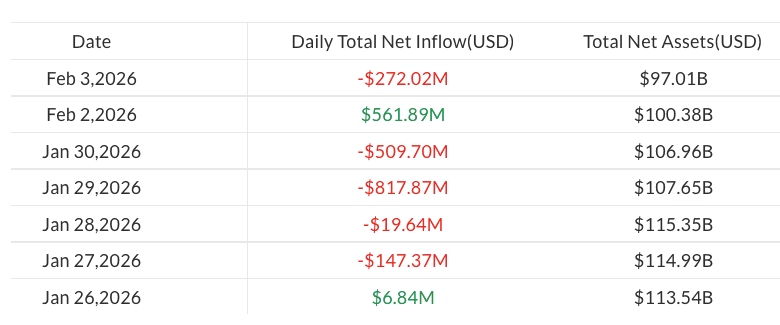
Spot Bitcoin ETF aum fell below the $100 billion threshold on Tuesday for the first time since April 2025, underscoring renewed pressure on crypto-linked investment products as Bitcoin prices slid sharply and broader market volatility intensified.
Data shows the decline was driven by fresh net outflows from U.S.-listed spot Bitcoin exchange-traded funds, coinciding with a broader downturn across digital asset markets.
According to data compiled by SoSoValue, Spot Bitcoin ETF aum dropped following $272 million in net outflows on Tuesday, reversing a brief recovery seen earlier in the week.
The decline came as Bitcoin traded below $74,000, while total cryptocurrency market capitalization fell sharply over the past seven days, reflecting deteriorating investor sentiment.
The latest decline marks a significant reversal from October, when Spot Bitcoin ETF aum peaked near $168 billion during a period of strong institutional inflows and rising Bitcoin prices.
Tuesday’s move below $100 billion highlights how quickly sentiment has shifted amid macro uncertainty and risk-off positioning across global markets.
Bitcoin’s price weakness has been a central driver of ETF pressure.
Over the past week, the global crypto market capitalization fell from approximately $3.11 trillion to $2.64 trillion, according to CoinGecko data, amplifying losses across major digital assets and contributing to ETF redemptions.
Despite the pullback, Tuesday’s outflows followed a short-lived rebound on Monday, when spot Bitcoin ETFs attracted $562 million in net inflows.
That bounce, however, proved insufficient to stabilize Spot Bitcoin ETF aum, which has now recorded nearly $1.3 billion in net outflows year to date.
Market analysts note that ETF flows remain highly sensitive to short-term price action, particularly as Bitcoin trades below key psychological and technical levels.
While Spot Bitcoin ETF aum declined, ETFs tracking major altcoins recorded modest inflows, suggesting some rotation rather than a full retreat from digital assets.
Funds tied to Ether, XRP, and Solana attracted $14 million, $19.6 million, and $1.2 million in net inflows, respectively, according to SoSoValue.
The divergence highlights a cautious shift among some investors seeking relative value or diversification as Bitcoin ETFs face sustained pressure.
Still, analysts caution that altcoin inflows remain small compared to the scale of recent Bitcoin ETF redemptions.
The broader context remains challenging. Bitcoin is currently trading below the estimated ETF creation cost basis of roughly $84,000, meaning new ETF shares are being issued at a loss.
That dynamic places additional strain on Spot Bitcoin ETF aum, as authorized participants reassess arbitrage incentives.
Despite this, some observers argue that the bulk of institutional ETF capital remains relatively stable.
ETF analysts and market participants say the recent decline in Spot Bitcoin ETF aum does not necessarily signal a mass institutional exit.
Instead, they view the current phase as a consolidation period following months of aggressive inflows.
“My guess is vast majority of assets in spot BTC ETFs stay put regardless,” — Nate Geraci, President, ETF Store, wrote on X.

That view was echoed by Thomas Restout, CEO of institutional liquidity provider B2C2, who emphasized that ETF-based exposure tends to attract longer-term capital than retail-driven spot markets.
“The benefit of institutions coming in and buying ETFs is they’re far more resilient. They will sit on their views and positions for longer,” — Thomas Restout, CEO, B2C2, said on the Rulematch Spot On podcast.
Restout added that the current downturn may reflect a broader transition in how institutions engage with digital assets, rather than a rejection of crypto exposure altogether.
“I think the next level of transformation is institutions actually trading crypto, rather than just using securitized ETFs. We’re expecting the next wave of institutions to be the ones trading the underlying assets directly,” — Thomas Restout, CEO, B2C2.
That shift, if it materializes, could reshape the role of ETFs within the crypto ecosystem while still supporting long-term demand for Bitcoin and other digital assets.
For now, Spot Bitcoin ETF aum remains a closely watched metric, offering real-time insight into institutional sentiment during periods of market stress.
While recent outflows reflect heightened caution, analysts say they also underscore the growing maturity of crypto markets, where ETFs are increasingly treated as long-term allocations rather than short-term trading vehicles.
As volatility persists, the trajectory of Spot Bitcoin ETF aum is likely to remain a key indicator of whether institutional confidence can stabilize amid ongoing price swings.



Copyright © 2025 - The Bit Gazette.

