




- Trending
- Comments
- Latest

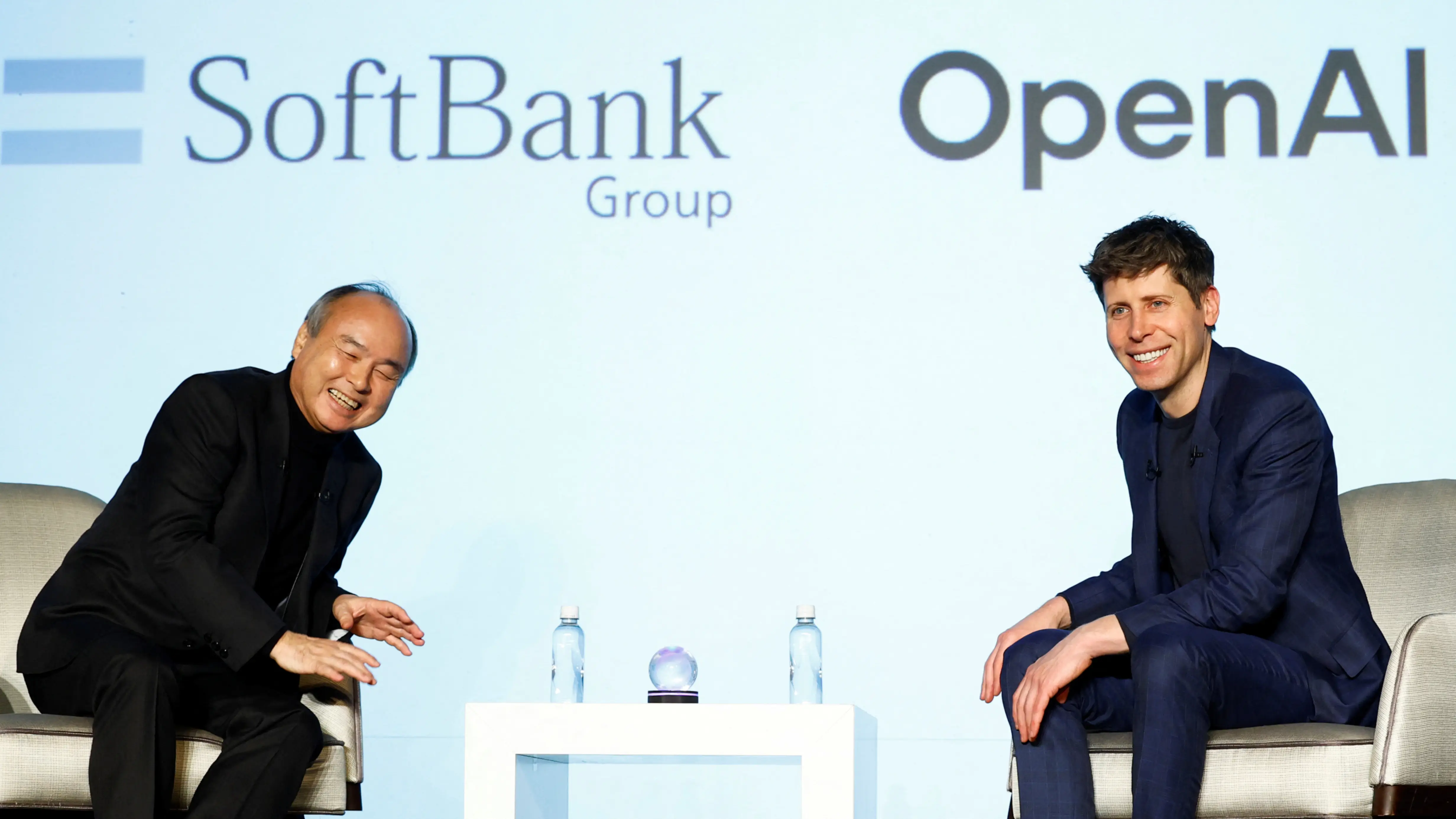
SoftBank missed quarterly profit estimates but reported a 400% surge in nine-month net income, a contrast that reflects the Japanese investment giant’s dramatic AI repositioning — including a full exit from Nvidia, a significant reduction of its T-Mobile stake, and the accumulation of an 11% ownership position in OpenAI across two funding rounds in 2025.
Yet beneath the surface, the numbers reveal a far more dramatic transformation—one centered squarely on AI and OpenAI.
For the nine-month period from April to December, net sales climbed 7.9% year-over-year. Income before tax surged 228%, while net income soared nearly 400% compared to the same period a year earlier.
Investment gains doubled during the stretch, even as the group’s investment business outside the Vision Funds plunged 91.9%.
The message is clear: the SoftBank OpenAI Stake is no side bet—it is the centerpiece of a strategic overhaul.
The SoftBank OpenAI Stake sits largely within SoftBank Vision Fund 2 (SVF2), which posted a substantial gain, reversing losses recorded in the prior year.
According to company disclosures, SoftBank committed capital to OpenAI in March 2025 via SVF2. The first funding round closed in April 2025, followed by a second in December.
After OpenAI’s recapitalization in October, SoftBank’s total ownership reached approximately 11%, spanning investments in OpenAI Global LLC and OpenAI Group PBC.
This calculated accumulation signals more than financial participation—it reflects conviction.
During the earnings call, Chief Financial Officer Yoshimitsu Goto underscored the company’s belief in OpenAI’s trajectory.
“We assume OpenAI will lead the industry and are convinced of its potential,” Goto said, explaining that this belief underpins SoftBank’s capital allocation strategy.
He acknowledged that OpenAI remains in early monetization stages but pointed to long-term revenue potential across enterprise deals, hardware, and advertising.
The SoftBank OpenAI Stake, in short, is a long-term dominance play.
SoftBank’s AI pivot has been funded through bold divestments. Between June and December, the company sold a significant portion of its stake in T-Mobile US Inc., according to securities filings. In October, it exited its entire Nvidia Corp. position.
These moves mark a dramatic rebalancing.
The SoftBank OpenAI Stake expanded as legacy telecom and semiconductor positions were reduced or eliminated.
SoftBank has also borrowed against holdings in Arm Holdings and other assets to maintain liquidity, reflecting a willingness to deploy capital aggressively into AI infrastructure and software.
This reallocation aligns with SoftBank founder Masayoshi Son’s long-standing thesis that artificial intelligence—and ultimately artificial superintelligence (ASI)—will define the next industrial revolution.
Goto reinforced that view, noting during the earnings call that roughly 60% of SoftBank’s assets are now AI- or ASI-related.
The SoftBank OpenAI Stake is therefore part of a broader AI concentration strategy rather than an isolated investment.
Beyond its direct OpenAI exposure, SoftBank is strengthening its AI infrastructure footprint.
In December 2025, the company announced plans to acquire DigitalBridge Group Inc., a Florida-based data center investment firm, including debt. In October, SoftBank agreed to acquire ABB Ltd.’s robotics division.
These acquisitions complement the SoftBank OpenAI Stake by targeting the physical and industrial backbone of AI deployment—data centers, robotics, and automation systems.
Industry analysts view this as vertical integration around AI’s value chain.
As Bloomberg Intelligence has previously noted in coverage of SoftBank’s strategy, the firm has increasingly concentrated on assets tied to AI growth, particularly through Vision Funds and Arm Holdings.
The SoftBank OpenAI Stake strengthens that ecosystem by securing exposure to one of the most influential AI developers globally.
SoftBank shares have risen in 2026 following gains in 2025, buoyed in part by Japan’s political climate.
Prime Minister Takaichi Sanae’s recent electoral victory provided additional momentum. Takaichi has advocated increased government spending in AI and semiconductor sectors, according to campaign statements.
This policy direction could further validate the SoftBank OpenAI Stake and its AI-heavy portfolio strategy.
With government support aligning with corporate capital flows, SoftBank appears positioned at the intersection of policy and innovation.
The SoftBank OpenAI Stake embodies both risk and conviction. While SoftBank missed quarterly profit estimates, its doubling of investment gains and aggressive AI repositioning signal a company betting on transformative technology over short-term earnings precision.
OpenAI has not yet achieved profitability, a fact Goto acknowledged. However, SoftBank’s leadership appears willing to absorb near-term volatility for long-term AI dominance.
The broader takeaway? The SoftBank OpenAI Stake is no incremental allocation—it is a defining strategic pivot.
As SoftBank exits legacy holdings, doubles down on Vision Fund gains, and aligns with national AI ambitions, the company is making its boldest bet yet: that OpenAI will shape the future of intelligence—and that owning a meaningful stake now will pay exponential dividends later.



Copyright © 2025 - The Bit Gazette.