






- Trending
- Comments
- Latest


Huione Guarantee, the Cambodia-linked marketplace that processed billions in illicit USDT flows, is now publicly auctioning off its Telegram channels, with bids on a single group already exceeding 131,000 USDT — as the network’s collapse into roughly 30 splinter groups signals a dangerous new phase for crypto-enabled financial crime.
The controversial network is now auctioning off more public Telegram handles, marking another dramatic twist in the evolving stablecoin underworld.
Stablecoin Money Laundering operations linked to Huione Guarantee have drawn years of scrutiny from blockchain investigators and financial crime researchers.
Now, as pressure intensifies, the group appears to be shedding digital assets in a calculated retreat.
One of Huione Group’s last remaining public channels, @feibo, recently announced an auction for several Telegram groups.
Participants must deposit 10,000 USDT to bid — refundable after the auction concludes. However, organizers reserve the right to withhold deposits in cases of suspected spam or spoof bids.
The most expensive group on offer — reportedly focused on gambling service advertisements — has attracted bids exceeding 131,000 USDT. Other groups are smaller, newly launched, or positioned for repurposing.
This auction underscores a broader reorganization in the ecosystem historically associated with Stablecoin Money Laundering.
Telegram channels have served as key infrastructure for escrow services, peer-to-peer transfers, gambling operations, and opaque USDT settlements.
Blockchain security firm SlowMist recently reported that Huione Guarantee has been systematically divesting Telegram usernames following heightened scrutiny.
The group has undergone multiple rebrandings, with “Haowang Guarantee” emerging as a new escrow-focused hub.
The collapse of Huione Pay at the end of 2025 marked a significant disruption. As previously reported by Cryptopolitan, Huione Pay froze withdrawals, triggering chaos among associated shop holders and escrow participants. The HWZF payment tool was also discontinued.
At its peak in mid-2025, Huione Pay was reportedly a central payment rail for Telegram-based gambling and Stablecoin Money Laundering activities.
The shutdown followed mounting pressure from authorities and blockchain analytics firms.
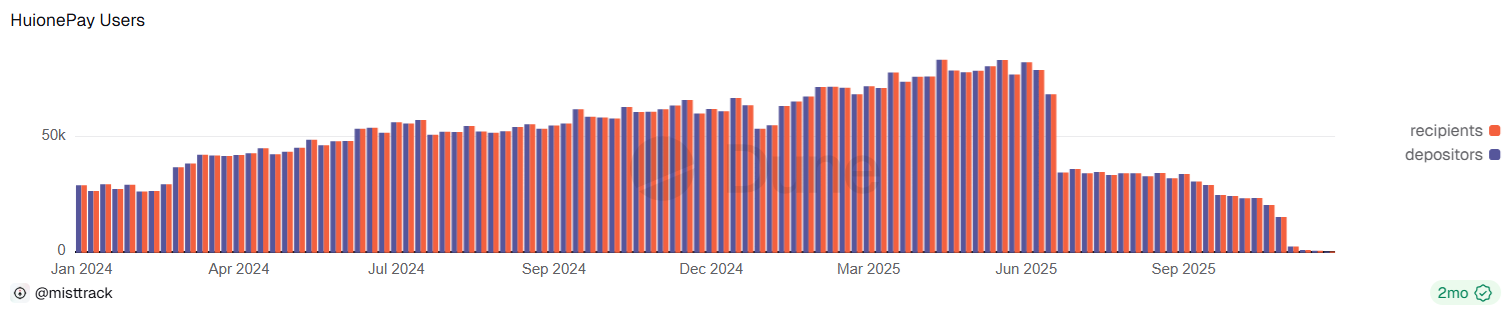
Yet the dismantling of Huione Pay did not eliminate Stablecoin Money Laundering risks. Instead, liquidity appears to be fragmenting into smaller, harder-to-trace clusters.
Researchers from Elliptic revealed that up to 30 alternative Telegram-based entities emerged after Huione Pay’s collapse.
These splinter groups now compete in the same gray market ecosystem.
“Criminal networks are highly adaptive,” Elliptic analysts have repeatedly noted in past investigations. “When one node is disrupted, activity migrates rather than disappears.”
The restructuring highlights a troubling reality: Stablecoin Money Laundering is becoming more decentralized and resilient.
USDT — issued by Tether — remains one of the most widely used stablecoins for cross-border payments.
While Tether has publicly emphasized its cooperation with law enforcement and its financial crime unit’s efforts to freeze illicit funds, the sheer scale of USDT circulation presents tracing challenges.
Small escrow shops and peer-to-peer operators now represent one of the least transparent avenues for moving funds.
These micro-markets distribute risk across numerous addresses, complicating blockchain analytics.
Following Huione’s distancing from its Guarantee division, the group reportedly sold off multiple Telegram usernames.
The divestment strategy appears designed to erase identifiable infrastructure while preserving influence through affiliates and rebranded entities.
For a brief period, Tudou Guarantee emerged as a successor marketplace. However, Tudou also wound down operations after increased scrutiny.
Notably, Huione Guarantee reportedly held a 30% stake in Tudou, making it the largest shareholder at the time.
The ongoing Telegram auctions symbolize more than asset liquidation — they reflect a shift in how Stablecoin Money Laundering networks operate.
Instead of centralized hubs, the ecosystem is evolving into dispersed micro-networks. This fragmentation increases operational resilience while reducing the visibility of any single entity.
Financial crime experts warn that dismantling infrastructure without broader enforcement coordination may only accelerate adaptation.
The takedown of major platforms often triggers short-term disruption but long-term redistribution.
For regulators and blockchain investigators, the Huione saga offers a sobering lesson: Stablecoin Money Laundering is not eradicated by removing one marketplace. It mutates.
As authorities intensify pressure on Telegram-based financial networks, the next phase may involve deeper cooperation between stablecoin issuers, analytics firms, and law enforcement agencies worldwide.
For now, Huione’s Telegram fire sale marks the end of one chapter — but not the end of the story.



Copyright © 2025 - The Bit Gazette.

