







- Trending
- Comments
- Latest

Pump.fun has introduced a new rewards mechanism that redirects trading fee earnings away from token creators and toward active traders, giving deployers a one-time, irreversible choice between the old Creator Fees model and the new cashback system.
Announced Tuesday in a post on X, the platform said creators must now choose between traditional “Creator Fees” and Pump.fun cashback coins before launching a token which is a decision that cannot be reversed.
The rollout comes amid falling platform revenues and renewed scrutiny of profit distribution within the memecoin market.
Under its original structure, Pump.fun allocated 0.3% of all token trading fees to creators through Creator Fees as a model that at its peak generated more than $15 million in a single day.
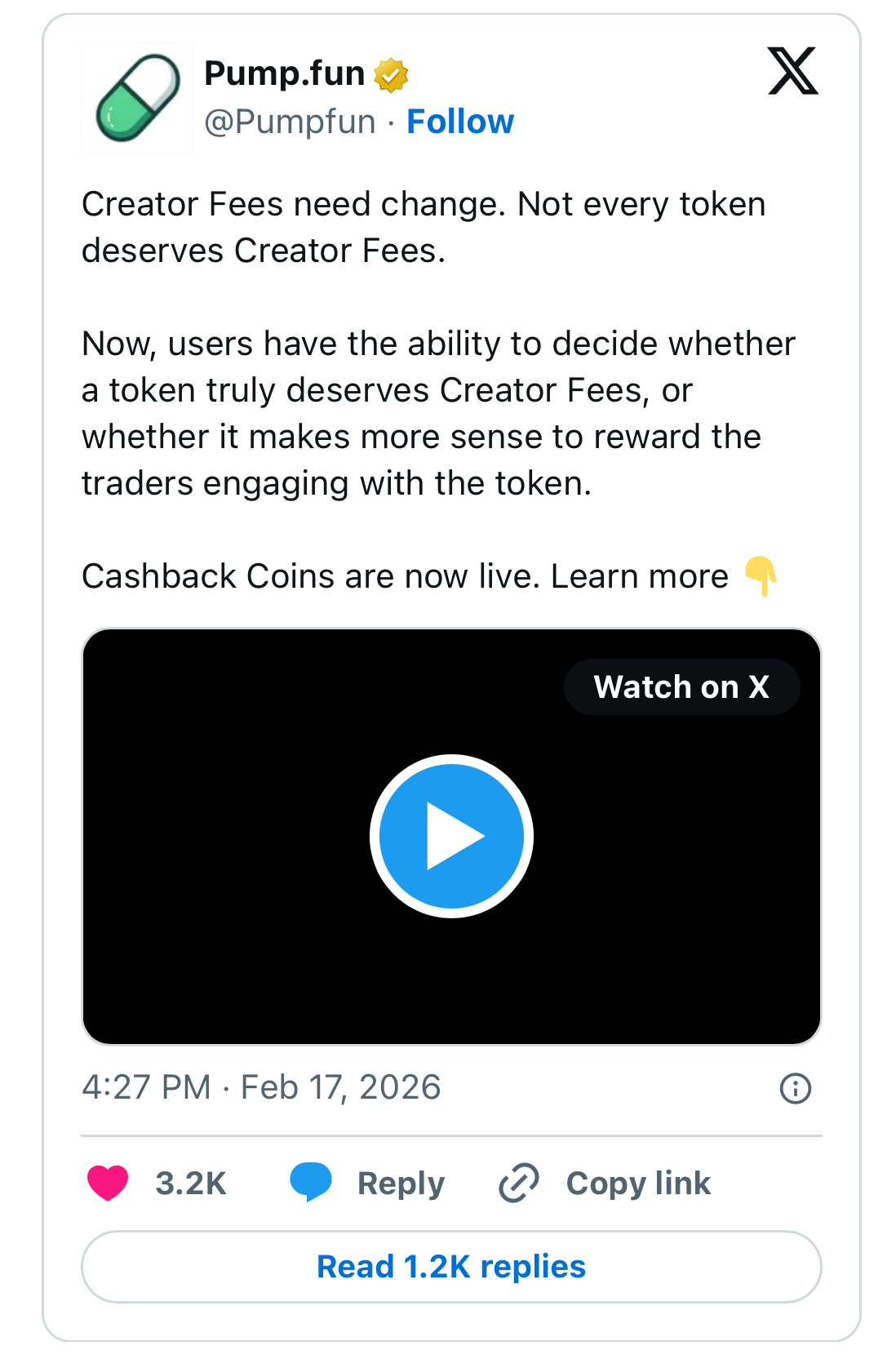
With Pump.fun cashback coins, however, traders earn rewards on each transaction, potentially redistributing incentives across the ecosystem.
In its official announcement, Pump.fun framed the update as a market-driven correction.
“Now, traders can choose to engage with tokens they feel the most aligned with, ultimately letting the market decide who gets rewarded and where the bar is set,” – the company said in a statement posted on X.
The Pump.fun cashback coins system allows token deployers to opt out of Creator Fees entirely and instead direct value back to traders through rewards generated on every trade.
According to Terminal which is the native trading interface integrated within Pump.fun, Cashback Coins are created per transaction and are accessible exclusively via Terminal.
The company argued that not all tokens warrant ongoing Creator Fees, noting that many achieve viral traction without centralized teams or structured development roadmaps.
By introducing Pump.fun cashback coins, the platform appears to be responding to criticism that early deployers disproportionately benefit, regardless of long-term token performance.
Still, some market participants question whether the new structure could reduce incentives for developers.
One X user, Coos, wrote: “So devs have less reasons to push coins longer, as the most lucrative time is when coins are still on pf, and have just graduated where there is the most volume.”
The comment reflects broader uncertainty over whether Pump.fun cashback coins will sustain token creation momentum.
The introduction of Pump.fun cashback coins comes as platform revenues have sharply declined.
According to publicly available blockchain analytics data from Dune Analytics, Pump.fun recorded $31.8 million in fees in January, representing a 75.6% drop from $148.1 million in January 2025 which is its strongest month to date.
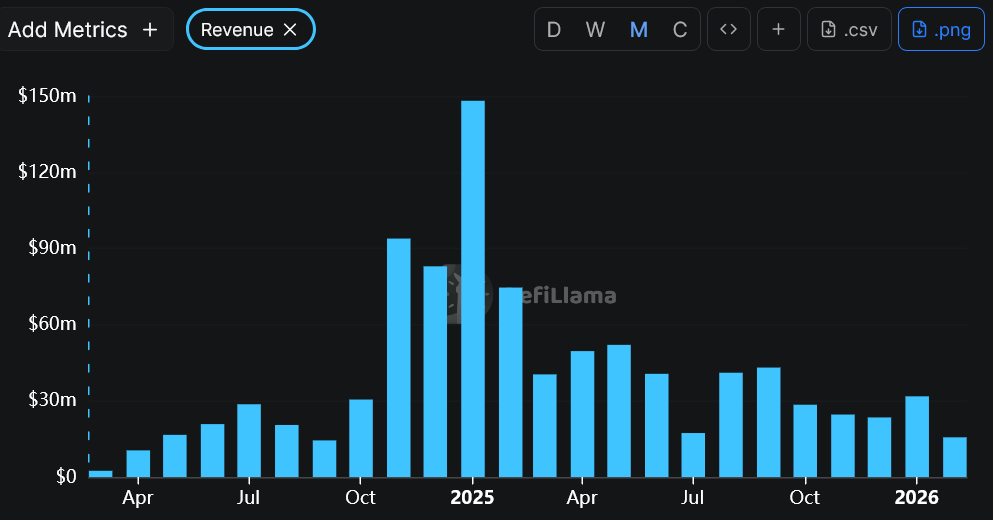
So far in February, the platform has generated approximately $15.6 million, putting it on pace to fall short of January’s total.
The revenue contraction coincides with cooling sentiment across the memecoin sector.
On-chain analytics firm Santiment recently suggested the market may be nearing a turning point.
“This collective acceptance of the ‘end of the meme era’ is a classic capitulation signal,” – Santiment said in a market commentary.
The firm added that when a sector is widely dismissed, it can become the “contrarian time” for renewed attention.
Whether Pump.fun cashback coins capitalize on that potential shift remains to be seen, but the timing indicates the platform is recalibrating as trading volumes fluctuate.
Criticism surrounding Pump.fun cashback coins also stems from disparities in user profitability.
Data from Dune Analytics shows that of the 58.7 million wallets interacting with Pump.fun, only 4.76 million posted profits between $1,000 and $10,000.
Meanwhile, 969,780 wallets recorded gains between $10,000 and $100,000, and fewer than 13,700 wallets achieved millionaire status on the platform.
The figures underscore concerns that a relatively small subset of participants capture the majority of returns which is a pattern not uncommon in speculative token markets.
By introducing Pump.fun cashback coins, the platform appears to be attempting to broaden reward distribution among active traders rather than concentrating returns among token deployers.
The sustainability of Pump.fun cashback coins will likely depend on whether the revised structure attracts sustained trading activity or simply redistributes existing fee flows.
Pump.fun is not alone in reassessing incentive models. On Feb. 10, Coinbase’s Base App announced it would sunset its Creator Rewards program, signaling a strategic pivot.
The Base App team stated on X that it had paid approximately $450,000 to 17,000 creators over seven months, with data indicating average earnings of about $26 per creator.
The rewards initiative had aimed to position Base which is Coinbase’s Ethereum layer-2 network as a social ecosystem where activity translated into earnings.
The contrast between Pump.fun cashback coins and Base’s withdrawal from creator incentives highlights diverging strategies across crypto platforms.
While some are doubling down on redistributive trading rewards, others are scaling back experimental monetization frameworks.
For crypto investors and market observers, Pump.fun cashback coins represent more than a technical update as they reflect evolving economics within speculative token markets.
As memecoin volumes fluctuate and scrutiny intensifies, the success of Pump.fun cashback coins may serve as a broader indicator of how platforms balance trader engagement, creator incentives, and sustainable revenue models in the next phase of the crypto cycle.



Copyright © 2025 - The Bit Gazette.

