







- Trending
- Comments
- Latest


Bitcoin capital inflows stall as institutional treasuries break whale-retail cycle, CryptoQuant says
Five entities — including wallets attributed to Satoshi Nakamoto, BlackRock’s spot ETF, Coinbase, Binance, and the U.S. government — collectively hold more than 3.7 million bitcoin, representing roughly 17% of total supply, according to Arkham Intelligence data. Most of those coins have not moved in months or years, raising questions about how much of bitcoin’s float is genuinely liquid.
As of press time, Bitcoin remains below its 50-day simple moving average near $83,000, a level traders are watching closely.
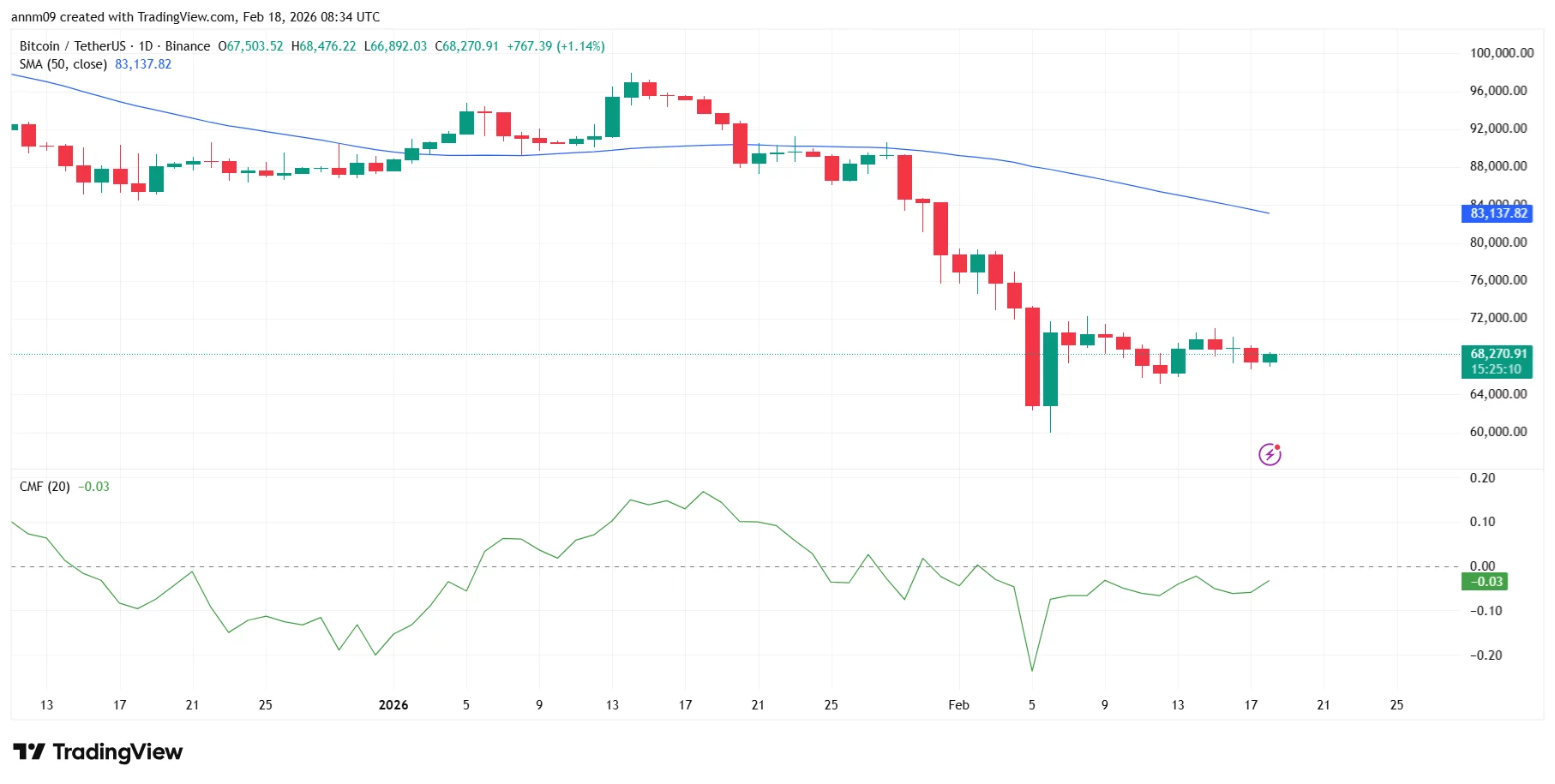
Earlier this year, Bitcoin fell from the mid-$90,000 range to a local low near $60,000 before rebounding.
Despite the recovery, price action continues to consolidate under the 50-day SMA, which now acts as dynamic resistance.
Until that level is reclaimed, short-term Bitcoin price prediction models remain cautious.
From a chart perspective, the Bitcoin price prediction remains technically constrained.
Heavy selling pressure through late January and early February culminated in a sharp capitulation candle that drove BTC toward $60,000.
A reflex bounce followed, but momentum indicators suggest capital inflows are still fragile.
The Chaikin Money Flow indicator remains slightly negative, signaling limited conviction behind the rebound.
For traders building a short-term Bitcoin price prediction, the key threshold remains the 50-day SMA around $83,000.
A sustained move above that level could reopen the path toward $90,000, while a failure to hold $65,000 may expose the $60,000 support zone once again.
Technical levels, however, tell only part of the Bitcoin price prediction story. Ownership concentration adds a structural layer that may amplify future volatility.
Arkham Intelligence’s 2026 data shows Bitcoin ownership remains highly concentrated among early adopters, exchanges, institutions and governments.
Wallets attributed to Satoshi Nakamoto still hold approximately 1.096 million BTC more than 5% of total supply and those coins have never moved.
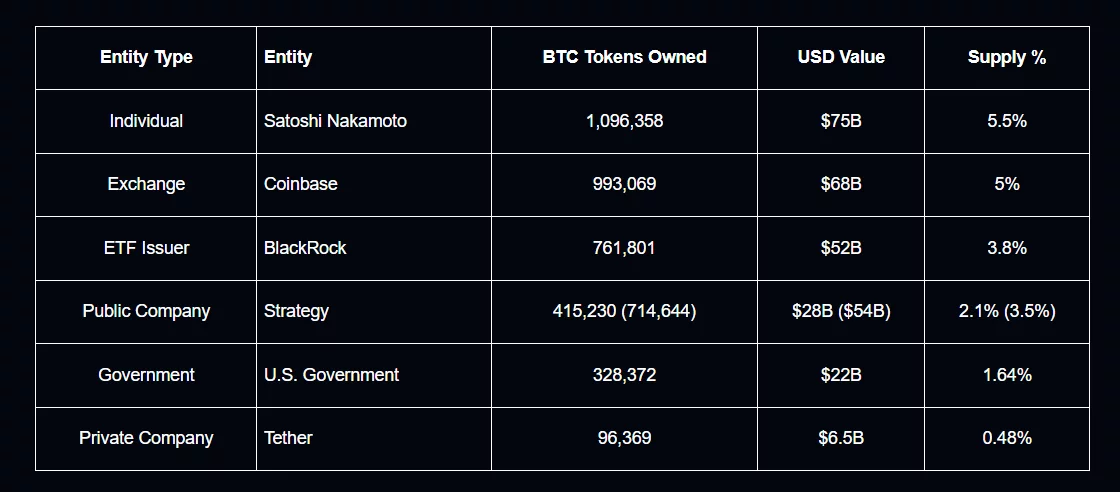
Meanwhile, Coinbase controls close to 1 million BTC across custodial wallets, and Binance holds more than 600,000 BTC.
BlackRock’s spot Bitcoin ETF alone holds over 760,000 BTC, while Strategy controls more than 400,000 BTC. The U.S. government also maintains holdings exceeding 300,000 BTC from prior seizures.
BlackRock CEO Larry Fink has previously described Bitcoin as “an international asset” in public remarks, underscoring growing institutional participation.
Strategy Executive Chairman Michael Saylor has repeatedly characterized Bitcoin as “digital property,” reinforcing the company’s long-term accumulation strategy.
For Bitcoin price prediction models, this concentration matters. Dormant holdings particularly Satoshi’s coins and long-term corporate allocations effectively reduce circulating supply.
When large balances remain inactive during periods of demand expansion, price reactions can become more pronounced.
While dormant whale holdings can tighten supply structurally, exchange reserves introduce a liquidity variable into any Bitcoin price prediction.
If exchanges maintain significant BTC inventories, market participants can access liquidity more easily, moderating volatility.
However, if exchange-held Bitcoin declines while ETFs and corporate treasuries continue accumulating, the effective float could tighten quickly.
In such a scenario, even modest demand could generate outsized price moves which is a dynamic that has shaped previous bull cycles.
Institutional demand trends remain central to forward-looking Bitcoin price prediction frameworks.
Spot ETFs have introduced new channels for capital inflows, while macroeconomic conditions including interest rate expectations and risk appetite influence allocation decisions.
Looking ahead, the next decisive Bitcoin price prediction hinges on two primary factors: technical confirmation and capital inflows.
Reclaiming the 50-day SMA near $83,000 would strengthen the bullish case and potentially re-open a move toward $90,000.
Conversely, a breakdown below $65,000 could renew pressure on the $60,000 support zone.
Structurally, concentrated ownership suggests long-term supply remains constrained.
If institutional inflows accelerate while major holders remain inactive, upward price pressure could build rapidly.
On the other hand, shifts in exchange balances or large-holder distribution would alter the Bitcoin price prediction calculus.
For crypto investors, the convergence of technical resistance and concentrated supply creates a pivotal moment.
The next phase of the Bitcoin price prediction narrative will likely be determined by whether capital returns with conviction and whether the largest holders continue to sit tight.



Copyright © 2025 - The Bit Gazette.

