- Trending
- Comments
- Latest

Ripple CEO Brad Garlinghouse is giving the CLARITY Act nine-in-ten odds of passing by April, but first, Congress has until March 1 to break a stalemate over whether stablecoin issuers can pay yield to holders, a dispute that banks say threatens the deposit system and that the crypto industry says is non-negotiable.
News outlets report that Ripple CEO Brad Garlinghouse now believes there’s a roughly 90 % chance the bill will pass by April 2026.
Despite political gridlock, markets responded positively — total crypto market capitalization reached approximately $2.32 trillion. The outcome of the stablecoin yield debate remains the principal near-term catalyst, with institutional actors and on-chain market activity watching the developments closely.
The CLARITY Act aims to provide statutory clarity on which U.S. regulators — the Securities and Exchange Commission (SEC) or the Commodity Futures Trading Commission (CFTC) — oversee various digital assets. The bill would codify functional tests for asset classification, replacing decades of enforcement ambiguity with defined regulatory regimes. Such clarity could unlock institutional capital currently sidelined by legal uncertainty.
Recent news suggests that White House-led negotiations have boosted momentum for bipartisan passage. However, Senate proceedings remain delayed due to unresolved stablecoin provisions and industry objections.
Stablecoin yield — whether issuers or platforms can offer interest or rewards on holdings — is the core sticking point in legislative negotiations. Banks argue such yields pose systemic risk and could incentivize deposit migration away from traditional banking, whereas the crypto industry contends that regulated yield structures are essential for competitive U.S. stablecoin issuers such as USD Coin (USDC) and PayPal USD (PYUSD).
If unresolved by March 1, the legislative package may stall or see revised language that weakens industry objectives. Market sentiment suggests that a compromise likely allowing modest yields under regulatory safeguards would be bullish for compliant stablecoins and DeFi protocols reliant on stablecoin liquidity.
Recent reports from multiple news outlets indicate increasing institutional engagement with XRP and its underlying settlement infrastructure:
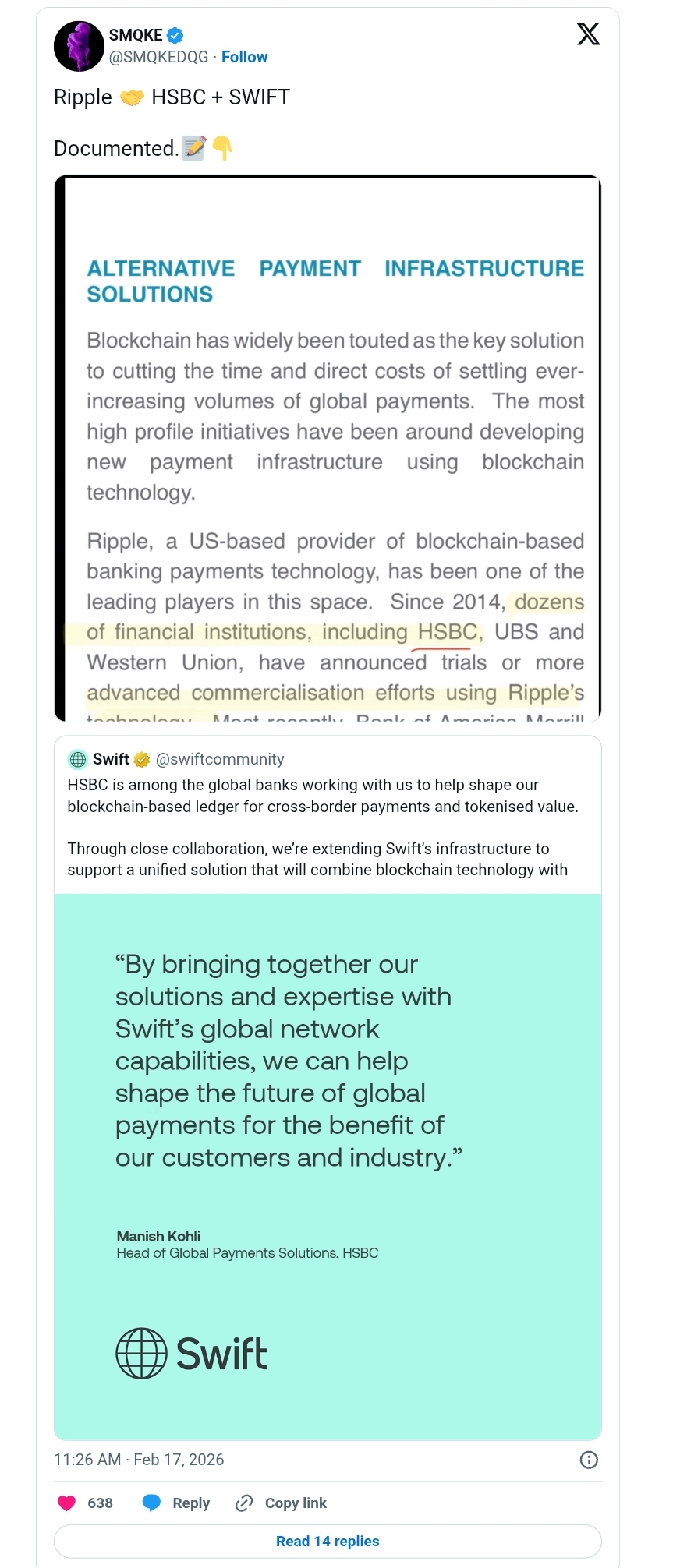
These developments reflect growing institutional confidence in XRPL’s utility for stablecoin deployments, cross-border settlement experiments, and multi-chain tokenization strategies.
Market sentiment remains highly correlated with regulatory news flow and institutional integration narratives. News coverage highlights that prediction markets and executives (e.g., Garlinghouse) view the CLARITY Act’s passage probability at historically elevated levels, often above ~80 % as of late February.
Additionally, XRP’s real-world asset growth — including increased tokenized assets and banking stablecoin initiatives — has been highlighted in several financial news outlets, signaling wider utility beyond pure speculative trading.
Potential Winners:
Conditional Winners:
Pressure Zones:
The primary risk remains legislative delay or adverse amendments to yield provisions, potentially resulting in market pullbacks. Losses on prediction markets and renewed banking objections could diminish near-term clarity expectations.
Institutionally, pilot infrastructure deployment stories (e.g., SWIFT, banks, SG-FORGE) are intriguing but not universally confirmed by official statements. Independent verification from SWIFT or major banks remains pending.
U.S. regulatory clarity would position domestic markets more favorably relative to international frameworks — especially the European Union’s MiCA regime, an operational legal structure shaping crypto regulation since late 2024. MiCA compliance has already enabled European institutional stablecoin products that may compete with U.S. alternatives. continued delays by Congress risk ceding market leadership to rival jurisdictions.
| Sector / Token | Catalyst | Outlook |
|---|---|---|
| XRP | Institutional integration + regulatory clarity | Strongly Bullish |
| Coinbase (COIN) | Regulatory moat | Bullish |
| USDC / Circle | Stablecoin yield compromise | Bullish (conditional) |
| PYUSD | Compliance structure risk | Watch |
| DeFi (Aave, Compound) | Safe harbor benefits | Bullish |
| RWA Tokens | Institutional on-chain demand | Bullish |
| Traditional Banks | Yield resistance | Cautious |
| Tether | Offshore issuer exposure | Neutral |
The CLARITY Act remains the structural fulcrum.
But the narrative has evolved.If regulatory clarity converges with SWIFT-level institutional integration, XRP transitions from legal battleground asset to infrastructure-layer settlement instrument. That would mark a regime shift — not just for XRP, but for how digital assets interface with global finance.
Disclaimer: This report is for informational purposes only and does not constitute financial or investment advice.



Copyright © 2025 - The Bit Gazette.