




- Trending
- Comments
- Latest

A senior UK lawmaker has called on the government to temporarily ban cryptocurrency political donations, warning that foreign states are actively seeking to exploit gaps in Britain’s electoral finance laws before regulators can close them.
The proposal, led by Matt Western, chairman of the Joint Committee on the National Security Strategy, seeks a moratorium on Political crypto donations until clearer statutory guidance is issued by the Electoral Commission.
At the heart of the debate is a fundamental question: Can Britain’s political finance system safely handle Political crypto donations in an era of escalating geopolitical tensions?
In a formal letter to Steve Reed, Secretary of State for Housing, Communities and Local Government, Western warned that the regulatory framework surrounding Political crypto donations remains dangerously underdeveloped.
Western wrote that there is “foreign state intent to interfere in UK political finance” and noted there is “no clear national enforcement lead for political finance and foreign interference risk.”
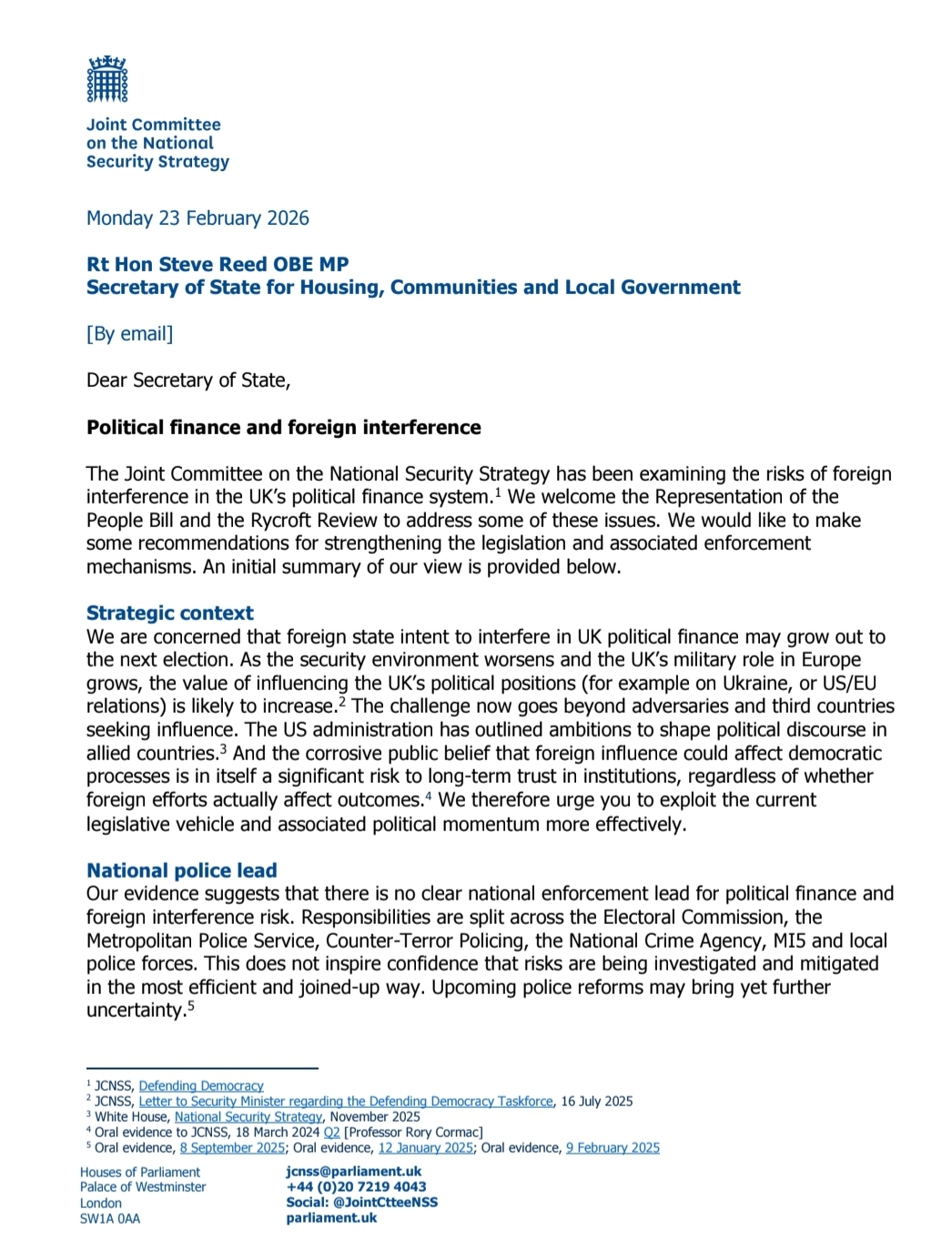
He added: “As the security environment worsens and the UK’s military role in Europe grows, the value of influencing the UK’s political positions (for example, on Ukraine, or US/EU relations) is likely to increase,” — Matt Western, Chair, Joint Committee on the National Security Strategy.
The proposed moratorium would halt Political crypto donations temporarily, allowing regulators time to create binding compliance standards. Western argues that without clear enforcement authority and traceability mechanisms, digital asset contributions may create blind spots in electoral oversight.
The issue is particularly sensitive as Political crypto donations continue gaining traction globally, raising broader questions about transparency and national security.
Beyond a temporary suspension, Western has outlined a framework of interim safeguards designed to reduce risks associated with Political crypto donations.
He urged the Electoral Commission to allow crypto-based political contributions only through Virtual Asset Service Providers registered with the Financial Conduct Authority. In addition, parties would need “high confidence” in identifying the ultimate source of funds before accepting them.
Western also recommended prohibiting the use of crypto mixers or tumblers, tools capable of obscuring transaction origins. Another key provision would require political parties to convert crypto donations into pound sterling within 48 hours of receipt — a measure aimed at reducing exposure to volatility and potential laundering pathways.
Further recommendations include stricter source-of-wealth checks, expanded regulatory enforcement powers, and tougher sentencing for breaches involving foreign money.
The push follows an earlier attempt by Western and other committee chairs to insert a full ban on Political crypto donations into the Representation of the People Bill. That provision, however, was not included when the bill was introduced to the House of Commons on Feb. 12.
The debate over Political crypto donations sharpened after Reform UK became the first Westminster party to publicly accept them. The initiative was championed by Nigel Farage, who announced the move following an appearance at the Bitcoin 2025 conference in Las Vegas.
According to reporting by BBC, Reform UK maintains that it does not accept anonymous donations. The party states on its website that it conducts permissibility checks to ensure funds originate from UK-registered companies or individuals listed on the electoral register. Contributions above £500 are subject to standard compliance procedures.
While supporters argue that Political crypto donations modernize fundraising and engage digital-native voters, critics caution that blockchain-based transfers can complicate traditional verification models — especially when intermediaries or privacy tools are involved.
Western’s letter explicitly questions whether existing safeguards are sufficient to prevent illicit foreign influence channeled through digital assets.
The UK debate mirrors developments in the United States, where Political crypto donations played a significant role in the 2024 election cycle.
The Federal Election Commission permits cryptocurrency contributions to political committees, provided they comply with contribution limits and disclosure rules. During the 2024 race, Donald Trump accepted digital asset contributions, helping normalize crypto fundraising at the highest political level.
The international expansion of Political crypto donations is reshaping campaign finance landscapes, but regulatory approaches differ sharply. While US authorities allow such contributions within defined reporting frameworks, UK lawmakers appear more cautious, emphasizing national security implications.
Western’s intervention underscores the urgency of clarifying whether Political crypto donations can be safely integrated into Britain’s electoral system — or whether a pause is necessary to prevent regulatory gaps from being exploited.
As Parliament weighs the proposal, the broader issue remains unresolved: how to balance financial innovation with electoral integrity. The government has yet to announce whether it will adopt the proposed moratorium, but pressure is mounting for a definitive response.
For now, Political crypto donations remain legal in the UK. Whether they remain so may depend on how quickly regulators can provide the statutory clarity lawmakers are demanding.



Copyright © 2025 - The Bit Gazette.