

- Trending
- Comments
- Latest

DYOR: “Do Your Own Research” has become a fundamental principle in cryptocurrency investing, a phrase designed to protect investors from hype-driven decisions, fraudulent projects, and the information asymmetry that characterizes crypto markets.
The phrase gained prominence during the 2017-2018 ICO boom, when thousands of fraudulent projects led to massive investor losses, but its relevance has only grown as the sector matures and complexity increases.
DYOR stands for “Do Your Own Research,” a phrase widely used across crypto communities to promote independent thinking and due diligence.
The concept gained traction during the initial coin offering (ICO) boom between 2016 and 2018, when a surge of fraudulent projects led to massive investor losses.
As scams spread, experienced participants began urging newcomers to DYOR before investing, turning the phrase into a standard warning across forums, social media, and trading platforms.
The importance of DYOR cannot be overstated. Unlike traditional financial markets, crypto operates in a largely decentralized and lightly regulated environment, making it easier for misinformation and fraudulent schemes to thrive.
“DYOR is one of the most important aspects of being a cryptocurrency investor,” according to educational materials.
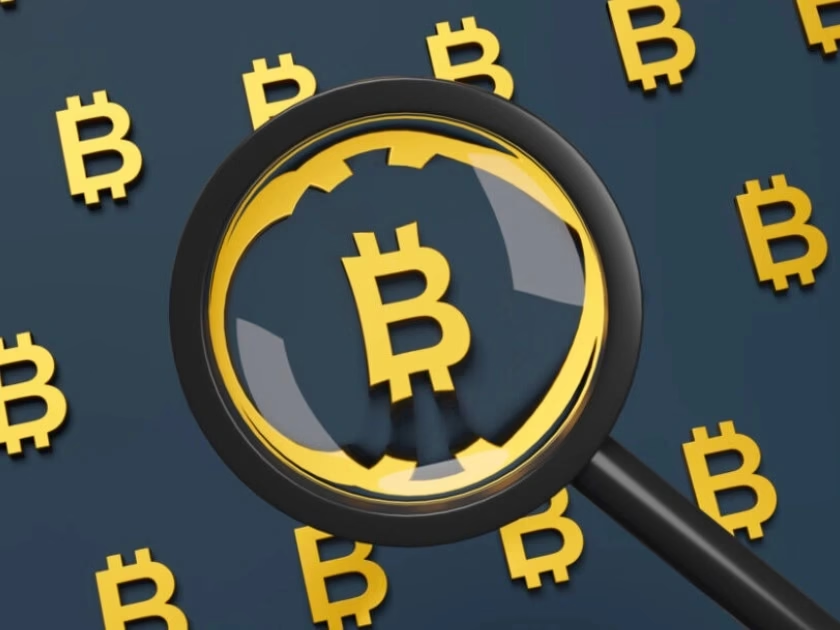
Without proper research, investors risk falling victim to hype-driven investments, Ponzi schemes, or projects that lack real utility. In many cases, bad decisions stem from blindly following influencers or trending narratives—precisely what DYOR aims to prevent.
Applying DYOR goes beyond reading headlines or checking token prices. It involves a deeper evaluation of several key factors:
Crypto exchange Kraken notes that DYOR includes analyzing both qualitative and quantitative data, from whitepapers to market activity.
In short, DYOR is about building enough understanding to make informed decisions—not just reacting to market noise.
While DYOR is designed to promote responsibility, it has also evolved into a widely used disclaimer. Influencers and project promoters often attach “DYOR” to their posts, effectively shifting accountability onto their audience.
This has diluted the meaning of DYOR in some cases. Instead of encouraging critical thinking, it can sometimes act as a shield for those promoting risky or unverified projects.
“Trying to find profitable projects solely by listening to influencers is remarkably difficult,” industry guides warn.
This highlights a key reality: DYOR only works when it is genuinely practiced—not when it is used as a formality.
At its best, DYOR acts as a defense mechanism against one of crypto’s biggest risks—information asymmetry. New investors often lack the technical knowledge to evaluate projects, making them more vulnerable to manipulation.
By encouraging independent verification, DYOR helps level the playing field. It pushes investors to question bold claims, verify sources, and avoid “too good to be true” opportunities.

It also reinforces a broader mindset: personal responsibility. In crypto, where transactions are irreversible and regulation is limited, the burden of decision-making falls largely on the individual.
As the crypto industry matures, the role of DYOR is evolving. With more institutional participation and improved regulatory frameworks, access to reliable information is improving—but the need for independent research remains.
Experts argue that DYOR will continue to be a core skill, especially as new sectors like DeFi, NFTs, and AI-integrated blockchain projects introduce additional complexity.



Copyright © 2025 - The Bit Gazette.