






- Trending
- Comments
- Latest

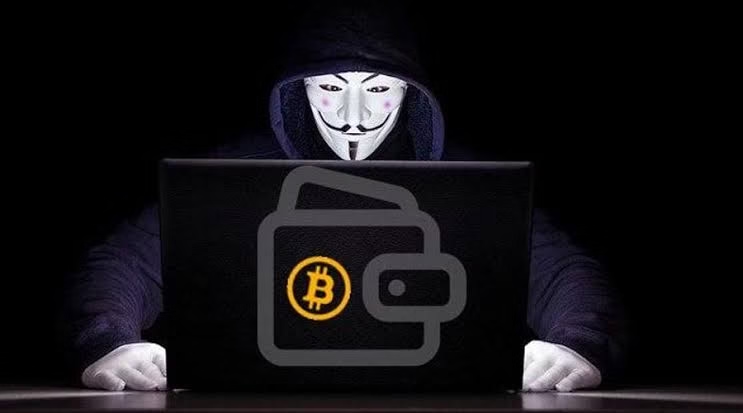
Approval phishing is no longer a fringe exploit, it is rapidly embedding itself into the everyday flow of on-chain activity.
Across decentralized exchanges, NFT marketplaces, and yield platforms, users routinely sign token approvals without a second thought.
This shift in behavior has created fertile ground for approval phishing, where malicious actors exploit token allowance mechanisms rather than directly stealing private keys.
The result is a subtle but systemic vulnerability: wallets remain technically uncompromised, yet funds can be drained at any moment, often long after the initial interaction.
At its core, approval phishing leverages the ERC-20 token standard’s allowance function, which enables users to grant smart contracts permission to spend tokens on their behalf.
Attackers disguise malicious contracts as legitimate dApps or interfaces. When users connect their wallets and approve token access, they unknowingly grant unlimited or excessive permissions.
Unlike traditional phishing, no immediate transaction occurs. Instead, the attacker waits, monitoring the wallet until sufficient assets accumulate before executing a transfer.
Approval phishing operates outside the assumptions of most wallet security frameworks.
Hardware wallets, multi-signature setups, and private key hygiene offer little protection because the user has technically authorized the transaction.
This creates a dangerous illusion of safety. Investors often assume that if their private keys remain secure, their funds are protected.
Approval phishing breaks this model by shifting the attack vector from authentication to authorization.
According to analysis from blockchain security firms, a significant portion of DeFi-related losses now stems from malicious approvals rather than protocol exploits or key compromises.
Recent incidents illustrate how widespread and costly approval phishing has become.
Users interacting with fake airdrops, cloned websites, or malicious ads have lost millions in tokens not instantly, but gradually, as attackers execute transfers over time.
The rise of wallet-draining kits has industrialized this process. These kits automate the detection of valuable wallets and trigger token transfers once approvals are in place.
The attack lifecycle is now scalable, repeatable, and difficult to trace in real time.
One of the defining characteristics of approval phishing is its latency. The delay between approval and exploitation makes detection difficult for both users and monitoring tools.
Revoking token approvals is currently the primary defense, yet most users remain unaware of this necessity. Tools like revoke cash allow users to review and revoke active allowances, but adoption remains limited.
Moreover, interfaces often obscure the scope of approvals, failing to clearly communicate whether access is limited or unlimited. This lack of transparency compounds the problem, especially for less technical participants.
Mitigating approval phishing requires a shift in both user behavior and platform design.
Investors must treat token approvals with the same caution as private key management, regularly auditing and revoking unnecessary permissions.
On the infrastructure side, wallet
providers and dApps need to redesign approval flows.
Granular permissions, clearer prompts, and default limits could significantly reduce risk exposure.
Emerging standards like ERC-20 Permit and session-based approvals may offer safer alternatives, but adoption is still evolving.
Approval phishing represents a structural vulnerability in the current DeFi stack, one that exploits convenience at scale.
It does not rely on breaking cryptography or hacking protocols; instead, it weaponizes user trust in the approval process itself.
As on-chain activity continues to expand, this attack vector will likely grow in parallel, demanding a more mature approach to permission management across the ecosystem.



Copyright © 2025 - The Bit Gazette.

