




- Trending
- Comments
- Latest

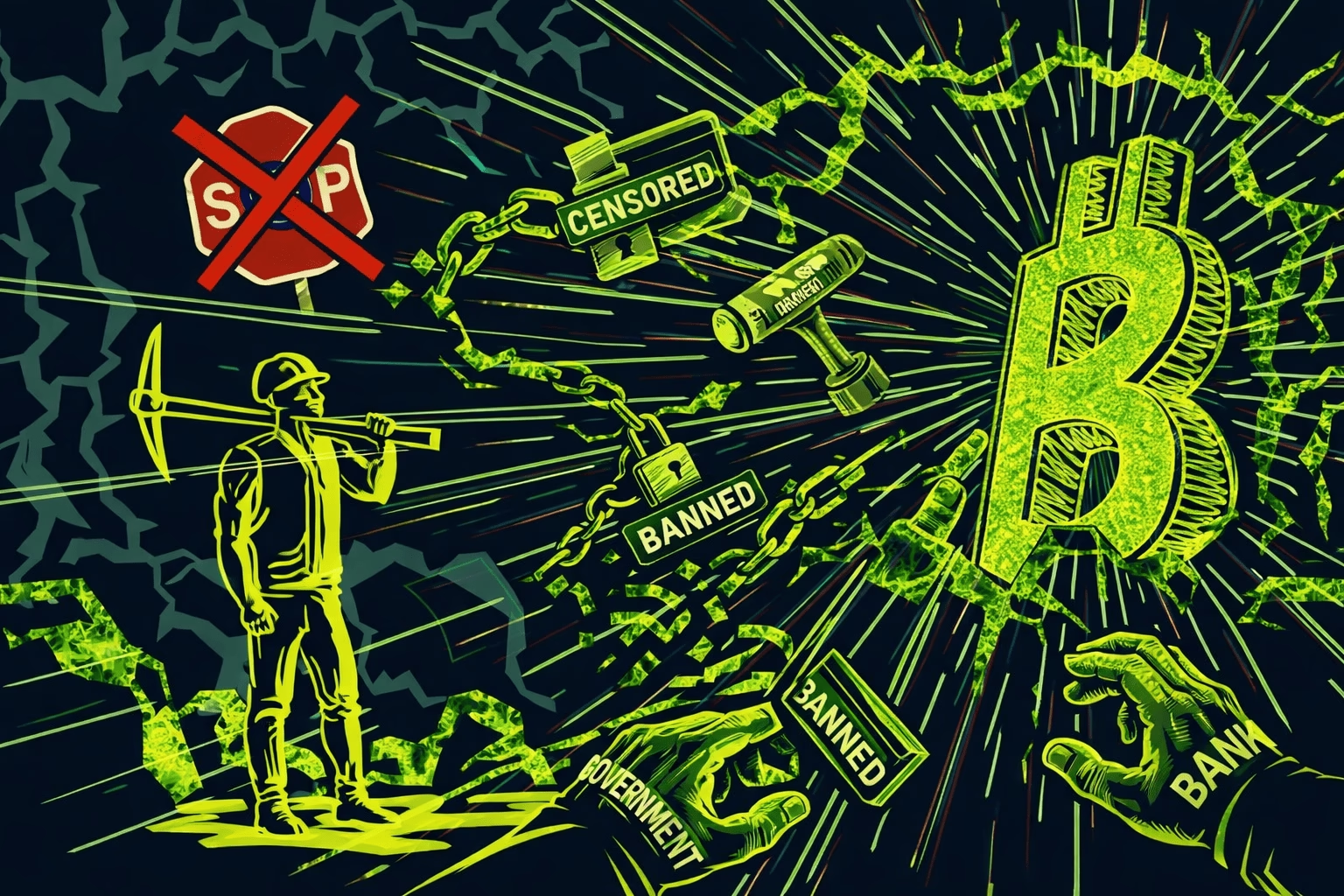
In 2025, China intensified its ban on cryptocurrency trading and mining. The Ethereum-based privacy tool Tornado Cash was sanctioned by US authorities. Neither action stopped the underlying networks from processing transactions.
That durability has a name: censorship resistance. It is the property that allows decentralised networks to function regardless of what any government, regulator, or corporation decides. And in an era of tightening financial control, it has become the most consequential feature in crypto.
The growing importance of Censorship Resistance reflects broader global trends toward financial control and digital surveillance. As traditional systems impose stricter rules, users increasingly value the autonomy that Censorship Resistance provides.
With Censorship Resistance, individuals maintain control over their assets without reliance on intermediaries. This ensures that funds cannot be frozen arbitrarily, offering a level of financial independence that traditional banking cannot guarantee. Censorship Resistance also supports freedom of expression by enabling unrestricted participation in digital economies.
A 2025 industry report noted that Bitcoin’s self-custody model enhances its appeal in unstable regions, further highlighting the importance of Censorship Resistance. In such environments, access to reliable financial systems is limited, making decentralized alternatives essential.
Industry voices continue to reinforce this narrative. Jack Mallers captured the sentiment succinctly, stating, “There is no second best,” underscoring Bitcoin’s role as a leading censorship-resistant monetary network. His statement reflects the growing consensus that Censorship Resistance is central to crypto’s value proposition.
Recent global developments have tested the durability of Censorship Resistance under pressure. In 2025, China intensified its ban on cryptocurrency trading and mining, triggering market volatility. Despite these actions, decentralized networks continued to function, demonstrating the resilience of Censorship Resistance.
Bitcoin has also been explored as a neutral payment system in complex geopolitical scenarios, where trust between parties is limited. The idea that “Bitcoin is for enemies” illustrates how Censorship Resistance allows transactions to occur without reliance on intermediaries.
Meanwhile, regulatory actions targeting tools like Tornado Cash on the Ethereum network highlight ongoing tensions between decentralization and oversight. Even so, efforts to fully suppress Censorship Resistance at the protocol level have proven ineffective.
These cases demonstrate that while authorities can impose restrictions, eliminating Censorship Resistance entirely remains a significant challenge.
Censorship Resistance is achieved through decentralization, cryptographic security, and distributed consensus mechanisms. Independent nodes validate transactions across the network, preventing any single authority from exerting control. This architecture ensures that Censorship Resistance remains intact even under external pressure.
Consensus models like Proof of Work further strengthen Censorship Resistance by requiring computational effort to validate transactions, making manipulation difficult. However, limitations exist. Regulatory measures can restrict access through centralized exchanges, and large network participants may influence transaction prioritization.
Despite these challenges, Censorship Resistance remains highly robust. As global adoption of decentralized technologies accelerates, its role will only become more significant. Increasing concerns over privacy, financial restrictions, and digital control are driving users toward systems that prioritize Censorship Resistance.
Ultimately, Censorship Resistance stands as the defining innovation of crypto, ensuring open participation and safeguarding financial freedom in an increasingly regulated digital world today.



Copyright © 2025 - The Bit Gazette.