







- Trending
- Comments
- Latest

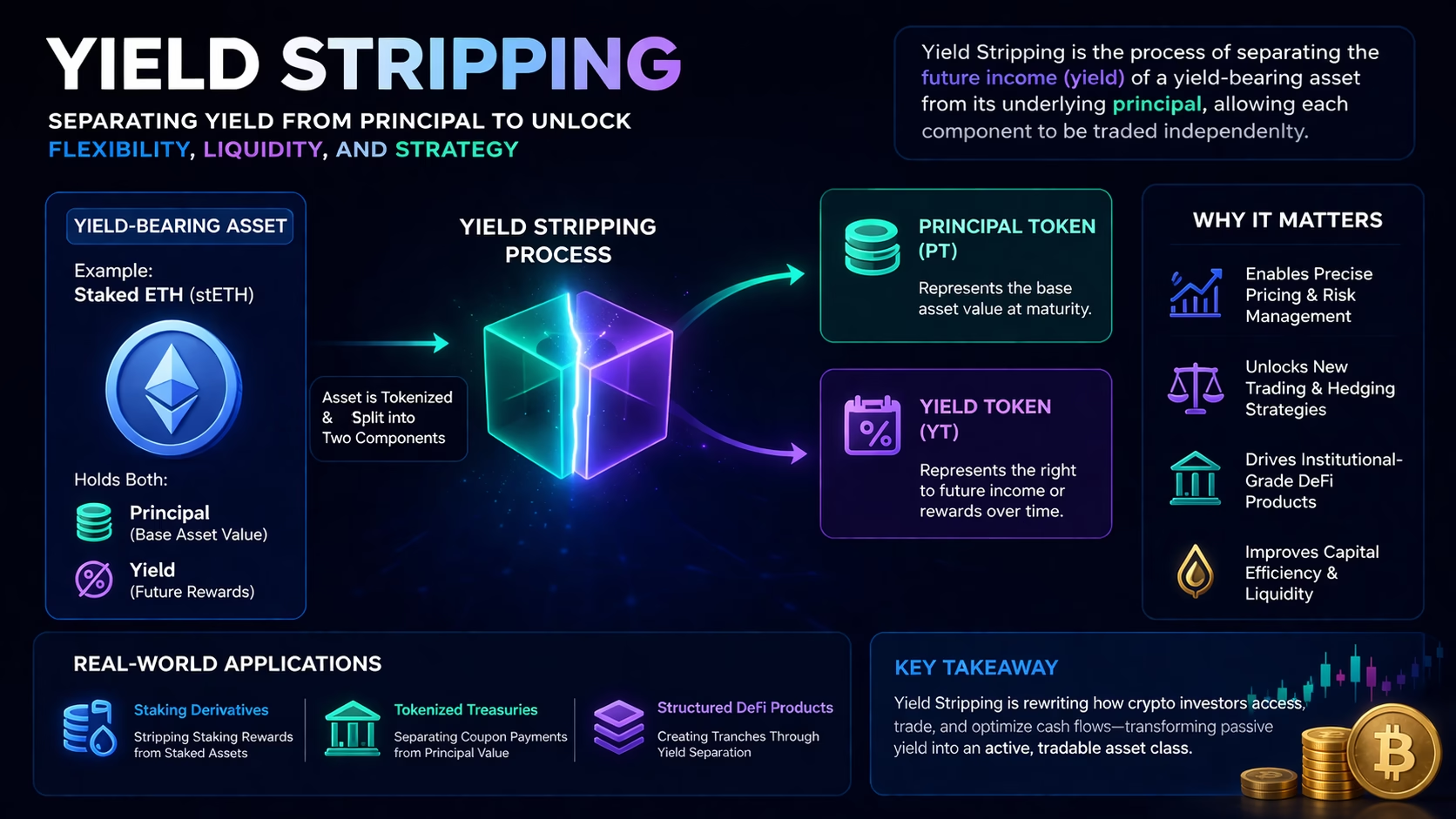
Crypto markets are learning to do something traditional bond markets have done for decades: separate the income an asset generates from the asset itself, and trade each independently. In DeFi, that process now has liquid markets, institutional demand, and a protocol, Pendle Finance, purpose-built around it.
Yield stripping involves separating an asset’s future income (yield) from its underlying principal, allowing each component to be traded independently.
This concept is well established in traditional finance through instruments like zero-coupon bonds and stripped treasuries.
The mechanism is being applied to yield-bearing tokens such as staked assets or interest-generating stablecoins.
For example, a token representing a staked asset can be split into a principal token (PT), representing the base asset value at maturity
Also, as a yield token (YT), representing the right to future income over a defined period.
This separation enables more precise pricing of risk and time preference, allowing market participants to speculate directly on yield movements without exposure to the underlying asset.
The rise of yield stripping in crypto is closely tied to the demand for predictable income streams in an otherwise volatile market.
Institutional players entering DeFi are not just chasing returns, they are engineering them.
Protocols like Pendle Finance have operationalized this concept by creating liquid markets for tokenized yield.
Investors can now hedge, speculate, or lock in returns with a level of granularity that was previously unavailable in decentralized systems.
This mirrors developments in traditional markets, where yield curve trading and interest rate derivatives dominate fixed income strategies.
The appeal is clear: yield stripping transforms passive income into an actively tradable asset class.
Yield stripping is already being deployed across several key areas of the crypto ecosystem:
Staking Derivatives: Platforms tokenize staked assets (e.g., ETH), enabling users to strip and trade future staking rewards separately.
Tokenized Treasuries: With the growth of on-chain exposure to U.S. Treasury yields, protocols are beginning to separate coupon payments from principal value.
Structured DeFi Products: Yield-bearing vaults now offer tranching mechanisms, where different risk-return profiles are created through yield separation.
These applications are not theoretical, they are actively reshaping liquidity flows and capital allocation.
Yield stripping introduces a new layer of market complexity, and opportunity. By isolating yield, investors can:
Hedge against declining returns without selling principal, leverage directional bets on interest rates or staking rewards, and access fixed-income-like strategies within DeFi.
However, this also introduces new risks. Pricing inefficiencies, liquidity fragmentation, and smart contract vulnerabilities can all distort the expected value of stripped components.
Moreover, the separation of yield from principal can obscure true risk exposure if not properly understood.
What makes yield stripping significant is not just its mechanics, but its implications. Crypto markets are transitioning from simple token speculation to structured financial engineering.
The ability to isolate and trade yield is a hallmark of mature financial systems, and its arrival in DeFi signals a deeper transformation.
As more assets become yield-bearing and tokenized, the logic of yield stripping will extend beyond niche protocols into core market infrastructure.
The result is a system where cash flows not just tokens become the primary unit of trade.
For investors and analysts, ignoring this shift means missing where the market is actually heading.



Copyright © 2025 - The Bit Gazette.

