




- Trending
- Comments
- Latest

For most of its existence, Bitcoin had one value proposition: price appreciation. It paid no dividends, generated no cash flow, and offered no yield in the traditional sense. You held it, and you waited.
Pakistan just made it infrastructure.
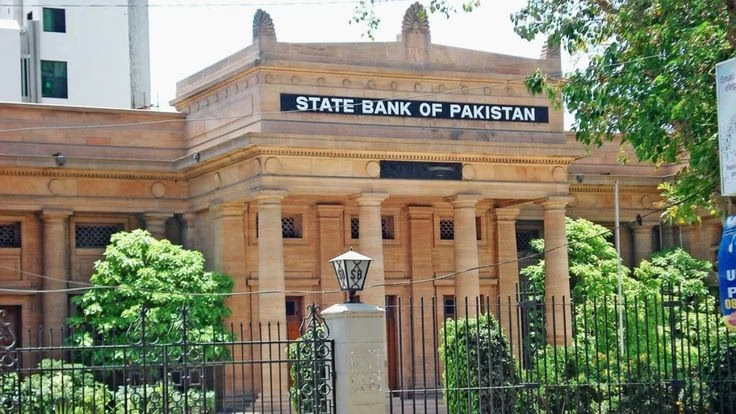
On April 14, 2026, the State Bank of Pakistan issued BPRD Circular Letter No. 10, formally replacing the blanket ban on crypto services it had imposed in 2018. Eight years. That’s how long one of the world’s most active crypto populations operated in the financial shadows, running an estimated $25 billion in annual volume through peer-to-peer channels, grey-market exchanges, and informal networks that the state could see but not touch.
That era is over. And what Pakistan has built to replace it is not a cautious experiment. It is a framework that could become a template, for the global South, for emerging markets everywhere, and frankly, for every Western regulator still locked in definitional arguments about whether a token is a security or a commodity.
While Washington debates, Islamabad builds. The $25 billion was already there. Pakistan just decided to govern it.
The mechanics of what Pakistan has built deserve serious attention, because the design choices are not obvious ones.
Under the new framework, banks and financial institutions are permitted to open accounts for crypto firms, but only those licensed by the Pakistan Virtual Asset Regulatory Authority (PVARA), the permanent statutory body created by the Virtual Assets Act 2026.
The accounts are deliberately constrained: segregated, PKR-denominated, non-interest-bearing Client Money Accounts with no cash deposits, no withdrawals, and no collateral use.
Here is the part that matters: banks are explicitly prohibited from investing in, trading, or holding virtual assets using their own funds or customer deposits.
Read that again. Pakistan has opened the on-ramp without letting the banks onto the track. The legacy financial system gains access to crypto firms. It does not gain exposure to crypto assets. The government is allowing Web3 startups to access banking infrastructure while legally ringfencing depositor funds from the underlying volatility.
This is not a compromise born of regulatory weakness. It is a structural choice, one that solves the single biggest argument against crypto adoption in fragile banking systems: the contagion risk. Pakistan built the firewall in from day one. The West is still arguing about whether one is needed.
The Virtual Assets Act 2026 does not just legalise the industry. It criminalises the underground one.
Unlicensed Virtual Asset Service Providers now face penalties that include fines of up to PKR 50 million (approximately $179,000) and five years of imprisonment. The state is executing a hostile takeover of its own shadow economy, forcing tens of billions in annual volume out of peer-to-peer networks and onto federally monitored ledgers.
For context: Pakistan is simultaneously pursuing IMF-backed fiscal reforms, with capital gains tax on crypto set at 15% and rising to 20%. Formalising a $25 billion informal market is not just a crypto story. It is a fiscal one. Every transaction that moves from a grey-market Telegram group to a PVARA-licensed exchange is a transaction that can now be taxed, tracked, and integrated into Pakistan’s monetary architecture.
There is also a requirement that every VASP maintain a Sharia compliance board, a detail that signals how seriously Pakistan is integrating this framework into its broader financial and cultural identity, not grafting it on as a foreign import.
Pakistan is not adopting crypto. It is domesticating it, on its own terms, within its own legal and cultural framework.
In December 2025, Pakistan’s Ministry of Finance signed a memorandum of understanding with Binance to explore the tokenisation of up to $2 billion in sovereign bonds, treasury bills, and commodity reserves.
Let’s be precise about what that means and what it does not.
The MoU is non-binding. It is an exploratory framework, not a commercial contract or an exclusive mandate. Definitive agreements are required within six months, subject to regulatory approvals and cabinet oversight. Binance has also been granted a preliminary No Objection Certificate, meaning it can begin AML registration and prepare a full licence application, but it is not yet authorised to operate commercially in Pakistan.
That said, the strategic signal is not subtle. When a crypto exchange is advising a national government on the blockchain-based issuance and secondary trading of its sovereign debt, the relationship has moved well beyond retail trading platform. Binance is positioning itself as critical state infrastructure. And Pakistan is letting it, with eyes open and legal guardrails in place.
Changpeng Zhao, who serves as a strategic advisor to the Pakistan Crypto Council, called the agreement “a great signal for the global blockchain industry.” That is the kind of endorsement that travels. It also raises a legitimate question that Pakistan’s policymakers will need to answer: at what point does deep integration with a private global exchange create dependency rather than leverage?
The answer will depend on execution. But the architecture of the framework, PVARA as independent regulator, phased licensing, strict AML requirements, suggests Pakistan is not handing over the keys. It is renting out the expertise.
This is not a small market discovering crypto. It is a large one getting a legal framework for something already deeply embedded in its economy.
According to official Pakistani government data published in February 2026, approximately 40 million people, roughly 17% of the population, actively trade cryptocurrencies. That is not a user base in development.
That is a user base in operation, running $25 billion in annual volume through informal channels, generating returns that the state could not tax and taking risks that the state could not regulate.
By retail user count, Pakistan is already the world’s third-largest crypto market, ahead of Germany and Japan. Those are not emerging market numbers. Those are major economy numbers, achieved entirely outside the formal financial system.
What April 14, 2026 represents is not the beginning of Pakistani crypto adoption. It is the moment the state caught up with the population.
40 million users. $25 billion in annual volume. Pakistan didn’t build a crypto market. It inherited one.
Pakistan’s move does not happen in a vacuum. It happens in a region where India, the world’s most populous country and arguably the most significant untapped crypto market on earth, remains paralysed by regulatory ambivalence, swinging between punitive taxation, banking restrictions, and periodic signals of openness that never resolve into a framework.
The contrast is uncomfortable. India has the technical talent, the developer ecosystem, and the user appetite. It does not have the political will to build the infrastructure. Pakistan, operating under far greater fiscal and political constraints, just did.
Beyond India, the signal extends to every emerging market government watching from the sidelines. Pakistan has demonstrated that a country can legalise crypto without destabilising its banking system, capture informal volume without triggering capital flight, and engage global exchanges as regulated partners rather than tolerated threats.
That is a replicable model. And in a world where the United States is still three Congresses away from comprehensive crypto legislation, replicable models are what the rest of the world is looking for.
Read the full scope of what is in motion and the picture becomes larger than a banking ban being lifted.
PVARA is exploring strategic Bitcoin reserves, placing Pakistan alongside a small but growing number of sovereigns treating Bitcoin as a balance sheet asset. The State Bank is running a central bank digital currency pilot in parallel.
Pakistan’s SC Financial Technologies, affiliated with the Trump-backed World Liberty Financial, is in discussions to explore USD-linked stablecoins for international remittances. The government has allocated 2,000 megawatts of electricity for Bitcoin mining and AI data centres.
This is not a single policy announcement. It is a coordinated national digital asset strategy, moving on multiple tracks simultaneously: private sector integration, monetary infrastructure, reserve strategy, and energy allocation.
Pakistan is not hedging on crypto. It is going long.
None of this is guaranteed to work. Pakistan is operating under an IMF programme, managing a fragile currency, and building new regulatory infrastructure in real time. PVARA is a new body with significant powers and limited track record. The Binance MoU is non-binding and faces a six-month deadline for definitive agreements. The informal $25 billion market will not migrate to licensed exchanges overnight, both systems will run in parallel for years.
The gap between architectural ambition and operational delivery is where Pakistani policy has historically struggled. The framework is sound. The execution is unproven.
But the direction is clear. And direction, in regulatory history, matters more than speed.
The framework is sound. The execution is unproven. But in regulatory history, direction matters more than speed.
Pakistan just did something that required genuine political courage: it looked at 40 million citizens operating outside the financial system, generating $25 billion in annual volume the state could not see or touch, and chose to build infrastructure for them rather than pretend the problem was the technology.
The borderless, permissionless ideal of crypto has always been in tension with the bordered, permissioned reality of global power. Pakistan has not resolved that tension. No single country can.
But it has found a way to work within it, building a regulated framework that preserves financial access, captures economic value, and positions the country as a destination for the next phase of crypto infrastructure development.
Washington can continue its roundtables. Brussels can continue its impact assessments. India can continue its deliberations.
Pakistan just passed the law.



Copyright © 2025 - The Bit Gazette.