







- Trending
- Comments
- Latest

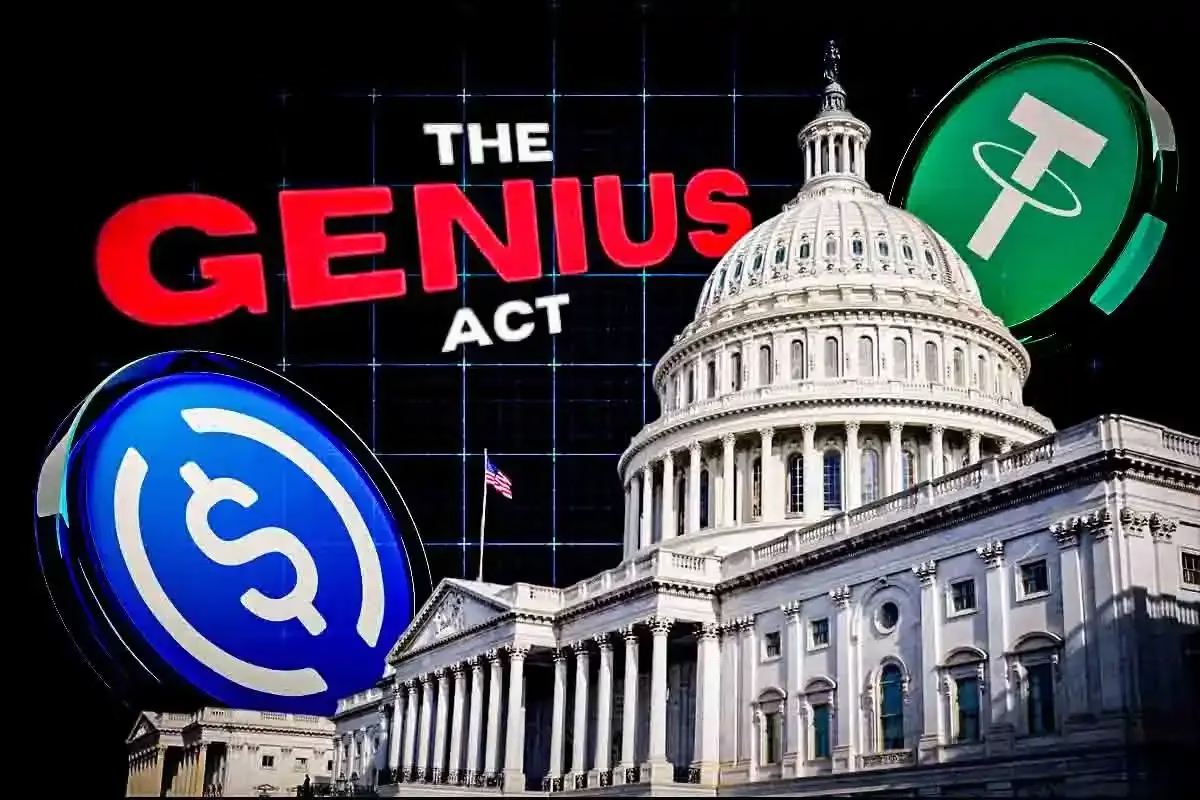
Washington is moving to put stablecoin issuers through rigorous audits. The stated goal is user protection and reserve transparency, and those are legitimate concerns.
But the structure of the GENIUS Act’s audit framework raises a harder question: whether rules designed to bring accountability to the stablecoin market will end up concentrating control over it instead.
The GENIUS Act stablecoin audit requirement is being positioned as a safeguard for users, ensuring that issuers properly back their tokens and maintain transparency. In principle, that aligns with long-standing concerns about reserve opacity in the stablecoin market.
But the structure of the GENIUS Act stablecoin audit raises a critical question: who benefits most from these rules?
By mandating stricter audit standards, the GENIUS Act stablecoin audit framework effectively raises the barrier to entry. Smaller issuers may struggle to meet compliance thresholds, while large, well-capitalized firms are better positioned to absorb the cost.
The GENIUS Act stablecoin audit is not just a reporting requirement; it introduces an operational burden that reshapes how stablecoin issuers function. Regular attestations, audit trails, and regulatory reporting frameworks require infrastructure that many startups simply do not have.
In traditional finance, similar regulatory layers have historically favored incumbents. The GENIUS Act stablecoin audit risks replicating that pattern in crypto, where innovation has typically come from smaller, more agile players.
To understand the broader implications of the GENIUS Act stablecoin audit, it’s important to recognize what stablecoins represent today. They are no longer just trading tools—they are becoming foundational infrastructure for payments, remittances, and decentralized finance.
Major issuers like Tether and Circle already process billions in daily transactions, effectively acting as private extensions of the dollar system.
With that level of influence, it’s not surprising that regulators want greater visibility. The GENIUS Act stablecoin audit provides exactly that—but at a cost.
The core issue is not the existence of audits—it’s how they are implemented. The GENIUS Act stablecoin audit framework could give regulators unprecedented insight into the inner workings of stablecoin issuers.
That level of oversight introduces a new layer of control, one that extends beyond transparency into influence over how these systems operate.
Critics argue that the GENIUS Act stablecoin audit could be used selectively, applying pressure on certain issuers while favoring others that align more closely with regulatory expectations.
The crypto industry has always operated in tension with regulation, but the GENIUS Act stablecoin audit represents a more direct intervention into how products are built and scaled.
On one hand, stronger oversight could reduce systemic risk and improve trust. On the other, it could slow innovation by forcing projects to prioritize compliance over experimentation.
There’s also a geopolitical dimension to consider. If the GENIUS Act stablecoin audit becomes too restrictive, innovation may shift to jurisdictions with more flexible frameworks.
Countries competing to become digital asset hubs may see an opportunity to attract projects pushed out by U.S. regulations.
In that sense, the GENIUS Act stablecoin audit is not just a domestic policy—it’s part of a global race to define the future of financial infrastructure.
At its core, the GENIUS Act stablecoin audit forces a fundamental question: is the goal to make stablecoins safer, or to bring them under tighter institutional control?
The answer likely sits somewhere in between. But the design of the policy suggests that control is a significant part of the equation.
The GENIUS Act stablecoin audit is not inherently negative. Greater transparency and accountability are necessary for any financial system to mature.
However, the way these rules are structured will determine whether they strengthen the ecosystem or concentrate power within it.



Copyright © 2025 - The Bit Gazette.

