


• Trending
  • Comments
  • Latest
AI People joins Dubai’s innovation one — Declares war on the forgetting of humanity

AI People joins Dubai’s Innovation One program: Declares war on the forgetting of humanity

07/22/2025 - Updated On 07/23/2025
FBI nabs Nigerian ‘tech queen’ Sapphire Egemasi in multi-million dollar fraud scheme

FBI arrests Nigerian ‘tech queen’ Sapphire Egemasi in $1.3M heist targeting U.S. government

06/05/2025 - Updated On 06/17/2025
Crypto investor and wife found dead in Dubai as police investigate possible link to digital assets

Crypto investor and wife found dead in Dubai as police investigate possible link to digital assets

11/08/2025
Polygon Discord Channel Hacked, Throws Crypto Community in Turmoil

Polygon Discord Channel Hacked, Throws Crypto Community in Turmoil

2
Bitcoin reclaims $107,000 as Iran-Israel ceasefire cools market tensions

Bitcoin reclaims $107,000 as Iran-Israel ceasefire cools market tensions

2

Hello world!

1
How an Afghan entrepreneur turned sanctions into a $60M-per-month blockchain aid platform

How an Afghan entrepreneur turned sanctions into a $60M-per-month blockchain aid platform

01/26/2026
Ethical Hacker Intercepts $2.6M Stolen Funds in Morpho Labs Hack

Derivatives platform Paradex refunds $650K after maintenance error forces first-ever chain rollback

01/25/2026
Bitwise seeks SEC approval for first-ever spot Chainlink ETF in U.S.

Bitwise introduces debasement hedge ETF as alternative to stock-bond portfolios

01/25/2026
  • Trending
  • Comments
  • Latest
AI People joins Dubai’s innovation one — Declares war on the forgetting of humanity

AI People joins Dubai’s Innovation One program: Declares war on the forgetting of humanity

07/22/2025 - Updated On 07/23/2025
FBI nabs Nigerian ‘tech queen’ Sapphire Egemasi in multi-million dollar fraud scheme

FBI arrests Nigerian ‘tech queen’ Sapphire Egemasi in $1.3M heist targeting U.S. government

06/05/2025 - Updated On 06/17/2025
Crypto investor and wife found dead in Dubai as police investigate possible link to digital assets

Crypto investor and wife found dead in Dubai as police investigate possible link to digital assets

11/08/2025
Polygon Discord Channel Hacked, Throws Crypto Community in Turmoil

Polygon Discord Channel Hacked, Throws Crypto Community in Turmoil

2
Bitcoin reclaims $107,000 as Iran-Israel ceasefire cools market tensions

Bitcoin reclaims $107,000 as Iran-Israel ceasefire cools market tensions

2

Hello world!

1
How an Afghan entrepreneur turned sanctions into a $60M-per-month blockchain aid platform

How an Afghan entrepreneur turned sanctions into a $60M-per-month blockchain aid platform

01/26/2026
Ethical Hacker Intercepts $2.6M Stolen Funds in Morpho Labs Hack

Derivatives platform Paradex refunds $650K after maintenance error forces first-ever chain rollback

01/25/2026
Bitwise seeks SEC approval for first-ever spot Chainlink ETF in U.S.

Bitwise introduces debasement hedge ETF as alternative to stock-bond portfolios

01/25/2026
Monday, January 26, 2026
  • Login
The Bit Gazette
  • Home
  • Crypto News
  • Expert Analysis
  • Finance
  • Tech
  • Sponsored
  • Press Release
  • Opinion
No Result
View All Result
The Bit Gazette
No Result
View All Result
Home Crypto News

How an Afghan entrepreneur turned sanctions into a $60M-per-month blockchain aid platform

A blockchain startup born out of Afghanistan’s financial collapse is quietly transforming how humanitarian aid reaches people in conflict zones, offering speed, transparency, and accountability where traditional systems have failed.

by Moses Edozie
2 hours ago
in Crypto News
Reading Time: 4 mins read
0
How an Afghan entrepreneur turned sanctions into a $60M-per-month blockchain aid platform

How an Afghan entrepreneur turned sanctions into a $60M-per-month blockchain aid platform

Share on FacebookShare on Twitter
Hala Mahmoud Almahmoud outside her family’s house near Ltamenah, Syria, Sept. 10, 2025. She received $500 in cryptocurrency to help restart her farm. (Emile Ducke/The New York Times)

When Hala Mahmoud Almahmoud arrived at a money changer in northwestern Syria, she carried a plastic card loaded with $500—funds meant to help her restart a farm devastated by nearly 14 years of war. She had never heard of cryptocurrency, nor did she know where the money truly came from. What mattered was that it worked.

The origin of the technology behind that card surprised her: Afghanistan.

In a country often associated with conflict, sanctions, and internet restrictions under Taliban rule, an Afghan-built blockchain platform is emerging as an unlikely tool for humanitarian innovation. The startup, HesabPay, is enabling aid groups to deliver cash assistance more efficiently in places where banks barely function and traditional remittance systems are c7ostly or unavailable.

A startup born from financial collapse

HesabPay was founded by Afghan American entrepreneur Sanzar Kakar, who previously ran Afghanistan’s leading payroll processor. That business collapsed following the U.S. withdrawal in 2021 and the Taliban’s return to power, which triggered sweeping sanctions and severed Afghanistan from much of the global financial system.
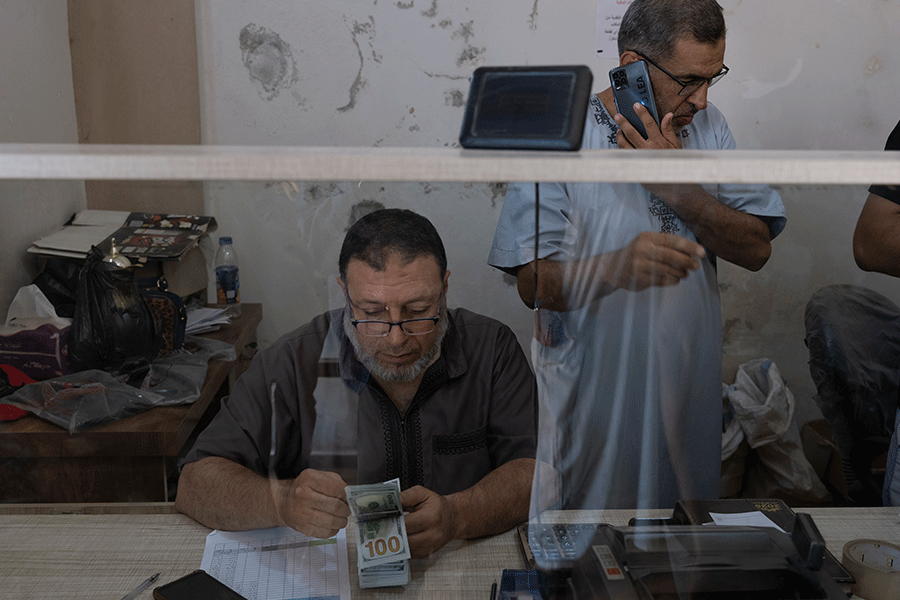
Clerks process aid payments for people in Halfaya, Syria, Sept. 10, 2025. Using blockchain made it easier for Mercy Corps to send funds to Syria, where cash is scarce and international banks generally do not do business. (Emile Ducke/The New York Times)
Clerks process aid payments for people in Halfaya, Syria, Sept. 10, 2025. (Emile Ducke/The New York Times)

“With banks paralyzed and international transfers frozen, we had to rethink how money could move,” Kakar has explained in earlier accounts of the platform’s origins.

He turned to blockchain technology, building HesabPay named after the Dari word for “account” as a mobile-based digital wallet system that allows instant peer-to-peer transfers without relying on international banks or direct government channels. Despite the Taliban’s general suspicion of the internet, Kakar said the Afghan authorities later granted HesabPay a license to operate as a regulated financial institution.

Today, HesabPay has more than 650,000 registered wallets in Afghanistan, with about 50,000 in regular use. The platform processes roughly $60 million per month, largely through stablecoins backed by the Afghan afghani.

How aid groups are using blockchain on the ground

Humanitarian organizations were quick to see the potential. The United Nations High Commissioner for Refugees (UNHCR) became an early adopter, using HesabPay to support more than 86,000 Afghan families making it one of the largest public blockchain-based aid programs globally.

Since February 2025, the U.N. has distributed nearly $25 million through about 80,000 digital wallets to vulnerable Afghans returning home.

“This helps reduce transaction fees, waiting periods and enhance traceability, real-time monitoring and accountability of transactions,” said Carmen Hett, corporate treasurer of UNHCR.

Mercy Corps, which provided the funds received by Almahmoud in Syria, partnered with HesabPay to expand the platform beyond Afghanistan. The aid group now uses it in Syria, where cash shortages, international banking restrictions, and high remittance fees sometimes reaching 10% make traditional transfers difficult. Programs for Sudan and Haiti are currently in development.

By using blockchain-based transfers, Mercy Corps can bypass many of the logistical and financial bottlenecks that slow aid delivery in conflict zones.

Transparency, trust, and the risks involved

Aid organizations have increasingly shifted toward cash assistance as a more dignified and flexible way to help people meet their own needs. But cash-based aid comes with a major drawback: limited traceability. Donors want proof that funds reach the intended recipients.

Blockchain technology offers a solution by creating a digital trail that records when funds are sent, to whom, and how they are used.

“That mix of speed and accountability could be a way to win back trust from those who have come to doubt the usefulness of aid,” said Scott Onder, chief investment officer at Mercy Corps.

HesabPay includes compliance tools such as real-time dashboards that monitor wallet activity and cross-check transactions against international sanctions and fraud databases. According to the company, the system is designed to flag potential money laundering, terrorist financing, or scam activity as it happens.

From a donor perspective, that visibility is crucial.

“A system that can automatically flag a fraud risk means you can check it out immediately instead of waiting six months for a report,” said Nigel Pont, HesabPay’s senior adviser for humanitarian affairs and a former Mercy Corps executive.

Still, experts caution that blockchain-based aid systems are not risk-free. Ric Shreves, president of the Decentralized Cooperation Foundation, noted that digital wallets especially those tied to local-currency stablecoins can theoretically be frozen for political or regulatory reasons. While digital currencies are often safer than carrying cash, he said, they cannot simply be hidden away.

A glimpse of the future of aid delivery

For recipients like Abdul Halim Hasan, a 22-year-old Syrian who lost his leg after driving over a land mine, the technology represents more than innovation it represents access.

“I want to see this method spread in Syria,” Hasan said as he waited to cash out his HesabPay balance. “For now, it’s enough that it helps me start again.”

As international aid budgets shrink and scrutiny over effectiveness grows, platforms like HesabPay highlight how crypto and blockchain technology are finding practical, non-speculative use cases. In one of the world’s most isolated countries, a financial tool built out of necessity is quietly reshaping how aid reaches some of the world’s most vulnerable people.

This article is adapted from reporting by Aryn Baker, originally published by The New York Times News Service on January 24, 2026. Adapted with additional context for Bit Gazette.


Tags: Afghanistanaid transparencyblockchainconflict zonescryptoCryptocurrencydigital walletsfinancial inclusionfintechHesabPayhumanitarian aidMercy CorpssanctionsstablecoinsUNHCR
Share196Tweet123
Moses Edozie

Moses Edozie

Moses Edozie is a writer and storyteller with a deep interest in cryptocurrency, blockchain innovation, and Web3 culture. Passionate about DeFi, NFTs, and the societal impact of decentralized systems, he creates clear, engaging narratives that connect complex technologies to everyday life.

  • Trending
  • Comments
  • Latest
AI People joins Dubai’s innovation one — Declares war on the forgetting of humanity

AI People joins Dubai’s Innovation One program: Declares war on the forgetting of humanity

07/22/2025 - Updated On 07/23/2025
FBI nabs Nigerian ‘tech queen’ Sapphire Egemasi in multi-million dollar fraud scheme

FBI arrests Nigerian ‘tech queen’ Sapphire Egemasi in $1.3M heist targeting U.S. government

06/05/2025 - Updated On 06/17/2025
Crypto investor and wife found dead in Dubai as police investigate possible link to digital assets

Crypto investor and wife found dead in Dubai as police investigate possible link to digital assets

11/08/2025
Polygon Discord Channel Hacked, Throws Crypto Community in Turmoil

Polygon Discord Channel Hacked, Throws Crypto Community in Turmoil

2
Bitcoin reclaims $107,000 as Iran-Israel ceasefire cools market tensions

Bitcoin reclaims $107,000 as Iran-Israel ceasefire cools market tensions

2

Hello world!

1
How an Afghan entrepreneur turned sanctions into a $60M-per-month blockchain aid platform

How an Afghan entrepreneur turned sanctions into a $60M-per-month blockchain aid platform

01/26/2026
Ethical Hacker Intercepts $2.6M Stolen Funds in Morpho Labs Hack

Derivatives platform Paradex refunds $650K after maintenance error forces first-ever chain rollback

01/25/2026
Bitwise seeks SEC approval for first-ever spot Chainlink ETF in U.S.

Bitwise introduces debasement hedge ETF as alternative to stock-bond portfolios

01/25/2026
No Result
View All Result
  • Home
  • Crypto News
  • Expert Analysis
  • Finance
  • Tech
  • Sponsored
  • Press Release
  • Opinion

Copyright © 2025 - The Bit Gazette.

Are you sure want to unlock this post?
Unlock left : 0
Are you sure want to cancel subscription?