Atomic swap technology is rapidly gaining attention as one of the most practical innovations in the cryptocurrency sector. By allowing users to trade digital assets directly—without relying on centralized platforms—Atomic swap is reshaping how value moves across blockchains.
At its core, Atomic swap removes intermediaries entirely. This means traders no longer need to trust exchanges with custody of their funds, significantly reducing exposure to hacks, withdrawal freezes, or platform failures. Instead, transactions are executed peer-to-peer using cryptographic protocols designed to guarantee fairness.
Atomic swap
What Is Atomic Swap?
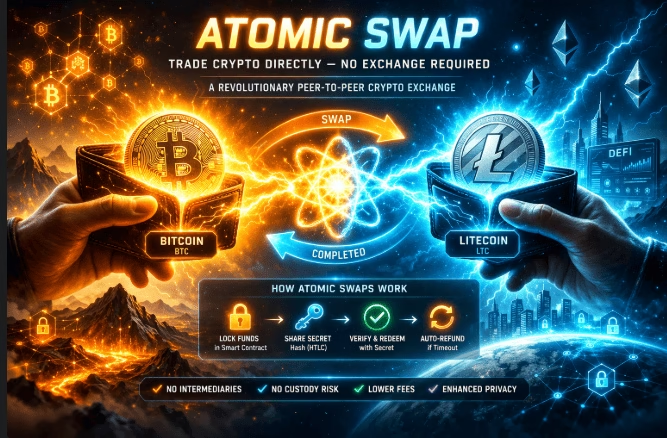
An Atomic swap is a method that enables two users to exchange different cryptocurrencies directly from their wallets. For instance, a holder of Bitcoin can trade with someone holding Litecoin without ever touching an exchange.
The term “atomic” reflects the transaction’s structure: it either completes fully or not at all. There is no middle ground. This all-or-nothing mechanism ensures that neither party can lose funds if the other fails to follow through.
According to Andreas M. Antonopoulos, “Trustless systems are the backbone of blockchain innovation,” a principle that Atomic swap technology embodies by design.
How Atomic Swap Works
Atomic swap transactions rely on a cryptographic framework known as a Hash Time-Locked Contract (HTLC). While the term may sound complex, the process follows a clear sequence.
First, one participant generates a secret cryptographic hash and shares it with the counterparty. Next, both parties lock their respective funds into smart contracts tied to that same hash. When one party claims the funds, the secret is revealed, enabling the other participant to unlock their share.
A built-in timeout feature ensures protection. If the transaction is not completed within a predefined period, both parties automatically recover their funds. This makes Atomic swap highly resistant to fraud or manipulation.
As Vitalik Buterin has noted in discussions around decentralized systems, “Mechanisms that reduce reliance on intermediaries are essential for long-term scalability and trust.” Atomic swap fits squarely into that vision.
Types of Atomic Swap
Atomic swap can be executed in two primary ways, depending on the infrastructure used.
On-chain Atomic swap occurs directly on the blockchain networks of the assets involved. While highly secure, these transactions may take longer due to network confirmation times.
Off-chain Atomic swap, on the other hand, leverages layer-2 solutions such as the Lightning Network. This approach enables near-instant transactions at a fraction of the cost, making it more practical for frequent trading.
Both approaches reinforce the flexibility of Atomic swap, allowing users to choose between maximum security and maximum speed.
Benefits and Limitations of Atomic Swap
The advantages of Atomic swap are substantial. First, it eliminates intermediaries, giving users full control over their assets at all times. Second, it reduces costs by removing exchange fees, which can accumulate significantly for active traders. Third, it enhances security by ensuring funds are never held by a third party. Finally, Atomic swap improves privacy, as it avoids the extensive identity verification processes required by centralized platforms.
However, the technology is not without challenges. Atomic swap currently supports a limited number of cryptocurrencies, as compatibility depends on shared cryptographic standards. The setup process can also be technically demanding, particularly for beginners. Additionally, liquidity remains a hurdle, as users must find a counterparty willing to execute the exact trade.
Why Atomic Swap Matters
Atomic swap represents a major step toward true decentralization in financial systems. By removing centralized exchanges from the equation, Atomic swap aligns with the original vision of blockchain—peer-to-peer transactions that operate without trust.
Industry observers believe that as interfaces improve and adoption expands, Atomic swap could become a foundational component of decentralized finance. Its ability to facilitate secure, direct trading positions it as a key building block for the next generation of crypto infrastructure.
Final Take
Atomic swap is more than a technical upgrade—it is a structural shift in how digital assets are exchanged. While still evolving, Atomic swap offers a glimpse into a future where users trade freely, securely, and without intermediaries.
For traders seeking greater autonomy and reduced risk, Atomic swap is a development worth close attention as the technology continues to mature.