






- Trending
- Comments
- Latest

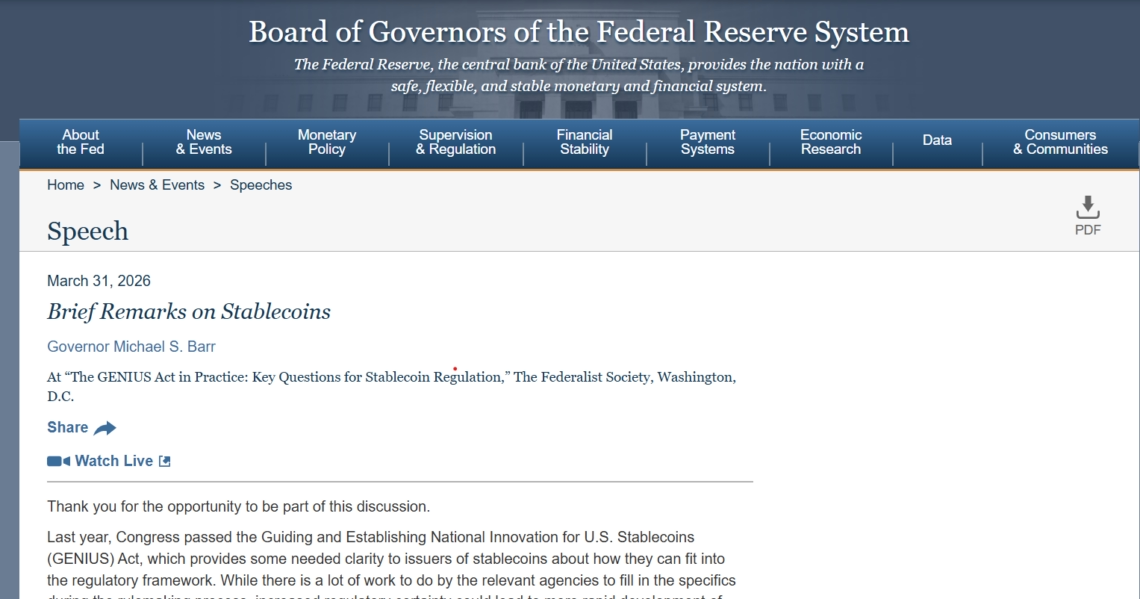
Federal Reserve Vice Chair for Supervision Michael Barr has warned that the GENIUS Act’s stablecoin framework could trigger bank-like runs if regulators fail to enforce strict reserve and redemption standards during the law’s critical implementation phase.
Speaking at an event organized by the Federalist Society, Barr said that while US stablecoin rules offer long-awaited clarity for issuers, the real test lies in how regulators enforce them. “A great deal will depend on how federal and state regulators implement the statute,” he noted, highlighting the complexity surrounding US stablecoin rules.
As the crypto industry matures, US stablecoin rules are increasingly viewed as essential infrastructure for broader adoption. Barr acknowledged that stablecoins currently serve as a backbone for crypto trading and as a digital dollar alternative in international markets. However, he emphasized that US stablecoin rules could unlock far more—ranging from faster remittances to streamlined trade finance and improved treasury management for businesses.
Despite this potential, Barr stressed that US stablecoin rules must address structural vulnerabilities. One key concern is the ability of bad actors to acquire stablecoins on secondary markets without proper identity verification, raising concerns about illicit finance.

He also warned that issuers might take excessive risks in pursuit of higher returns on reserve assets. “There may be incentives to stretch for yield,” Barr said, adding that weak reserve practices could erode confidence during periods of market stress. In this context, US stablecoin rules must ensure that reserves remain liquid and secure under all conditions.
Barr placed the discussion around US stablecoin rules within a broader historical framework, pointing to past financial crises triggered by fragile private money systems. He referenced the Panic of 1907 and the 2008 Global Financial Crisis as examples of how liquidity mismatches can escalate into systemic failures.
He also cited stress events during the COVID-19 pandemic, when money market funds faced redemption pressures, as a modern reminder of the risks tied to assets marketed as stable. According to Barr, US stablecoin rules must avoid repeating these failures by ensuring that redemption promises are credible and enforceable.
“Private money has a long and painful history when safeguards are weak,” he said, reinforcing the importance of strong US stablecoin rules.
With the GENIUS Act now signed into law, US regulators are entering the rulemaking phase that will define how US stablecoin rules operate in practice. The U.S. Department of the Treasury has already initiated additional rounds of public consultation, signaling that the process will involve extensive industry input.
Meanwhile, Michelle Bowman confirmed that banking regulators are developing capital and liquidity requirements tailored to stablecoin issuers. At the same time, Travis Hill indicated that stablecoins are unlikely to receive deposit insurance under current US stablecoin rules.
These developments highlight the balancing act regulators face. Without deposit insurance, stablecoin issuers must rely entirely on robust reserves and operational safeguards to maintain trust, making the design of US stablecoin rules even more critical.
Barr outlined several areas where US stablecoin rules will face significant debate. These include the composition of reserve assets, the risk of regulatory arbitrage between jurisdictions, and the scope of activities issuers can engage in beyond minting and redemption.
Anti-Money Laundering compliance is another major focus. Regulators are expected to tighten identity requirements to prevent misuse, ensuring that US stablecoin rules address gaps that could be exploited by illicit actors.
Consumer protection is also high on the agenda. Clear disclosure requirements, redemption rights, and operational transparency will likely play a central role in shaping US stablecoin rules.
Barr emphasized that these unresolved issues will determine whether stablecoins can scale safely. “The implementation phase will test the strength of these safeguards,” he said.
The GENIUS Act, enacted in July 2025, established the first comprehensive federal framework for payment stablecoins in the United States. It requires issuers to maintain one-to-one backing with high-quality assets such as U.S. dollars and short-term Treasury securities.
The law is expected to come into force within 18 months of its signing or shortly after final regulations are completed. This timeline places pressure on agencies to finalize US stablecoin rules that both support innovation and mitigate risk.
Industry participants have largely welcomed the clarity provided by the GENIUS Act, but concerns remain about how strict enforcement could impact competitiveness. Some fear that overly rigid US stablecoin rules could push innovation offshore, while others argue that strong safeguards are necessary to build long-term trust.
The rollout of US stablecoin rules comes at a time when stablecoins are becoming increasingly central to both crypto markets and traditional finance. Their ability to facilitate instant, low-cost transactions has made them a key component of digital finance infrastructure.
Barr’s remarks suggest that regulators are aware of both the opportunity and the risk. By emphasizing caution alongside optimism, he framed US stablecoin rules as a pivotal moment for the industry.
Ultimately, the success of US stablecoin rules will depend on execution. If regulators strike the right balance, the framework could accelerate adoption and strengthen market integrity. If not, the risks outlined by Barr—ranging from bank-like runs to weak reserves—could undermine confidence in one of crypto’s most important sectors.



Copyright © 2025 - The Bit Gazette.