

- Trending
- Comments
- Latest

Bhutan will deploy 10,000 Bitcoin—worth approximately $875 million and representing 89% of its national cryptocurrency reserves—to finance the Gelephu Mindfulness City, a special economic zone under construction in southern Bhutan near the Indian border.
The Himalayan kingdom, which holds an estimated 11,286 Bitcoin accumulated largely through state-run renewable energy mining operations, said the funds would support infrastructure development over the next 20 years as part of efforts to slow youth emigration and establish a regional tech and finance hub.
The Bitcoin development pledge is closely tied to the Gelephu Mindfulness City (GMC), launched in 2024 as Bhutan’s new economic hub. The city was conceived to slow the outward migration of young Bhutanese by creating high-value jobs across finance, tourism, green energy, healthcare, agriculture and technology.
Spanning roughly 1,544 square miles — about 10% of the country’s land area — GMC offers regulatory flexibility for crypto and fintech firms and serves as a focal point for Bhutan’s existing Bitcoin mining activities.
Under the Bitcoin development pledge, 10,000 Bitcoin, valued at about $875 million at current prices, will be strategically deployed to support the city’s long-term buildout.
Bhutan said a range of approaches is under consideration, including risk-managed yield strategies, treasury management frameworks and long-term holding plans. The emphasis, officials said, is on sustainability rather than short-term liquidation.
“The priority will be to preserve the long-term potential of Bitcoin while ensuring development proceeds stably and sustainably,” the government said. “Bitcoin’s enduring strength lies in its ability to compound value over time.”
Officials stressed that the Bitcoin development pledge would be governed by strict oversight and transparency measures. According to the government, any use of Bitcoin reserves will be guided by capital preservation principles, clear accountability structures and prudent risk management.
“Any use of Bitcoin will be guided by strong governance and prudence, with an emphasis on capital preservation, appropriate oversight, and transparency,” the statement added.
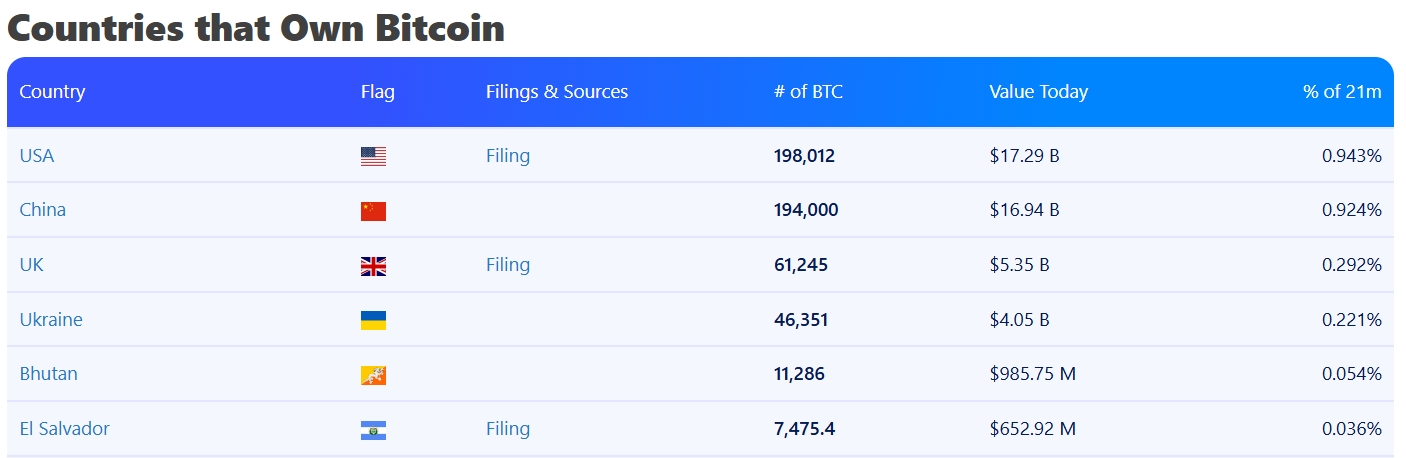
Bhutan’s approach stands out among sovereign Bitcoin holders. Data from Bitbo estimates the kingdom holds around 11,286 Bitcoin in total — worth more than $986 million — largely accumulated through state-backed mining operations powered by renewable energy.
That places Bhutan as the fifth-largest known national holder of Bitcoin globally, behind countries such as the United States.
For crypto investors and policymakers, the Bitcoin development pledge signals a rare example of a government framing Bitcoin not as a speculative asset, but as a strategic reserve tied to long-term national planning.
The Bitcoin development pledge is part of a broader national Bitcoin development policy aimed at aligning digital asset holdings with Bhutan’s economic philosophy, which emphasizes sustainability and collective well-being.
King Jigme Khesar Namgyel Wangchuck has framed the Gelephu project as a vehicle for inclusive growth, ensuring that development benefits extend beyond a narrow segment of society.
“We are therefore developing a new land policy that protects landowners, prevents widening disparities, and ensures shared national prosperity,” — King Jigme Khesar Namgyel Wangchuck, King of Bhutan, said.
He likened the city’s structure to a corporate model with shared ownership.
“Think of GMC as a company and landowners as its shareholders. Since most land is state-owned, Bhutanese from all Dzongkhags will share in its success,” — King Jigme Khesar Namgyel Wangchuck added.
A master plan and legal framework for the city have already been released, alongside the appointment of a governor and a board of directors. Construction work is underway to prepare sites for phased development over the next 20 years.
Beyond infrastructure, the Bitcoin development pledge supports a broader experiment in digital finance. GMC already enables crypto-based payments across merchants and tourism services and has launched TER, a sovereign-backed digital token linked to physical gold.
Bhutan envisions the city as an economic corridor connecting South Asia and Southeast Asia, with executive autonomy and legal independence designed to attract global investors while maintaining national control.
For policymakers watching closely, the pledge offers a test case for whether sovereign Bitcoin reserves can be mobilized responsibly without undermining fiscal stability.
As governments worldwide debate how to regulate and adopt digital assets, Bhutan’s Bitcoin development pledge positions the small kingdom as an outlier — one that is betting that disciplined governance, renewable energy and long-term thinking can turn Bitcoin into a cornerstone of national development rather than a source of volatility.



Copyright © 2025 - The Bit Gazette.