





- Trending
- Comments
- Latest

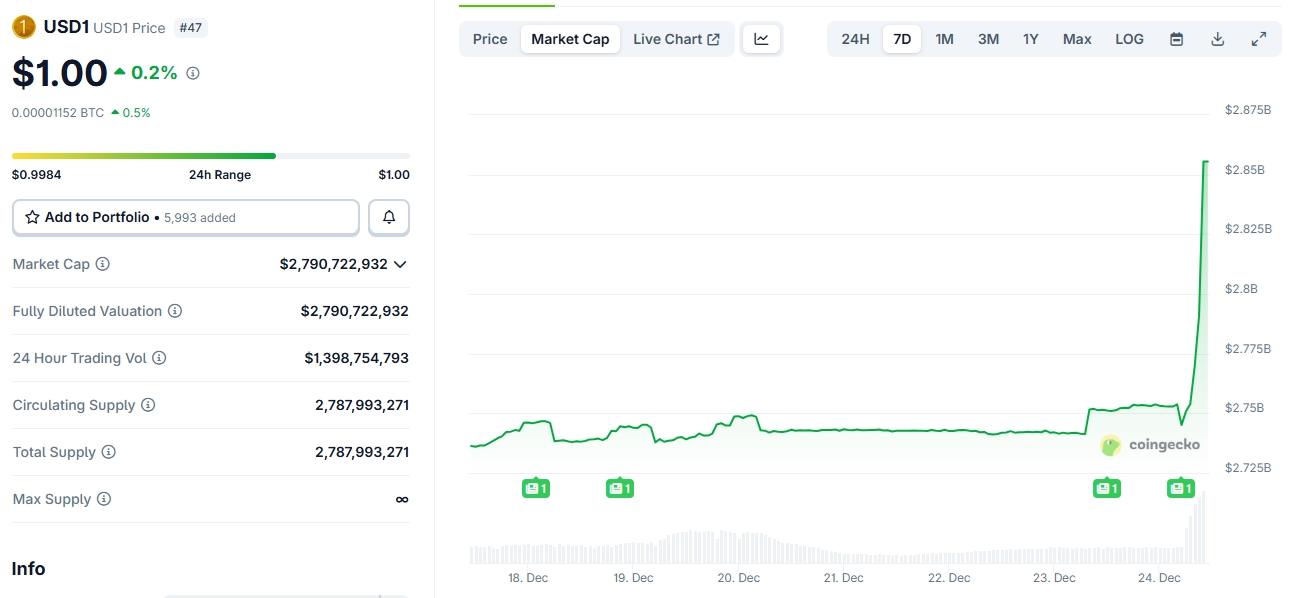
Binance launched a 20% annualized yield program for the USD1 stablecoin on December 24, triggering a same-day supply expansion of more than 45 million tokens—approximately 1.6% of total circulation.
The limited-time offer, capped at 50,000 USD1 deposits through January 23, pushed USD1’s total supply to roughly $2.79 billion while daily trading volumes spiked to a one-month high of $1.39 billion across exchanges.
The immediate catalyst for USD1’s supply growth was its inclusion in Binance’s Booster and Earn programs, where the usd1 yield product is being offered to users willing to lock deposits for a fixed period. According to details released with the program, subscriptions are capped at 50,000 USD1 deposits and run from Dec. 24, 2025, to Jan. 23, 2026.
“The program is limited to 50,000 USD1 deposits and offers a 20% annualized yield,” Binance noted in the product description accompanying the launch of the usd1 yield product.
The incentive mirrors similar yield campaigns Binance has used in the past to jumpstart liquidity for new or expanding assets within its ecosystem.
USD1 is currently accessible on Binance through the USD1/USDT trading pair, as well as via the platform’s P2P Express market. Existing holders can also transfer tokens into their Binance accounts to participate in the usd1 yield product, lowering barriers to entry for both retail and larger participants.
Market response to the usd1 yield product was swift. Following the minting of more than 45 million new tokens, USD1 trading volumes climbed to a one-month high, reaching approximately $1.39 billion in daily turnover. On Binance alone, more than $150 million in buy orders appeared on the USD1/USDT pair shortly after the yield announcement.
“The newly injected supply coincided with sudden investor interest,” data accompanying the market update showed, pointing to heightened demand driven by the usd1 yield product rather than organic payment or settlement use.
Analysts tracking stablecoin flows say this pattern reflects a broader shift in crypto markets, where yield-bearing stablecoins are increasingly favored over higher-risk narratives.
Large investors, in particular, have gravitated toward highly liquid platforms and predictable returns, making programs like the usd1 yield product especially attractive during periods of market uncertainty.
While Binance now dominates USD1 spot trading, most of the stablecoin’s supply remains active on the BNB Chain, with a total float exceeding $2.85 billion.
Beyond centralized exchange offerings, USD1 is already integrated into several decentralized finance protocols, including PancakeSwap, Uniswap, and Venus Protocol, though yields on those platforms are significantly lower than those offered through the usd1 yield product on Binance.
“The addition to Binance’s official yield program will give the token more exposure,” the project’s ecosystem update stated, underscoring how centralized platforms can amplify demand far more quickly than decentralized alternatives.
Before the yield launch, USD1 had been widely used as a base asset in meme-token trading pairs on Binance.
While those pairs once generated intense activity, extreme volatility eventually pushed many users away. The usd1 yield product now positions the stablecoin as a lower-volatility option with predictable, daily-accruing returns.
The growing footprint of the usd1 yield product has also revived discussion around the future of World Liberty Fi, the issuer behind USD1. WLFI is expected to launch a consumer-facing app in early 2026, a move that could reintroduce the WLFI token to a broader audience.
As of Dec. 24, WLFI traded above $0.13, recovering modestly from a recent low near $0.12. However, previous buyback efforts failed to generate sustained momentum, raising questions about whether the success of the usd1 yield product will translate into lasting value for the broader WLFI ecosystem.



Copyright © 2025 - The Bit Gazette.