






- Trending
- Comments
- Latest

Bitcoin ATM scams cost Americans more than $333 million between January and November 2025, according to data released by the Federal Bureau of Investigation, representing a 33% increase from the roughly $250 million lost in 2024.
The losses, detailed in the FBI’s Internet Crime Complaint Center annual report, reflect growing exploitation of cryptocurrency kiosks by scammers who use social engineering tactics to pressure victims into making irreversible payments, the agency said.
“These schemes are not slowing down,” the FBI said in its public advisory, noting that criminals are increasingly targeting older adults and individuals with limited familiarity with digital assets.
The agency added that once funds are transferred through a kiosk, recovery is extremely difficult due to the immutable nature of blockchain transactions.
According to the FBI, Bitcoin ATM scams frequently rely on social engineering tactics designed to create urgency and fear. Victims are commonly contacted by individuals posing as representatives of government agencies, banks or well known companies.
Scammers often claim that immediate payment is required to resolve legal issues, prevent account closures or stop fraudulent activity.
In many cases, victims are instructed to withdraw cash and deposit it into a nearby Bitcoin ATM, then send the cryptocurrency to a wallet address controlled by the scammer. The FBI explained that these transactions are intentionally structured to bypass traditional banking safeguards that might otherwise flag suspicious activity.
“Criminals know that once cryptocurrency is sent, it is nearly impossible to reverse,” said Cynthia Kaiser, Assistant Director of the FBI’s Criminal Investigative Division, in comments published via the FBI Internet Crime Complaint Center. “That finality is what makes Bitcoin ATM scams so attractive to fraudsters.”
The agency also noted that scammers frequently remain on the phone with victims throughout the process, coaching them step by step and discouraging them from seeking advice from family members, bank employees or law enforcement.
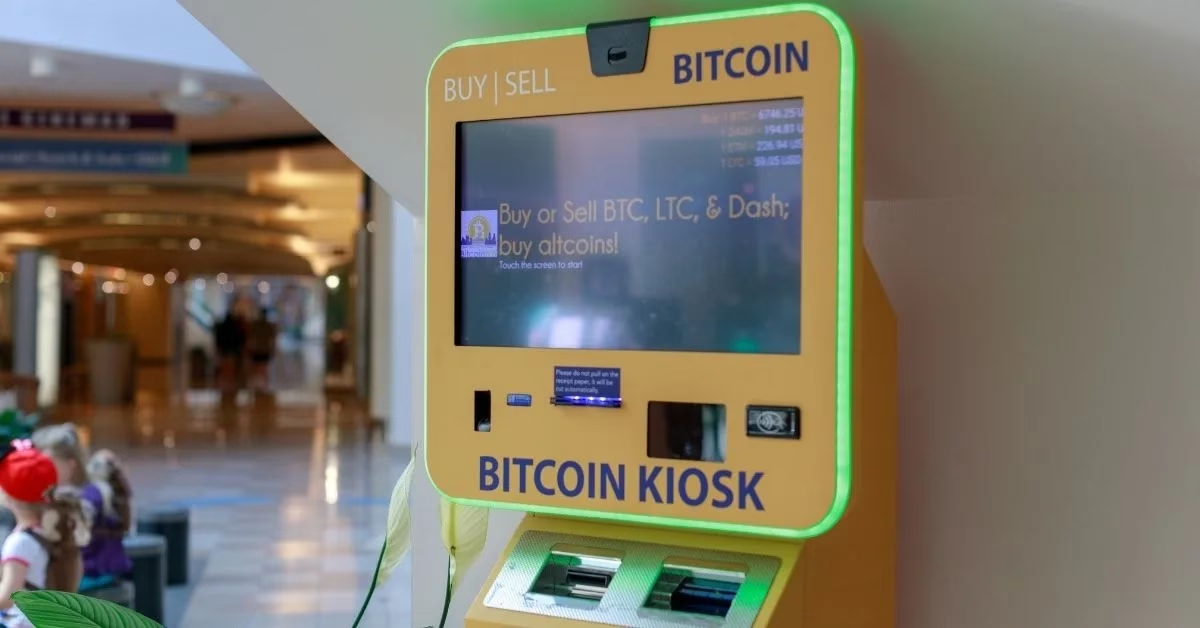
The rapid expansion of cryptocurrency kiosks has played a central role in the growth of Bitcoin ATM scams. According to data compiled by Coin ATM Radar, more than 45,000 Bitcoin ATMs are currently operating across the United States, making the country the largest market for crypto kiosks globally.
While these machines were initially marketed as tools for financial inclusion and convenient access to digital assets, regulators and consumer advocates have increasingly warned that their widespread availability has created new attack surfaces for fraud.
“Every new kiosk increases the pool of potential victims,” said John Breyault, Vice President of Public Policy at the National Consumers League, in remarks shared with The Guardian. “Bitcoin ATM scams thrive because the machines look legitimate and familiar, even though the transaction mechanics are very different from traditional banking.”
Several US states have begun exploring stricter disclosure requirements and transaction limits for crypto kiosks. Some proposals include mandatory fraud warnings on ATM screens, cooling off periods for large transactions and enhanced reporting obligations for operators.
The FBI emphasized that public awareness remains one of the most effective tools for reducing Bitcoin ATM scams. The agency urged consumers to treat any unsolicited request for payment via cryptocurrency as a major red flag, especially when accompanied by threats or time pressure.
“No legitimate government agency or financial institution will demand payment through a Bitcoin ATM,” the FBI stated in its advisory. The agency encouraged individuals who encounter suspected Bitcoin ATM scams to immediately stop the transaction and report the incident through the IC3 reporting portal.
Financial regulators have echoed these warnings, stressing that education must keep pace with technological adoption. As cryptocurrency infrastructure becomes more visible in everyday environments such as convenience stores and shopping centers, scammers are likely to continue refining their tactics.
Despite growing scrutiny, Bitcoin ATM scams remain one of the fastest growing forms of crypto related fraud in the United States. With losses already exceeding hundreds of millions of dollars this year, authorities say sustained cooperation between law enforcement, operators and the public will be critical to curbing further harm.
As the FBI data makes clear, the convenience that draws users to crypto kiosks is the same feature that criminals exploit, turning Bitcoin ATM scams into a costly threat for unsuspecting Americans.



Copyright © 2025 - The Bit Gazette.