






• Trending
  • Comments
  • Latest
AI People joins Dubai’s innovation one — Declares war on the forgetting of humanity

AI People joins Dubai’s Innovation One program: Declares war on the forgetting of humanity

07/22/2025 - Updated On 07/23/2025
FBI nabs Nigerian ‘tech queen’ Sapphire Egemasi in multi-million dollar fraud scheme

FBI arrests Nigerian ‘tech queen’ Sapphire Egemasi in $1.3M heist targeting U.S. government

06/05/2025 - Updated On 06/17/2025
Crypto investor and wife found dead in Dubai as police investigate possible link to digital assets

Crypto investor and wife found dead in Dubai as police investigate possible link to digital assets

11/08/2025
Polygon Discord Channel Hacked, Throws Crypto Community in Turmoil

Polygon Discord Channel Hacked, Throws Crypto Community in Turmoil

2
Bitcoin reclaims $107,000 as Iran-Israel ceasefire cools market tensions

Bitcoin reclaims $107,000 as Iran-Israel ceasefire cools market tensions

2

Hello world!

1
Wyoming Crypto Bank petition headlines a rapidly intensifying legal confrontation that could reshape how crypto banks access the U.S. financial system. Wyoming-chartered Custodia Bank has formally petitioned the full Tenth Circuit Court of Appeals to review the Federal Reserve’s denial of its master account, escalating a five-year fight with sweeping implications for federal power, state banking authority, and digital asset innovation. Wyoming Crypto Bank petition filings submitted on December 15 request an en banc review, asking all active judges on the Tenth Circuit to reconsider an October panel ruling that upheld the Fed’s decision. Custodia argues the panel misread federal law and endorsed a system that grants regional Federal Reserve Banks unchecked discretion over legally eligible state-chartered institutions. Wyoming Crypto Bank Petition Challenges Fed’s Master Account Authority At the heart of the Wyoming Crypto Bank petition is the Federal Reserve’s refusal to grant Custodia access to a master account—an essential gateway to core payment rails such as wire transfers and automated clearinghouse (ACH) services. Without it, Custodia says its Wyoming-issued charter is effectively rendered meaningless. Custodia contends the ruling conflicts directly with the Monetary Control Act (MCA), which states that Federal Reserve services shall be available to nonmember depository institutions. The bank argues the Fed has transformed that mandate into what it calls an unconstitutional veto over state banking decisions. When the Fed denies a master account to a state-chartered financial institution, it effectively vetoes a bank charter that State regulators have approved, Custodia wrote in its petition. State Banking Authority Under Threat The Wyoming Crypto Bank petition also raises serious federalism concerns. Wyoming chartered Custodia in 2020 as a Special Purpose Depository Institution (SPDI), a regulatory framework specifically designed to attract digital asset firms while minimizing systemic risk through 100% reserve backing and a prohibition on lending. Custodia argues the Fed’s rejection undermines Wyoming’s carefully constructed regulatory regime and erodes states’ constitutional authority to charter banks. The petition warns that allowing the Fed such power could discourage innovation-driven state banking models nationwide. Constitutional Red Flags in the Wyoming Crypto Bank Petition Beyond federalism, the Wyoming Crypto Bank petition pushes into constitutional territory. Custodia’s legal team argues that if regional Federal Reserve Bank presidents possess unreviewable discretion over master accounts, they effectively function as “Officers of the United States” without proper constitutional appointment. Federal Reserve Bank presidents are selected by private bank directors and approved by the Board of Governors. Custodia says that structure violates the Appointments Clause if those officials wield significant executive authority. Judicial Split Deepens Over Wyoming Crypto Bank Petition The petition highlights a growing divide within the Tenth Circuit itself. Judge Timothy Tymkovich’s dissent in Custodia’s case aligns with Judge Robert Bacharach’s earlier opinion in Fourth Corner Credit Union v. Federal Reserve Bank of Kansas City, creating a 2-2 split among circuit judges. Tymkovich warned that the Fed’s interpretation grants “unreviewable discretion” that contradicts the plain language of the MCA and raises “thorny questions” under Article II of the Constitution. Fed’s Own Records Undermine Denial Rationale The Wyoming Crypto Bank petition also points to contradictions within the Federal Reserve’s own process. The Kansas City Fed denied Custodia’s application in January 2023 after a 27-month review, citing risks tied to “crypto-asset activities.” Yet internal documents show Fed staff initially found Custodia’s capital levels “adequate” and praised its leadership as “impressive.” Custodia says the decision only shifted after intervention by the Board of Governors. Federal Reserve Governor Christopher Waller later acknowledged publicly that the Fed has sufficient supervisory tools to manage risk without blanket denials. In an October interview, Waller said the Fed can “tailor” master account structures to fit a bank’s specific risk profile. Wyoming Crypto Bank Petition Lands Amid Crypto Debanking Reckoning The Wyoming Crypto Bank petition arrives as regulators face mounting scrutiny over crypto debanking. In December, the Office of the Comptroller of the Currency revealed that all nine of the largest U.S. banks imposed “inappropriate” restrictions on lawful businesses, including digital asset firms, between 2020 and 2023. Institutions such as JPMorgan Chase, Bank of America, Citibank, and Wells Fargo maintained internal policies that escalated or restricted entire sectors, reinforcing claims of systemic exclusion. If the full Tenth Circuit agrees to hear the Wyoming Crypto Bank petition, the outcome could redefine the balance of power between state banking regulators and the Federal Reserve—setting a precedent that reaches far beyond Custodia and Wyoming. For the crypto industry, the case may determine whether compliance-focused digital asset banks can ever gain equal footing within the U.S. financial system.Wyoming Crypto Bank Petition Sparks High-Stakes Legal Showdown as Fed Power Faces Fierce Constitutional Test

Wyoming-chartered Custodia Bank challenges Federal Reserve’s master account veto power

12/16/2025
DWF Labs is placing a bold bet on the transformative power of AI agents | Photo: freepik

Whale dumps AI agent tokens at 90%+ loss, exposing thin liquidity in niche markets

12/16/2025
Solana disinflation Ross Ulbricht Loses $12M in Solana Token Loss Due to Liquidity Error

Solana survives one of internet’s largest DDoS attacks with no downtime

12/16/2025
  • Trending
  • Comments
  • Latest
AI People joins Dubai’s innovation one — Declares war on the forgetting of humanity

AI People joins Dubai’s Innovation One program: Declares war on the forgetting of humanity

07/22/2025 - Updated On 07/23/2025
FBI nabs Nigerian ‘tech queen’ Sapphire Egemasi in multi-million dollar fraud scheme

FBI arrests Nigerian ‘tech queen’ Sapphire Egemasi in $1.3M heist targeting U.S. government

06/05/2025 - Updated On 06/17/2025
Crypto investor and wife found dead in Dubai as police investigate possible link to digital assets

Crypto investor and wife found dead in Dubai as police investigate possible link to digital assets

11/08/2025
Polygon Discord Channel Hacked, Throws Crypto Community in Turmoil

Polygon Discord Channel Hacked, Throws Crypto Community in Turmoil

2
Bitcoin reclaims $107,000 as Iran-Israel ceasefire cools market tensions

Bitcoin reclaims $107,000 as Iran-Israel ceasefire cools market tensions

2

Hello world!

1
Wyoming Crypto Bank petition headlines a rapidly intensifying legal confrontation that could reshape how crypto banks access the U.S. financial system. Wyoming-chartered Custodia Bank has formally petitioned the full Tenth Circuit Court of Appeals to review the Federal Reserve’s denial of its master account, escalating a five-year fight with sweeping implications for federal power, state banking authority, and digital asset innovation. Wyoming Crypto Bank petition filings submitted on December 15 request an en banc review, asking all active judges on the Tenth Circuit to reconsider an October panel ruling that upheld the Fed’s decision. Custodia argues the panel misread federal law and endorsed a system that grants regional Federal Reserve Banks unchecked discretion over legally eligible state-chartered institutions. Wyoming Crypto Bank Petition Challenges Fed’s Master Account Authority At the heart of the Wyoming Crypto Bank petition is the Federal Reserve’s refusal to grant Custodia access to a master account—an essential gateway to core payment rails such as wire transfers and automated clearinghouse (ACH) services. Without it, Custodia says its Wyoming-issued charter is effectively rendered meaningless. Custodia contends the ruling conflicts directly with the Monetary Control Act (MCA), which states that Federal Reserve services shall be available to nonmember depository institutions. The bank argues the Fed has transformed that mandate into what it calls an unconstitutional veto over state banking decisions. When the Fed denies a master account to a state-chartered financial institution, it effectively vetoes a bank charter that State regulators have approved, Custodia wrote in its petition. State Banking Authority Under Threat The Wyoming Crypto Bank petition also raises serious federalism concerns. Wyoming chartered Custodia in 2020 as a Special Purpose Depository Institution (SPDI), a regulatory framework specifically designed to attract digital asset firms while minimizing systemic risk through 100% reserve backing and a prohibition on lending. Custodia argues the Fed’s rejection undermines Wyoming’s carefully constructed regulatory regime and erodes states’ constitutional authority to charter banks. The petition warns that allowing the Fed such power could discourage innovation-driven state banking models nationwide. Constitutional Red Flags in the Wyoming Crypto Bank Petition Beyond federalism, the Wyoming Crypto Bank petition pushes into constitutional territory. Custodia’s legal team argues that if regional Federal Reserve Bank presidents possess unreviewable discretion over master accounts, they effectively function as “Officers of the United States” without proper constitutional appointment. Federal Reserve Bank presidents are selected by private bank directors and approved by the Board of Governors. Custodia says that structure violates the Appointments Clause if those officials wield significant executive authority. Judicial Split Deepens Over Wyoming Crypto Bank Petition The petition highlights a growing divide within the Tenth Circuit itself. Judge Timothy Tymkovich’s dissent in Custodia’s case aligns with Judge Robert Bacharach’s earlier opinion in Fourth Corner Credit Union v. Federal Reserve Bank of Kansas City, creating a 2-2 split among circuit judges. Tymkovich warned that the Fed’s interpretation grants “unreviewable discretion” that contradicts the plain language of the MCA and raises “thorny questions” under Article II of the Constitution. Fed’s Own Records Undermine Denial Rationale The Wyoming Crypto Bank petition also points to contradictions within the Federal Reserve’s own process. The Kansas City Fed denied Custodia’s application in January 2023 after a 27-month review, citing risks tied to “crypto-asset activities.” Yet internal documents show Fed staff initially found Custodia’s capital levels “adequate” and praised its leadership as “impressive.” Custodia says the decision only shifted after intervention by the Board of Governors. Federal Reserve Governor Christopher Waller later acknowledged publicly that the Fed has sufficient supervisory tools to manage risk without blanket denials. In an October interview, Waller said the Fed can “tailor” master account structures to fit a bank’s specific risk profile. Wyoming Crypto Bank Petition Lands Amid Crypto Debanking Reckoning The Wyoming Crypto Bank petition arrives as regulators face mounting scrutiny over crypto debanking. In December, the Office of the Comptroller of the Currency revealed that all nine of the largest U.S. banks imposed “inappropriate” restrictions on lawful businesses, including digital asset firms, between 2020 and 2023. Institutions such as JPMorgan Chase, Bank of America, Citibank, and Wells Fargo maintained internal policies that escalated or restricted entire sectors, reinforcing claims of systemic exclusion. If the full Tenth Circuit agrees to hear the Wyoming Crypto Bank petition, the outcome could redefine the balance of power between state banking regulators and the Federal Reserve—setting a precedent that reaches far beyond Custodia and Wyoming. For the crypto industry, the case may determine whether compliance-focused digital asset banks can ever gain equal footing within the U.S. financial system.Wyoming Crypto Bank Petition Sparks High-Stakes Legal Showdown as Fed Power Faces Fierce Constitutional Test

Wyoming-chartered Custodia Bank challenges Federal Reserve’s master account veto power

12/16/2025
DWF Labs is placing a bold bet on the transformative power of AI agents | Photo: freepik

Whale dumps AI agent tokens at 90%+ loss, exposing thin liquidity in niche markets

12/16/2025
Solana disinflation Ross Ulbricht Loses $12M in Solana Token Loss Due to Liquidity Error

Solana survives one of internet’s largest DDoS attacks with no downtime

12/16/2025
Tuesday, December 16, 2025
  • Login
The Bit Gazette
  • Home
  • Crypto News
  • Expert Analysis
  • Finance
  • Tech
  • Sponsored
  • Press Release
  • Opinion
No Result
View All Result
The Bit Gazette
No Result
View All Result
Home Crypto News

Bitcoin investor loses retirement savings to romance scam despite advisor’s warnings

The Pig butchering scam highlights how AI-driven romance fraud is wiping out crypto nest eggs despite repeated warnings.

by Moses Edozie
6 hours ago
in Crypto News
Reading Time: 3 mins read
0
The Nigeria Crypto Romance Scam crackdown, led by EFCC Executive Chairman

The Nigeria Crypto Romance Scam crackdown, led by EFCC Executive Chairman

Share on FacebookShare on Twitter

A Bitcoin investor lost his entire retirement fund after falling victim to a pig butchering scam, ignoring repeated warnings from his financial advisor as a fraudster posing as both a romantic partner and successful trader convinced him to transfer his savings.

The case, disclosed this week by Bitcoin wealth adviser Terence Michael, underscores how even experienced investors can be manipulated into willingly transferring digital assets to scammers through emotional grooming—making recovery impossible even when professionals intervene.

The incident came to light on Sunday when Terence Michael, an adviser and author who works with The Bitcoin Adviser, shared the account of an unidentified client who sent his Bitcoin savings to a fraudster posing as both a successful trader and a romantic partner. The funds were transferred voluntarily, eliminating the possibility of recovery through traditional fraud controls.
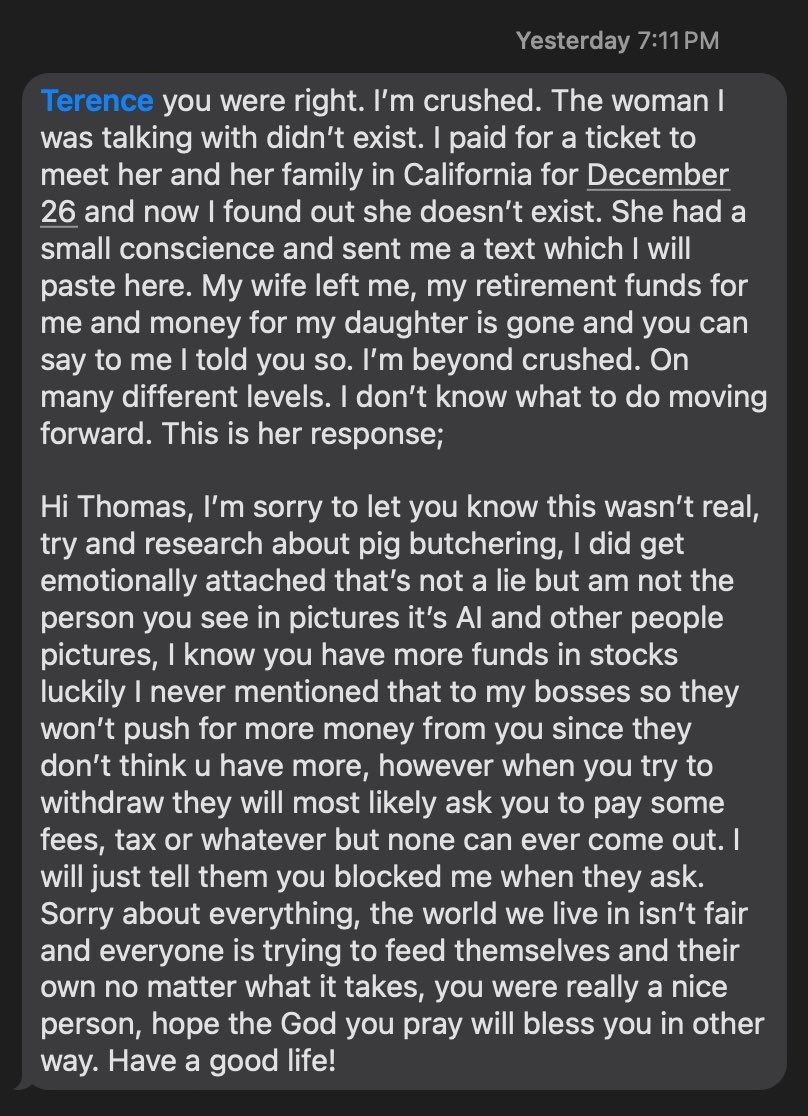
Pig butchering scam drains Bitcoin retiree’s life savings
Source: Terence Michael

How a Pig butchering scam bypassed professional warnings

According to Michael, the investor was repeatedly cautioned that he was dealing with a Pig butchering scam, yet proceeded with the transfer anyway. The scammer promised to double the client’s Bitcoin holdings and simultaneously cultivated an online romantic relationship, a hallmark of this type of fraud.

“My client was falling for a pig butchering scam,” Michael wrote on X. “And as of last night while out to dinner, I received a devastating text message from him saying he had lost it all.”

Michael said he made “numerous phone calls” and sent a “string of text messages” warning the client not to proceed. Despite those efforts, the investor sent his Bitcoin retirement stash to the scammer, believing both the investment pitch and the personal relationship were genuine.

Unlike exchange hacks or wallet breaches, a Pig butchering scam relies on trust rather than technical exploitation. Victims are groomed emotionally, often over days or weeks, until they are convinced that sending funds is both safe and beneficial.

AI deception and emotional manipulation

In this case, the deception extended beyond financial promises. Michael said the investor, who was recently divorced, also purchased a plane ticket for the scammer, expecting to meet her in person. Only after the Bitcoin was transferred did the attacker admit that the photographs used during the relationship were fake.

According to Michael, the images had been generated using artificial intelligence tools, adding a new layer of sophistication to the Pig butchering scam. The revelation illustrates how advances in AI are making it harder for victims to distinguish between real people and fabricated online identities.

The emotional fallout was severe. In addition to losing his retirement savings, the investor was forced to confront the fact that the relationship he believed in never existed. The combination of financial loss and personal betrayal is common in these scams, experts say, and often leaves victims reluctant to report what happened.

Pig butchering scam losses reach billions

Cases like this are no longer isolated. Pig butchering scam operations have grown into a major threat for cryptocurrency holders, draining billions of dollars from victims worldwide. According to industry data cited by blockchain security platform Cyvers, these scams stole an estimated $5.5 billion in crypto across roughly 200,000 cases in 2024 alone.
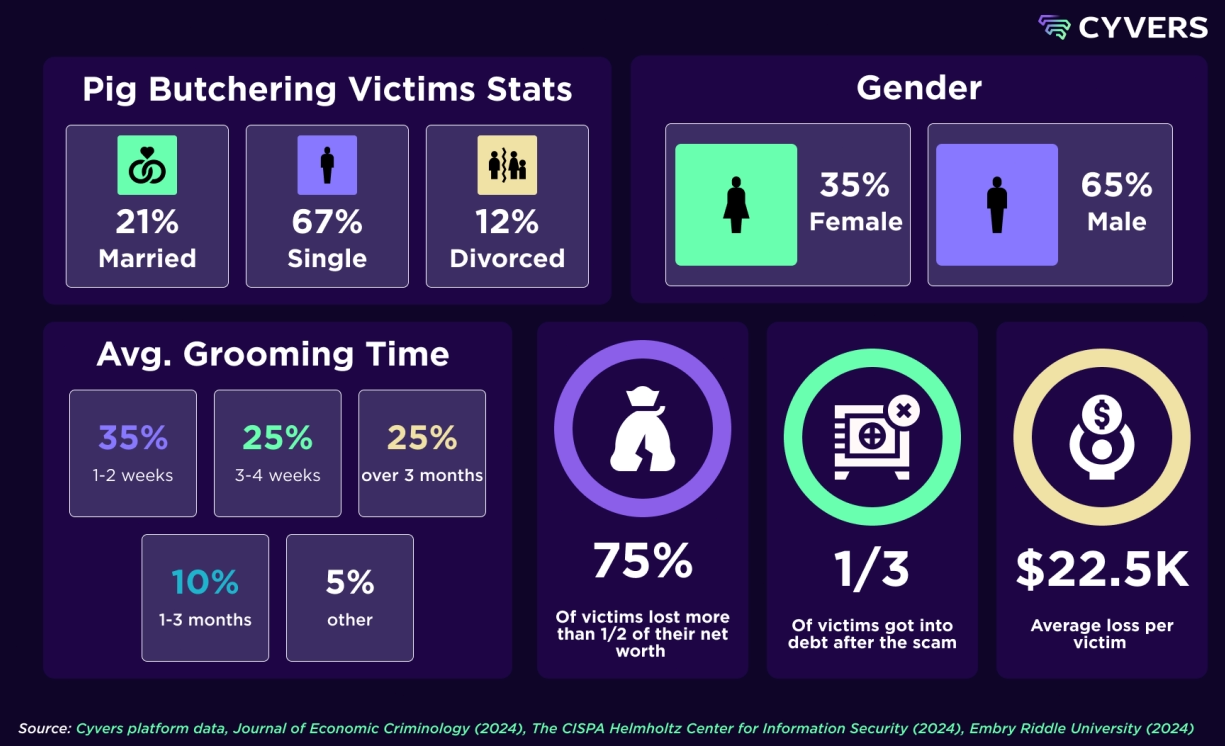
Pig butchering victim stats, grooming time. Source: Cyvers

As a subset of phishing fraud, grooming timelines vary. Cyvers reports that 35% of victims are groomed for one to two weeks, while about 10% experience manipulation lasting up to three months. The extended engagement builds trust and reduces skepticism, increasing the likelihood that victims will willingly transfer funds.

The scale of losses has caught the attention of law enforcement and national security officials, who increasingly view the Pig butchering scam as more than just a consumer protection issue.

National security concerns and law enforcement response

Earlier in November, blockchain analytics firm Chainalysis warned that pig butchering operations are evolving into a national security concern. Andrew Fierman, Head of National Security Intelligence at Chainalysis, explained how victims are often targeted repeatedly.

The warning highlights a dangerous feedback loop: falling for one Pig butchering scam can increase exposure to future attacks. Criminal networks share victim data, making those who have already lost funds prime targets for follow-up frauds, including fake recovery services.

Authorities have begun to respond. In June, the US Department of Justice announced the seizure of more than $225 million in cryptocurrency linked to pig butchering operations, one of the largest recoveries tied to this form of fraud. While significant, the seizure represents only a fraction of total losses.

A cautionary tale for crypto investors

For crypto investors and policymakers alike, the case serves as a stark reminder that technological literacy does not automatically confer immunity to deception. The Pig butchering scam thrives not on software vulnerabilities but on human emotion, trust, and isolation.

As digital assets become more mainstream and AI tools more accessible, experts warn that such scams are likely to grow in both scale and sophistication. The loss of a Bitcoin retirement fund, despite repeated professional warnings, illustrates the urgent need for broader education, stronger reporting mechanisms, and continued law enforcement coordination.

Ultimately, the rise of the Pig butchering scam shows that in the crypto economy, the greatest risk may not come from code—but from carefully engineered lies.


Tags: AI scamsBitcoin fraudBlockchain Securitycrypto investmentCrypto scamscybercrimeEuropean footballExorFootball sharesItalyJuventus stocklaw enforcementmarketsphishingpig butcheringpublic companiesRetirement lossromance scamsSports financetether
Share196Tweet123
Moses Edozie

Moses Edozie

Moses Edozie is a writer and storyteller with a deep interest in cryptocurrency, blockchain innovation, and Web3 culture. Passionate about DeFi, NFTs, and the societal impact of decentralized systems, he creates clear, engaging narratives that connect complex technologies to everyday life.

  • Trending
  • Comments
  • Latest
AI People joins Dubai’s innovation one — Declares war on the forgetting of humanity

AI People joins Dubai’s Innovation One program: Declares war on the forgetting of humanity

07/22/2025 - Updated On 07/23/2025
FBI nabs Nigerian ‘tech queen’ Sapphire Egemasi in multi-million dollar fraud scheme

FBI arrests Nigerian ‘tech queen’ Sapphire Egemasi in $1.3M heist targeting U.S. government

06/05/2025 - Updated On 06/17/2025
Crypto investor and wife found dead in Dubai as police investigate possible link to digital assets

Crypto investor and wife found dead in Dubai as police investigate possible link to digital assets

11/08/2025
Polygon Discord Channel Hacked, Throws Crypto Community in Turmoil

Polygon Discord Channel Hacked, Throws Crypto Community in Turmoil

2
Bitcoin reclaims $107,000 as Iran-Israel ceasefire cools market tensions

Bitcoin reclaims $107,000 as Iran-Israel ceasefire cools market tensions

2

Hello world!

1
Wyoming Crypto Bank petition headlines a rapidly intensifying legal confrontation that could reshape how crypto banks access the U.S. financial system. Wyoming-chartered Custodia Bank has formally petitioned the full Tenth Circuit Court of Appeals to review the Federal Reserve’s denial of its master account, escalating a five-year fight with sweeping implications for federal power, state banking authority, and digital asset innovation. Wyoming Crypto Bank petition filings submitted on December 15 request an en banc review, asking all active judges on the Tenth Circuit to reconsider an October panel ruling that upheld the Fed’s decision. Custodia argues the panel misread federal law and endorsed a system that grants regional Federal Reserve Banks unchecked discretion over legally eligible state-chartered institutions. Wyoming Crypto Bank Petition Challenges Fed’s Master Account Authority At the heart of the Wyoming Crypto Bank petition is the Federal Reserve’s refusal to grant Custodia access to a master account—an essential gateway to core payment rails such as wire transfers and automated clearinghouse (ACH) services. Without it, Custodia says its Wyoming-issued charter is effectively rendered meaningless. Custodia contends the ruling conflicts directly with the Monetary Control Act (MCA), which states that Federal Reserve services shall be available to nonmember depository institutions. The bank argues the Fed has transformed that mandate into what it calls an unconstitutional veto over state banking decisions. When the Fed denies a master account to a state-chartered financial institution, it effectively vetoes a bank charter that State regulators have approved, Custodia wrote in its petition. State Banking Authority Under Threat The Wyoming Crypto Bank petition also raises serious federalism concerns. Wyoming chartered Custodia in 2020 as a Special Purpose Depository Institution (SPDI), a regulatory framework specifically designed to attract digital asset firms while minimizing systemic risk through 100% reserve backing and a prohibition on lending. Custodia argues the Fed’s rejection undermines Wyoming’s carefully constructed regulatory regime and erodes states’ constitutional authority to charter banks. The petition warns that allowing the Fed such power could discourage innovation-driven state banking models nationwide. Constitutional Red Flags in the Wyoming Crypto Bank Petition Beyond federalism, the Wyoming Crypto Bank petition pushes into constitutional territory. Custodia’s legal team argues that if regional Federal Reserve Bank presidents possess unreviewable discretion over master accounts, they effectively function as “Officers of the United States” without proper constitutional appointment. Federal Reserve Bank presidents are selected by private bank directors and approved by the Board of Governors. Custodia says that structure violates the Appointments Clause if those officials wield significant executive authority. Judicial Split Deepens Over Wyoming Crypto Bank Petition The petition highlights a growing divide within the Tenth Circuit itself. Judge Timothy Tymkovich’s dissent in Custodia’s case aligns with Judge Robert Bacharach’s earlier opinion in Fourth Corner Credit Union v. Federal Reserve Bank of Kansas City, creating a 2-2 split among circuit judges. Tymkovich warned that the Fed’s interpretation grants “unreviewable discretion” that contradicts the plain language of the MCA and raises “thorny questions” under Article II of the Constitution. Fed’s Own Records Undermine Denial Rationale The Wyoming Crypto Bank petition also points to contradictions within the Federal Reserve’s own process. The Kansas City Fed denied Custodia’s application in January 2023 after a 27-month review, citing risks tied to “crypto-asset activities.” Yet internal documents show Fed staff initially found Custodia’s capital levels “adequate” and praised its leadership as “impressive.” Custodia says the decision only shifted after intervention by the Board of Governors. Federal Reserve Governor Christopher Waller later acknowledged publicly that the Fed has sufficient supervisory tools to manage risk without blanket denials. In an October interview, Waller said the Fed can “tailor” master account structures to fit a bank’s specific risk profile. Wyoming Crypto Bank Petition Lands Amid Crypto Debanking Reckoning The Wyoming Crypto Bank petition arrives as regulators face mounting scrutiny over crypto debanking. In December, the Office of the Comptroller of the Currency revealed that all nine of the largest U.S. banks imposed “inappropriate” restrictions on lawful businesses, including digital asset firms, between 2020 and 2023. Institutions such as JPMorgan Chase, Bank of America, Citibank, and Wells Fargo maintained internal policies that escalated or restricted entire sectors, reinforcing claims of systemic exclusion. If the full Tenth Circuit agrees to hear the Wyoming Crypto Bank petition, the outcome could redefine the balance of power between state banking regulators and the Federal Reserve—setting a precedent that reaches far beyond Custodia and Wyoming. For the crypto industry, the case may determine whether compliance-focused digital asset banks can ever gain equal footing within the U.S. financial system.Wyoming Crypto Bank Petition Sparks High-Stakes Legal Showdown as Fed Power Faces Fierce Constitutional Test

Wyoming-chartered Custodia Bank challenges Federal Reserve’s master account veto power

12/16/2025
DWF Labs is placing a bold bet on the transformative power of AI agents | Photo: freepik

Whale dumps AI agent tokens at 90%+ loss, exposing thin liquidity in niche markets

12/16/2025
Solana disinflation Ross Ulbricht Loses $12M in Solana Token Loss Due to Liquidity Error

Solana survives one of internet’s largest DDoS attacks with no downtime

12/16/2025
No Result
View All Result
  • Home
  • Crypto News
  • Expert Analysis
  • Finance
  • Tech
  • Sponsored
  • Press Release
  • Opinion

Copyright © 2025 - The Bit Gazette.

Are you sure want to unlock this post?
Unlock left : 0
Are you sure want to cancel subscription?