
- Trending
- Comments
- Latest

The era of the petrodollar is facing its most direct challenge yet, and the weapon delivering it is not a missile. It is a decentralized ledger.
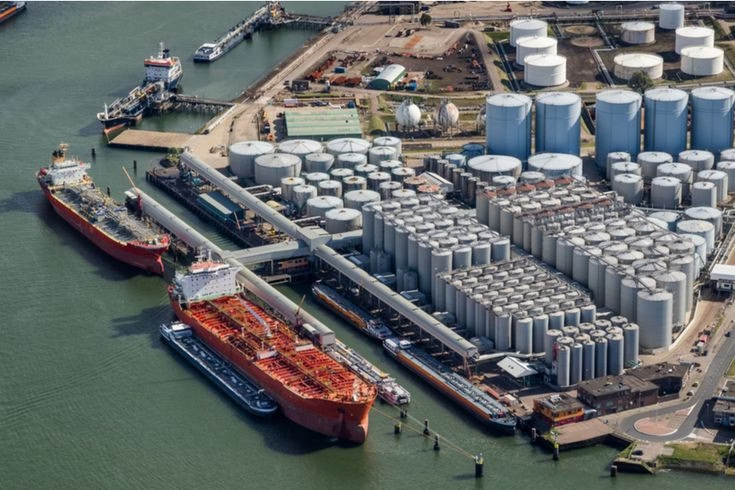
Iran has mandated that fully laden oil tankers passing through the Strait of Hormuz pay a transit toll of approximately $1 per barrel of cargo, settled in Bitcoin or Chinese yuan. A fully loaded Very Large Crude Carrier carries roughly two million barrels. That means shipping companies are being asked to source and transfer up to $2 million in cryptocurrency before a single barrel moves through the world’s most critical oil corridor.
This is not a proposal. Iran’s parliament approved the Strait of Hormuz Management Plan on March 30–31, 2026. The system was already operational before this week’s headlines. What changed is that the world is only now paying attention.
For Western shipping conglomerates, this toll creates a compliance nightmare with no clean exit.
On one side sits the U.S. Treasury’s Office of Foreign Assets Control. OFAC strictly prohibits any American-linked entity from transacting with sanctioned Iranian wallets. Transferring $2 million in Bitcoin to Tehran is a potential federal violation that can result in corporate blacklisting and the freezing of global bank accounts.
On the other side sits physical reality. The Strait of Hormuz is the single chokepoint through which roughly 20% of the world’s oil supply flows. Before the current conflict, between 100 and 120 commercial vessels transited it daily. That traffic has been reduced to a trickle. Shipping executives have confirmed they remain in a holding pattern, with no direct contact from Iranian authorities and crew safety as their overriding concern.
The toll does not resolve that standoff. It deepens it. Compliance risks federal sanction. Non-compliance keeps your vessel and its crew anchored in a conflict zone indefinitely.
Iran’s choice of cryptocurrency is not incidental. It is the entire point.
The dollar’s power as a sanctions weapon depends on controlling financial plumbing, correspondent banking, SWIFT, the clearing infrastructure that underpins every dollar-denominated transaction. The U.S. government can freeze a bank account. It cannot freeze a Bitcoin wallet.
Bitcoin transactions clear on-chain, outside the correspondent banking system entirely. According to statements from Hamid Hosseini, spokesperson for Iran’s Oil, Gas and Petrochemical Products Exporters’ Union, vessels are given a short window to complete payment once approved, specifically designed to ensure transactions cannot be traced or intercepted by Western authorities in time.
The system also accepts Chinese yuan routed through Kunlun Bank via CIPS, outside SWIFT entirely. Both options tell the same story: Iran has built payment infrastructure that the dollar-based sanctions regime was not designed to stop.
This is not symbolic. The financial scale is significant.
At current traffic levels, analysts estimate the toll system could generate up to $20 million per day from oil tankers alone. If liquefied natural gas vessels are included, projections reach $600 to $800 million per month. The IRGC has been operating this system since mid-March 2026, quietly accumulating Bitcoin and yuan as sovereign revenue while the world focused on ceasefire negotiations.
Iran applies a five-tier nationality ranking to vessels. Nations deemed friendly receive lower rates. Ships linked to the United States or Israel are denied transit entirely.
Crypto markets processed the implications immediately. Following the FT report on April 8, Bitcoin rose sharply, trading above $71,700. Solana gained 7% and Ethereum 8% in the same session.
The interpretation driving that move is straightforward. A nation-state is now accumulating Bitcoin as sovereign revenue at scale, using energy supply as leverage. If that model holds, and particularly if the ceasefire collapses and the strait tightens further, the same asset being collected as a toll becomes a macro safe-haven at the precise moment traditional markets are pricing in an oil shock.
That feedback loop is not theoretical. It is already visible in the price.
Since the 1970s, the petrodollar system has served as one of the foundational pillars of American financial dominance. Pricing global oil in dollars forced every nation to hold dollar reserves, giving Washington unmatched leverage to weaponize its currency through sanctions.
That leverage depends entirely on participation. It works when adversaries have no alternative settlement infrastructure. For decades, they largely did not.
Iran has now demonstrated, at a major maritime chokepoint, that an alternative exists, one that is technically operational, economically significant, and structurally immune to the mechanisms that make dollar sanctions effective. Whether this moment represents a crack or a fracture in the petrodollar system will depend on how many other actors take note.
The toll itself, $1 per barrel is a relatively small fraction of crude’s market price. That is not the point. The point is what it proves: that a sanctioned state can collect sovereign revenue in cryptocurrency, at scale, using energy infrastructure as enforcement, outside the reach of the Western financial system.
Iran did not invent a new weapon. It found a gap in an old one, and walked a supertanker through it.
The rules of money did not change overnight. But the map just got redrawn in a way that will take years to fully understand.



Copyright © 2025 - The Bit Gazette.