

- Trending
- Comments
- Latest

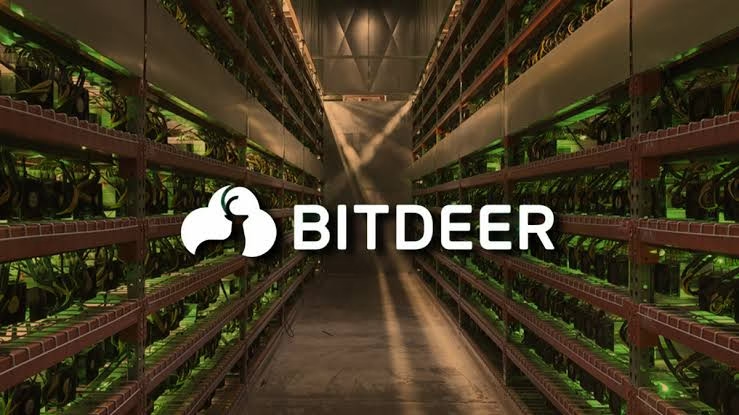
Bitdeer Technologies reported 71 exahashes per second of hashrate under management in December, a figure that would exceed MARA Holdings’ 61.7 EH/s of energized hashrate.
However, the Singapore-based miner’s claim to industry leadership is complicated by differing measurement standards that make direct comparisons difficult.
Bitdeer’s claim is based on its internal metric of “total hashrate under management,” which combines company-owned mining power with machines operated for customers under hosting and subscription agreements.
According to the company’s December operational update published on its investor relations portal, Bitdeer crossed the 71 EH/s threshold following aggressive hardware deployment and site expansion.
MARA, by contrast, reports “energized hashrate,” a narrower metric reflecting only mining rigs that are installed, powered, and actively hashing within its owned and leased facilities.
MARA’s latest disclosed capacity of 61.7 EH/s is detailed on its official mining statistics page at MARA Holdings mining statistics.
This distinction complicates efforts to definitively crown a new Top bitcoin miner. While Bitdeer’s broader metric captures its growing role as an infrastructure provider, MARA’s figures emphasize direct operational control.
Still, the headline number matters. Since mid-2023, MARA has marketed itself as the industry leader by self-generated hashrate, growing from under 20 EH/s to above 60 EH/s by September 2025.
Bitdeer’s latest disclosure challenges that narrative, even if the metrics are not perfectly aligned.
Bitdeer reported self-mining capacity of 55.2 EH/s supported by more than 1,100 deployed chips, 538 of which operate under external subscription agreements.
The company’s vertically integrated model centers on its proprietary SEALMINER hardware, which it claims delivers superior efficiency compared with third-party ASICs.
In its December production report available via Bitdeer December 2025 production update, the company disclosed that it mined 636 bitcoins during the month, sharply higher than the 145 bitcoins produced in December 2024.
“Bitdeer reported 71 EH/s of capacity as of end December, roughly six percent of the global hashrate,” said Matt Sigel, Head of Digital Assets Research at VanEck. “Like other miners, they are actively selling production to fund expansion into AI and high-performance computing,” he wrote in a public post.
Bitdeer’s SEAL04-1 chip has demonstrated energy efficiency of approximately 6–7 joules per terahash at the chip level under low-voltage conditions, according to technical disclosures linked from Bitdeer’s SEALMINER documentation.
MARA, meanwhile, reports fleet-wide energy efficiency of roughly 19 joules per terahash, a figure that includes cooling, infrastructure, and operational overhead.
Although the metrics are not directly comparable, efficiency remains a key determinant in determining the next Top bitcoin miner as network difficulty continues to rise.
Both companies are also reshaping their strategies amid surging demand for AI and high-performance computing infrastructure.
Bitdeer is developing AI-ready facilities across eight locations spanning Canada, Ethiopia, Norway, and U.S. states including Ohio, Tennessee, and Washington, according to project disclosures outlined in Bitdeer SEC filings.
MARA operates 18 data centers, primarily powered by Bitmain Antminer ASICs, and has taken a markedly different financial approach.
Rather than selling production, MARA continues to retain mined bitcoin, holding more than 55,000 BTC which is the second-largest treasury among public companies as disclosed in its latest balance sheet at MARA investor financials. Bitdeer, by contrast, reported holdings of 2,017 BTC.
This divergence reflects broader strategic tension within the sector. For a Top bitcoin miner, scale alone is no longer sufficient.
Capital discipline, energy sourcing, and exposure to AI workloads increasingly influence valuations and investor confidence.
The race to be recognized as the Top bitcoin miner is no longer settled solely by headline hashrate numbers.
As Bitdeer and MARA pursue different operational models, investors must weigh metric transparency, efficiency, treasury strategy, and diversification.
Bitdeer’s rapid expansion underscores how infrastructure-first miners can challenge incumbents through vertical integration and aggressive deployment.
MARA’s continued emphasis on self-mining and bitcoin accumulation reflects a longer-term conviction strategy.
Whether Bitdeer’s 71 EH/s ultimately secures its place as the Top bitcoin miner will depend on how the market standardizes reporting and how effectively each company balances mining economics with the capital demands of AI infrastructure.
What is clear is that leadership in bitcoin mining is becoming more complex and far more contested than ever before.



Copyright © 2025 - The Bit Gazette.