






• Trending
  • Comments
  • Latest
AI People joins Dubai’s innovation one — Declares war on the forgetting of humanity

AI People joins Dubai’s Innovation One program: Declares war on the forgetting of humanity

07/22/2025 - Updated On 07/23/2025
FBI nabs Nigerian ‘tech queen’ Sapphire Egemasi in multi-million dollar fraud scheme

FBI arrests Nigerian ‘tech queen’ Sapphire Egemasi in $1.3M heist targeting U.S. government

06/05/2025 - Updated On 06/17/2025
Crypto investor and wife found dead in Dubai as police investigate possible link to digital assets

Crypto investor and wife found dead in Dubai as police investigate possible link to digital assets

11/08/2025
Polygon Discord Channel Hacked, Throws Crypto Community in Turmoil

Polygon Discord Channel Hacked, Throws Crypto Community in Turmoil

2
Bitcoin reclaims $107,000 as Iran-Israel ceasefire cools market tensions

Bitcoin reclaims $107,000 as Iran-Israel ceasefire cools market tensions

2

Hello world!

1
Wyoming Crypto Bank petition headlines a rapidly intensifying legal confrontation that could reshape how crypto banks access the U.S. financial system. Wyoming-chartered Custodia Bank has formally petitioned the full Tenth Circuit Court of Appeals to review the Federal Reserve’s denial of its master account, escalating a five-year fight with sweeping implications for federal power, state banking authority, and digital asset innovation. Wyoming Crypto Bank petition filings submitted on December 15 request an en banc review, asking all active judges on the Tenth Circuit to reconsider an October panel ruling that upheld the Fed’s decision. Custodia argues the panel misread federal law and endorsed a system that grants regional Federal Reserve Banks unchecked discretion over legally eligible state-chartered institutions. Wyoming Crypto Bank Petition Challenges Fed’s Master Account Authority At the heart of the Wyoming Crypto Bank petition is the Federal Reserve’s refusal to grant Custodia access to a master account—an essential gateway to core payment rails such as wire transfers and automated clearinghouse (ACH) services. Without it, Custodia says its Wyoming-issued charter is effectively rendered meaningless. Custodia contends the ruling conflicts directly with the Monetary Control Act (MCA), which states that Federal Reserve services shall be available to nonmember depository institutions. The bank argues the Fed has transformed that mandate into what it calls an unconstitutional veto over state banking decisions. When the Fed denies a master account to a state-chartered financial institution, it effectively vetoes a bank charter that State regulators have approved, Custodia wrote in its petition. State Banking Authority Under Threat The Wyoming Crypto Bank petition also raises serious federalism concerns. Wyoming chartered Custodia in 2020 as a Special Purpose Depository Institution (SPDI), a regulatory framework specifically designed to attract digital asset firms while minimizing systemic risk through 100% reserve backing and a prohibition on lending. Custodia argues the Fed’s rejection undermines Wyoming’s carefully constructed regulatory regime and erodes states’ constitutional authority to charter banks. The petition warns that allowing the Fed such power could discourage innovation-driven state banking models nationwide. Constitutional Red Flags in the Wyoming Crypto Bank Petition Beyond federalism, the Wyoming Crypto Bank petition pushes into constitutional territory. Custodia’s legal team argues that if regional Federal Reserve Bank presidents possess unreviewable discretion over master accounts, they effectively function as “Officers of the United States” without proper constitutional appointment. Federal Reserve Bank presidents are selected by private bank directors and approved by the Board of Governors. Custodia says that structure violates the Appointments Clause if those officials wield significant executive authority. Judicial Split Deepens Over Wyoming Crypto Bank Petition The petition highlights a growing divide within the Tenth Circuit itself. Judge Timothy Tymkovich’s dissent in Custodia’s case aligns with Judge Robert Bacharach’s earlier opinion in Fourth Corner Credit Union v. Federal Reserve Bank of Kansas City, creating a 2-2 split among circuit judges. Tymkovich warned that the Fed’s interpretation grants “unreviewable discretion” that contradicts the plain language of the MCA and raises “thorny questions” under Article II of the Constitution. Fed’s Own Records Undermine Denial Rationale The Wyoming Crypto Bank petition also points to contradictions within the Federal Reserve’s own process. The Kansas City Fed denied Custodia’s application in January 2023 after a 27-month review, citing risks tied to “crypto-asset activities.” Yet internal documents show Fed staff initially found Custodia’s capital levels “adequate” and praised its leadership as “impressive.” Custodia says the decision only shifted after intervention by the Board of Governors. Federal Reserve Governor Christopher Waller later acknowledged publicly that the Fed has sufficient supervisory tools to manage risk without blanket denials. In an October interview, Waller said the Fed can “tailor” master account structures to fit a bank’s specific risk profile. Wyoming Crypto Bank Petition Lands Amid Crypto Debanking Reckoning The Wyoming Crypto Bank petition arrives as regulators face mounting scrutiny over crypto debanking. In December, the Office of the Comptroller of the Currency revealed that all nine of the largest U.S. banks imposed “inappropriate” restrictions on lawful businesses, including digital asset firms, between 2020 and 2023. Institutions such as JPMorgan Chase, Bank of America, Citibank, and Wells Fargo maintained internal policies that escalated or restricted entire sectors, reinforcing claims of systemic exclusion. If the full Tenth Circuit agrees to hear the Wyoming Crypto Bank petition, the outcome could redefine the balance of power between state banking regulators and the Federal Reserve—setting a precedent that reaches far beyond Custodia and Wyoming. For the crypto industry, the case may determine whether compliance-focused digital asset banks can ever gain equal footing within the U.S. financial system.Wyoming Crypto Bank Petition Sparks High-Stakes Legal Showdown as Fed Power Faces Fierce Constitutional Test

Wyoming-chartered Custodia Bank challenges Federal Reserve’s master account veto power

12/16/2025
DWF Labs is placing a bold bet on the transformative power of AI agents | Photo: freepik

Whale dumps AI agent tokens at 90%+ loss, exposing thin liquidity in niche markets

12/16/2025
Solana disinflation Ross Ulbricht Loses $12M in Solana Token Loss Due to Liquidity Error

Solana survives one of internet’s largest DDoS attacks with no downtime

12/16/2025
  • Trending
  • Comments
  • Latest
AI People joins Dubai’s innovation one — Declares war on the forgetting of humanity

AI People joins Dubai’s Innovation One program: Declares war on the forgetting of humanity

07/22/2025 - Updated On 07/23/2025
FBI nabs Nigerian ‘tech queen’ Sapphire Egemasi in multi-million dollar fraud scheme

FBI arrests Nigerian ‘tech queen’ Sapphire Egemasi in $1.3M heist targeting U.S. government

06/05/2025 - Updated On 06/17/2025
Crypto investor and wife found dead in Dubai as police investigate possible link to digital assets

Crypto investor and wife found dead in Dubai as police investigate possible link to digital assets

11/08/2025
Polygon Discord Channel Hacked, Throws Crypto Community in Turmoil

Polygon Discord Channel Hacked, Throws Crypto Community in Turmoil

2
Bitcoin reclaims $107,000 as Iran-Israel ceasefire cools market tensions

Bitcoin reclaims $107,000 as Iran-Israel ceasefire cools market tensions

2

Hello world!

1
Wyoming Crypto Bank petition headlines a rapidly intensifying legal confrontation that could reshape how crypto banks access the U.S. financial system. Wyoming-chartered Custodia Bank has formally petitioned the full Tenth Circuit Court of Appeals to review the Federal Reserve’s denial of its master account, escalating a five-year fight with sweeping implications for federal power, state banking authority, and digital asset innovation. Wyoming Crypto Bank petition filings submitted on December 15 request an en banc review, asking all active judges on the Tenth Circuit to reconsider an October panel ruling that upheld the Fed’s decision. Custodia argues the panel misread federal law and endorsed a system that grants regional Federal Reserve Banks unchecked discretion over legally eligible state-chartered institutions. Wyoming Crypto Bank Petition Challenges Fed’s Master Account Authority At the heart of the Wyoming Crypto Bank petition is the Federal Reserve’s refusal to grant Custodia access to a master account—an essential gateway to core payment rails such as wire transfers and automated clearinghouse (ACH) services. Without it, Custodia says its Wyoming-issued charter is effectively rendered meaningless. Custodia contends the ruling conflicts directly with the Monetary Control Act (MCA), which states that Federal Reserve services shall be available to nonmember depository institutions. The bank argues the Fed has transformed that mandate into what it calls an unconstitutional veto over state banking decisions. When the Fed denies a master account to a state-chartered financial institution, it effectively vetoes a bank charter that State regulators have approved, Custodia wrote in its petition. State Banking Authority Under Threat The Wyoming Crypto Bank petition also raises serious federalism concerns. Wyoming chartered Custodia in 2020 as a Special Purpose Depository Institution (SPDI), a regulatory framework specifically designed to attract digital asset firms while minimizing systemic risk through 100% reserve backing and a prohibition on lending. Custodia argues the Fed’s rejection undermines Wyoming’s carefully constructed regulatory regime and erodes states’ constitutional authority to charter banks. The petition warns that allowing the Fed such power could discourage innovation-driven state banking models nationwide. Constitutional Red Flags in the Wyoming Crypto Bank Petition Beyond federalism, the Wyoming Crypto Bank petition pushes into constitutional territory. Custodia’s legal team argues that if regional Federal Reserve Bank presidents possess unreviewable discretion over master accounts, they effectively function as “Officers of the United States” without proper constitutional appointment. Federal Reserve Bank presidents are selected by private bank directors and approved by the Board of Governors. Custodia says that structure violates the Appointments Clause if those officials wield significant executive authority. Judicial Split Deepens Over Wyoming Crypto Bank Petition The petition highlights a growing divide within the Tenth Circuit itself. Judge Timothy Tymkovich’s dissent in Custodia’s case aligns with Judge Robert Bacharach’s earlier opinion in Fourth Corner Credit Union v. Federal Reserve Bank of Kansas City, creating a 2-2 split among circuit judges. Tymkovich warned that the Fed’s interpretation grants “unreviewable discretion” that contradicts the plain language of the MCA and raises “thorny questions” under Article II of the Constitution. Fed’s Own Records Undermine Denial Rationale The Wyoming Crypto Bank petition also points to contradictions within the Federal Reserve’s own process. The Kansas City Fed denied Custodia’s application in January 2023 after a 27-month review, citing risks tied to “crypto-asset activities.” Yet internal documents show Fed staff initially found Custodia’s capital levels “adequate” and praised its leadership as “impressive.” Custodia says the decision only shifted after intervention by the Board of Governors. Federal Reserve Governor Christopher Waller later acknowledged publicly that the Fed has sufficient supervisory tools to manage risk without blanket denials. In an October interview, Waller said the Fed can “tailor” master account structures to fit a bank’s specific risk profile. Wyoming Crypto Bank Petition Lands Amid Crypto Debanking Reckoning The Wyoming Crypto Bank petition arrives as regulators face mounting scrutiny over crypto debanking. In December, the Office of the Comptroller of the Currency revealed that all nine of the largest U.S. banks imposed “inappropriate” restrictions on lawful businesses, including digital asset firms, between 2020 and 2023. Institutions such as JPMorgan Chase, Bank of America, Citibank, and Wells Fargo maintained internal policies that escalated or restricted entire sectors, reinforcing claims of systemic exclusion. If the full Tenth Circuit agrees to hear the Wyoming Crypto Bank petition, the outcome could redefine the balance of power between state banking regulators and the Federal Reserve—setting a precedent that reaches far beyond Custodia and Wyoming. For the crypto industry, the case may determine whether compliance-focused digital asset banks can ever gain equal footing within the U.S. financial system.Wyoming Crypto Bank Petition Sparks High-Stakes Legal Showdown as Fed Power Faces Fierce Constitutional Test

Wyoming-chartered Custodia Bank challenges Federal Reserve’s master account veto power

12/16/2025
DWF Labs is placing a bold bet on the transformative power of AI agents | Photo: freepik

Whale dumps AI agent tokens at 90%+ loss, exposing thin liquidity in niche markets

12/16/2025
Solana disinflation Ross Ulbricht Loses $12M in Solana Token Loss Due to Liquidity Error

Solana survives one of internet’s largest DDoS attacks with no downtime

12/16/2025
Tuesday, December 16, 2025
  • Login
The Bit Gazette
  • Home
  • Crypto News
  • Expert Analysis
  • Finance
  • Tech
  • Sponsored
  • Press Release
  • Opinion
No Result
View All Result
The Bit Gazette
No Result
View All Result
Home Crypto

BlackRock Bitcoin ETF Secures SEC Approval for Options Trading, Sparking Market Excitement

by Davidson Okechukwu
1 year ago
in Crypto, Crypto News
Reading Time: 4 mins read
0
BlackRock Bitcoin ETF approval paves the way for physically settled options on IBIT

BlackRock Bitcoin ETF approval paves the way for physically settled options on IBIT

Share on FacebookShare on Twitter

BlackRock Bitcoin ETF has received approval from the U.S. Securities and Exchange Commission (SEC) for options trading. The SEC recently gave the green light to BlackRock’s iShares Bitcoin Trust (IBIT), a spot Bitcoin exchange-traded fund (ETF), granting it the ability to offer options trading. This BlackRock Bitcoin ETF approval is expected to set off waves of excitement across the investment world.

In the SEC filing, the decision marks a new chapter for crypto enthusiasts and institutional investors alike, allowing more sophisticated strategies for managing Bitcoin exposure.

The BlackRock Bitcoin ETF approval paves the way for physically settled options on IBIT, offering a broader toolkit for investors who seek to hedge or magnify their returns through Bitcoin’s volatility.

BlackRock Bitcoin ETF Options Approval As A Catalyst for Market Growth

The SEC’s decision to approve BlackRock Bitcoin ETF for options trading has sparked conversations in the financial community about what this could mean for the broader crypto market.

The approval for physically settled options, particularly on a fund as large as BlackRock’s iShares Bitcoin Trust, is seen as a groundbreaking step toward integrating Bitcoin into traditional finance.

Eric Balchunas, a senior ETF analyst at Bloomberg Intelligence, called the move a “huge win” for the cryptocurrency sector. He tweeted, “This will bring more liquidity and attract bigger institutional players to Bitcoin ETFs. We had placed a 70% chance of approval by the end of May, so this is a welcome development.”

His prediction hints at a chain reaction—potentially leading to other Bitcoin ETFs getting similar approvals, thus driving even more liquidity into the crypto market.
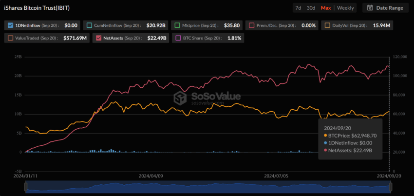
BlackRock’s IBIT Inflows and Net Assets. Source: SoSo Value

The BlackRock Bitcoin ETF approval didn’t come without careful scrutiny. Recognizing the inherent risks posed by Bitcoin’s notorious volatility, the SEC imposed strict position and exercise limits to minimize any market manipulation or undue risk.

The approval includes a cap of 25,000 contracts on positions and exercises, ensuring that no individual or group can disproportionately influence the market. These conservative limits are essential for keeping the trading environment stable, especially as Bitcoin’s price often sees wild fluctuations.

Additionally, the SEC implemented sophisticated surveillance mechanisms like real-time pattern tracking and post-trade monitoring, which aim to reduce the risks of market abuse and manipulation. This increased oversight offers investors greater confidence and security when trading Bitcoin-linked options.

Blackrock Bitcoin ETF Impact on Traditional Financial Markets

The approval of BlackRock Bitcoin ETF options trading signals more than just another crypto financial product entering the scene. It underscores a growing acceptance of Bitcoin and other digital assets within traditional financial systems. Institutional investors now have a regulated and SEC-approved method to engage with Bitcoin through advanced financial instruments.

Physically settled options will allow investors to take more dynamic positions—whether hedging risk, speculating on Bitcoin price movements, or amplifying their profits in a high-volatility environment. With BlackRock Bitcoin ETF approval, these strategies are now accessible in a safer, more structured way.

According to SoSo Value, BlackRock’s iShares Bitcoin Trust (IBIT) has a net asset value exceeding $22.49 billion as of September 20, showing just how massive its impact on the market could be. Investors view this approval as a watershed moment for Bitcoin’s place in global finance.

The BlackRock Bitcoin ETF approval isn’t just a win for the company; it’s a win for the broader crypto market. As one of the most influential asset managers globally, BlackRock’s move sends a strong signal that cryptocurrency ETFs are here to stay, and they’re increasingly becoming part of the traditional financial world.

BlackRock’s dominance in the spot Bitcoin ETF space has been evident for years. Now, with options trading approved for its iShares Bitcoin Trust, the company continues to blaze a trail that others will likely follow.

BlackRock Bitcoin ETF Secures SEC Approval for Options Trading, Sparking Market Excitement

In August, BlackRock also filed a proposal with the SEC for options trading on its iShares Ethereum Trust (ETHA), showing its commitment to expanding crypto ETF offerings.

As Eric Balchunas mentioned, the approval could snowball, with other ETFs following suit. This could lead to a significant influx of institutional money into the crypto space, fundamentally altering market dynamics and liquidity levels.

Industry Reactions to BlackRock Bitcoin ETF Approval

The crypto community is buzzing with reactions to the SEC’s approval of the BlackRock Bitcoin ETF. Many industry experts believe that this is the beginning of a new era for Bitcoin in traditional finance. Along with Eric Balchunas, several financial professionals have weighed in on the significance of this move.

David Weisberger, CEO of CoinRoutes, pointed out that this approval could accelerate the adoption of Bitcoin by institutional investors. He stated, “With BlackRock leading the charge, the ETF approval will drive mainstream adoption, especially as other asset managers race to follow suit.”

The overwhelming consensus is that the approval of BlackRock Bitcoin ETF options will have a lasting impact, not just on Bitcoin itself, but on the broader acceptance and integration of digital assets in traditional financial markets.

Despite the excitement, the journey isn’t over. While the SEC’s approval is a huge milestone, further approvals are required before trading can commence.

As Eric Balchunas noted, the Commodity Futures Trading Commission (CFTC) and Options Clearing Corporation (OCC) still need to give their nod of approval.

However, most analysts agree that it’s only a matter of time before these additional hurdles are cleared. Once the remaining regulatory approvals are in place, options trading on the BlackRock Bitcoin ETF will officially begin, marking another significant chapter in Bitcoin’s evolution from a fringe asset to a mainstream financial instrument.

With the SEC’s recent approval, the BlackRock Bitcoin ETF is poised to bring Bitcoin further into the mainstream financial landscape. The move is expected to attract large institutional investors, create additional liquidity, and open the door for more Bitcoin ETFs to follow suit.

The approval of options trading on BlackRock’s iShares Bitcoin Trust signifies a watershed moment for Bitcoin and could reshape the financial markets as more investors turn to digital assets as part of their portfolios.

Get more from The Bit Gazette.

Tags: Blackrock Bitcoin ETF
Share196Tweet123
Davidson Okechukwu

Davidson Okechukwu

Davidson Okechukwu is a passionate crypto journalist/writer and Web3 enthusiast, focusing on blockchain innovation, deFI, NFT ecosystems, and the societal impact of decentralized systems. His engaging style bridges the gap between technology and everyday understanding with a degree in Computer Science and various professional certifications from prestigious institutions. With over four years of experience in the crypto and DeFi space, Davidson combines his technical knowledge with a keen understanding of market dynamics. In addition to his work in cryptocurrency, he is a dedicated realtor and web management professional.

  • Trending
  • Comments
  • Latest
AI People joins Dubai’s innovation one — Declares war on the forgetting of humanity

AI People joins Dubai’s Innovation One program: Declares war on the forgetting of humanity

07/22/2025 - Updated On 07/23/2025
FBI nabs Nigerian ‘tech queen’ Sapphire Egemasi in multi-million dollar fraud scheme

FBI arrests Nigerian ‘tech queen’ Sapphire Egemasi in $1.3M heist targeting U.S. government

06/05/2025 - Updated On 06/17/2025
Crypto investor and wife found dead in Dubai as police investigate possible link to digital assets

Crypto investor and wife found dead in Dubai as police investigate possible link to digital assets

11/08/2025
Polygon Discord Channel Hacked, Throws Crypto Community in Turmoil

Polygon Discord Channel Hacked, Throws Crypto Community in Turmoil

2
Bitcoin reclaims $107,000 as Iran-Israel ceasefire cools market tensions

Bitcoin reclaims $107,000 as Iran-Israel ceasefire cools market tensions

2

Hello world!

1
Wyoming Crypto Bank petition headlines a rapidly intensifying legal confrontation that could reshape how crypto banks access the U.S. financial system. Wyoming-chartered Custodia Bank has formally petitioned the full Tenth Circuit Court of Appeals to review the Federal Reserve’s denial of its master account, escalating a five-year fight with sweeping implications for federal power, state banking authority, and digital asset innovation. Wyoming Crypto Bank petition filings submitted on December 15 request an en banc review, asking all active judges on the Tenth Circuit to reconsider an October panel ruling that upheld the Fed’s decision. Custodia argues the panel misread federal law and endorsed a system that grants regional Federal Reserve Banks unchecked discretion over legally eligible state-chartered institutions. Wyoming Crypto Bank Petition Challenges Fed’s Master Account Authority At the heart of the Wyoming Crypto Bank petition is the Federal Reserve’s refusal to grant Custodia access to a master account—an essential gateway to core payment rails such as wire transfers and automated clearinghouse (ACH) services. Without it, Custodia says its Wyoming-issued charter is effectively rendered meaningless. Custodia contends the ruling conflicts directly with the Monetary Control Act (MCA), which states that Federal Reserve services shall be available to nonmember depository institutions. The bank argues the Fed has transformed that mandate into what it calls an unconstitutional veto over state banking decisions. When the Fed denies a master account to a state-chartered financial institution, it effectively vetoes a bank charter that State regulators have approved, Custodia wrote in its petition. State Banking Authority Under Threat The Wyoming Crypto Bank petition also raises serious federalism concerns. Wyoming chartered Custodia in 2020 as a Special Purpose Depository Institution (SPDI), a regulatory framework specifically designed to attract digital asset firms while minimizing systemic risk through 100% reserve backing and a prohibition on lending. Custodia argues the Fed’s rejection undermines Wyoming’s carefully constructed regulatory regime and erodes states’ constitutional authority to charter banks. The petition warns that allowing the Fed such power could discourage innovation-driven state banking models nationwide. Constitutional Red Flags in the Wyoming Crypto Bank Petition Beyond federalism, the Wyoming Crypto Bank petition pushes into constitutional territory. Custodia’s legal team argues that if regional Federal Reserve Bank presidents possess unreviewable discretion over master accounts, they effectively function as “Officers of the United States” without proper constitutional appointment. Federal Reserve Bank presidents are selected by private bank directors and approved by the Board of Governors. Custodia says that structure violates the Appointments Clause if those officials wield significant executive authority. Judicial Split Deepens Over Wyoming Crypto Bank Petition The petition highlights a growing divide within the Tenth Circuit itself. Judge Timothy Tymkovich’s dissent in Custodia’s case aligns with Judge Robert Bacharach’s earlier opinion in Fourth Corner Credit Union v. Federal Reserve Bank of Kansas City, creating a 2-2 split among circuit judges. Tymkovich warned that the Fed’s interpretation grants “unreviewable discretion” that contradicts the plain language of the MCA and raises “thorny questions” under Article II of the Constitution. Fed’s Own Records Undermine Denial Rationale The Wyoming Crypto Bank petition also points to contradictions within the Federal Reserve’s own process. The Kansas City Fed denied Custodia’s application in January 2023 after a 27-month review, citing risks tied to “crypto-asset activities.” Yet internal documents show Fed staff initially found Custodia’s capital levels “adequate” and praised its leadership as “impressive.” Custodia says the decision only shifted after intervention by the Board of Governors. Federal Reserve Governor Christopher Waller later acknowledged publicly that the Fed has sufficient supervisory tools to manage risk without blanket denials. In an October interview, Waller said the Fed can “tailor” master account structures to fit a bank’s specific risk profile. Wyoming Crypto Bank Petition Lands Amid Crypto Debanking Reckoning The Wyoming Crypto Bank petition arrives as regulators face mounting scrutiny over crypto debanking. In December, the Office of the Comptroller of the Currency revealed that all nine of the largest U.S. banks imposed “inappropriate” restrictions on lawful businesses, including digital asset firms, between 2020 and 2023. Institutions such as JPMorgan Chase, Bank of America, Citibank, and Wells Fargo maintained internal policies that escalated or restricted entire sectors, reinforcing claims of systemic exclusion. If the full Tenth Circuit agrees to hear the Wyoming Crypto Bank petition, the outcome could redefine the balance of power between state banking regulators and the Federal Reserve—setting a precedent that reaches far beyond Custodia and Wyoming. For the crypto industry, the case may determine whether compliance-focused digital asset banks can ever gain equal footing within the U.S. financial system.Wyoming Crypto Bank Petition Sparks High-Stakes Legal Showdown as Fed Power Faces Fierce Constitutional Test

Wyoming-chartered Custodia Bank challenges Federal Reserve’s master account veto power

12/16/2025
DWF Labs is placing a bold bet on the transformative power of AI agents | Photo: freepik

Whale dumps AI agent tokens at 90%+ loss, exposing thin liquidity in niche markets

12/16/2025
Solana disinflation Ross Ulbricht Loses $12M in Solana Token Loss Due to Liquidity Error

Solana survives one of internet’s largest DDoS attacks with no downtime

12/16/2025
No Result
View All Result
  • Home
  • Crypto News
  • Expert Analysis
  • Finance
  • Tech
  • Sponsored
  • Press Release
  • Opinion

Copyright © 2025 - The Bit Gazette.

Are you sure want to unlock this post?
Unlock left : 0
Are you sure want to cancel subscription?