


- Trending
- Comments
- Latest

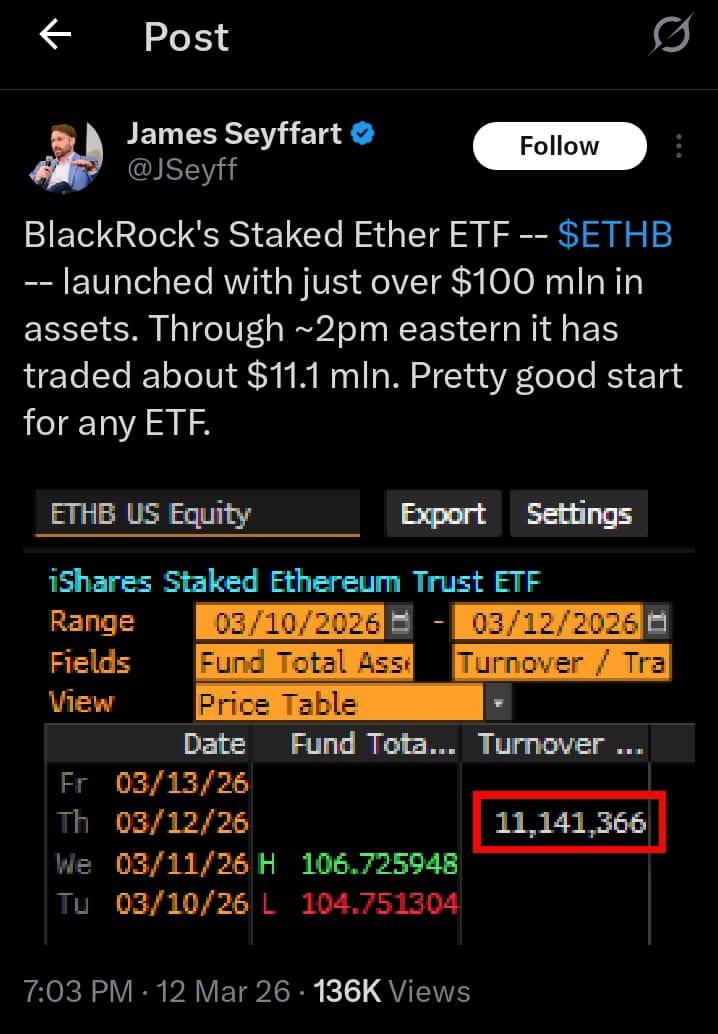
BlackRock launched the iShares Staked Ethereum Trust this week, marking the first major asset manager entry into crypto yield-bearing ETFs and signaling Wall Street’s deepening commitment to blockchain-based financial products.
The fund stakes 70–95% of its Ethereum holdings to generate approximately 3% annual returns for investors—a move that transforms Ethereum from a speculative asset into a yield-bearing instrument accessible through traditional brokerage accounts.
The staking-enabled Ethereum ETF launched with strong early trading volumes and investor attention, reflecting a broader trend of institutional participation in digital assets.
The fund allows investors to gain exposure to Ethereum while also earning yield generated through staking, a process that secures the blockchain and rewards participants with additional ETH.
Unlike traditional spot ETFs that simply track the price of Ethereum, the new product stakes a majority of the fund’s ETH holdings to generate income.
According to filings reviewed by several industry outlets, the fund plans to stake between 70% and 95% of its Ethereum holdings under normal market conditions.
The remainder of the assets is kept unstaked in what the issuer calls a “liquidity sleeve,” allowing the ETF to process investor redemptions quickly without needing to withdraw staked assets.
Eric Balchunas, senior ETF analyst at Bloomberg, said staking could make Ethereum ETFs significantly more attractive to long-term investors.
“A staking-enabled ETF changes the investment case for Ethereum because it introduces yield alongside price exposure.” Eric Balchunas, Senior ETF Analyst, Bloomberg.
The launch follows the rapid growth of crypto ETFs since 2024, when U.S. regulators approved spot Bitcoin funds and opened the door for more institutional crypto products.
The ETF, often referred to in filings as the iShares Staked Ethereum Trust, is designed to combine two investment drivers: ETH price appreciation and staking rewards generated on the blockchain.
Under the structure outlined in regulatory filings: 70–95% of the ETF’s ETH will be staked to generate yield. 5–30% will remain liquid to meet redemption requests.
Lastly, 82% of staking rewards will go to investors, while the remaining portion covers fees and operational costs.
The staking rewards typically estimated around 3% annually under current network conditions are distributed to investors through the ETF structure.
Custody and execution services are expected to involve major crypto infrastructure providers, including Coinbase, which serves as a key execution and custody partner for several institutional crypto funds.
“Providing investors access to Ethereum staking through a regulated ETF structure represents a meaningful step in bridging traditional markets and blockchain-based finance.”
Spokesperson, BlackRock, said in a statement cited by industry reports.
For traditional investors who may not want to manage wallets or run validators, the ETF provides a simplified alternative to staking directly on the Ethereum network.
The debut of a staking-enabled Ethereum ETF highlights a larger shift in the crypto ETF landscape.
Asset managers are increasingly exploring products that offer yield in addition to price exposure.
Industry analysts say the innovation could unlock billions in new institutional inflows.
Some forecasts suggest staking-enabled funds could attract $10 billion to $20 billion in new capital by mid-2026 if regulatory clarity continues to improve.
Competition in the space is also heating up. Asset managers including Fidelity Investments, Franklin Templeton, and Grayscale Investments have explored similar staking-related ETF structures as institutional demand accelerates.
Still, the growing role of large financial institutions in Ethereum staking has sparked debate within the crypto community.
Some industry observers worry that concentrated institutional staking could influence validator distribution and governance dynamics on the network.
Despite those concerns, the market response suggests investors are eager for regulated exposure to blockchain yield.
The launch represents more than just another ETF. It reflects the financialization of Ethereum, transforming the asset from a speculative investment into a yield-bearing financial instrument.
Institutional asset managers now view staking as a critical part of Ethereum’s investment thesis.
By packaging it inside a regulated ETF wrapper, firms like BlackRock aim to attract pension funds, wealth managers, and retail investors who previously avoided direct interaction with crypto networks.
The strategy aligns with the broader vision expressed by BlackRock leadership that digital assets and tokenized financial products could play a growing role in global capital markets.
As staking-enabled ETFs gain traction, analysts expect the products to increase Ethereum demand while simultaneously locking up significant portions of supply through staking.
Institutional finance is moving deeper into Ethereum’s ecosystem, and the ETF market may become one of the most powerful drivers of crypto adoption in the coming years.



Copyright © 2025 - The Bit Gazette.