







- Trending
- Comments
- Latest

Confidence among blockchain gaming professionals reached 65.8% in 2025, recovering from a brutal market correction that saw annual funding plummet from $4 billion to $293 million and killed up to 93% of Web3 game projects.
The recovery reflects a fundamental shift away from speculative play-to-earn models toward sustainable, product-focused development, according to the Blockchain Game Alliance’s latest industry survey of more than 500 professionals.
The BGA noted that Web3 gaming is “moving beyond its speculative origins toward a more operationally disciplined, product-led future.”
As blockchain gaming sentiment recovers from the lows of 2024, developers are prioritizing sustainable revenue structures and more resilient monetization systems.
Reflecting this shift, the report emphasized that “the clearest indicator of the industry’s broader transition lies in its reorientation toward sustainable economics.”
This renewed emphasis on operational maturity marks a defining moment for the sector, as blockchain gaming sentiment becomes increasingly tied to quality, regulatory clarity, and market realism rather than hype cycles.
The BGA report outlines how the exuberance of the 2021 play-to-earn boom faded sharply, leading to a collapse in P2E models, a contraction in funding, and widespread studio failures.
Annual capital inflows fell to $293 million in 2025, down from $4 billion at the height of the cycle, a decline that reshaped blockchain gaming sentiment and forced companies to streamline operations.
Between 80% and 93% of Web3 game projects failed during this period, with many lasting only months. Studios that had raised substantial funds could not sustain operations without continuous external financing.
This deterioration in market conditions drove blockchain gaming sentiment to its lowest point in years and prompted venture firms to pause new investments.
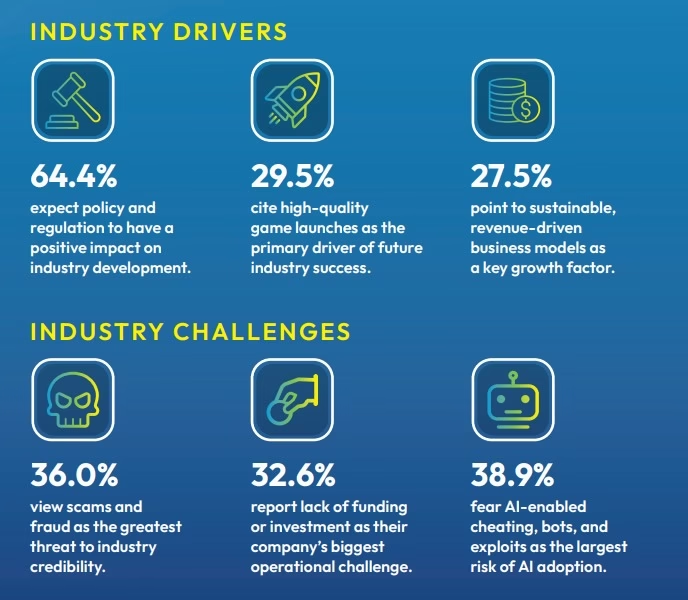
Despite the downturn, the steep correction accelerated a structural realignment. According to the report, growth is now anchored in “high-quality games, resilient revenue models, and payment infrastructure” capable of supporting real-world commerce.
Clearer regulatory frameworks also influenced blockchain gaming sentiment, with many developers viewing policy stabilization as a positive catalyst.
Animoca Brands co-founder Yat Siu noted that improved U.S. regulatory conditions mean companies “no longer need to rely on setting up nonprofit foundations when planning token launches.”
This shift is contributing to a broader sense that blockchain gaming sentiment is benefiting from a more predictable compliance environment.
Several developments underpin the sector’s gradual rebound and the strengthening of blockchain gaming sentiment. One is the rising use of stablecoins, which the BGA described as transformative for Web3 games because they enable “fast, low-cost, borderless transactions without the volatility associated with other crypto assets.”
Their integration provides a more reliable financial layer for in-game economies and cross-border player transactions.
Another factor is the launch of higher-quality games. Nearly 30% of survey participants identified strong game releases as the leading driver of future industry growth. The report indicates that these launches are beginning to counterbalance earlier reputational damage and help stabilize blockchain gaming sentiment.
Immutable’s vice president of global sales, Andrew Sorokovsky, underscored the sector’s underlying resilience, stating that “despite the negative headlines, blockchain gaming is now one of crypto’s most proven sectors — where quality projects are thriving and real adoption is taking hold.”
His comments reflect a broader industry perception that blockchain gaming sentiment will continue improving as the market matures.
Looking ahead, the BGA argues that the path forward depends on sustainable design choices, revenue models capable of enduring market cycles, and the delivery of compelling gameplay experiences.
If these conditions hold, blockchain gaming sentiment may continue to shift toward cautious optimism as the industry moves into a more stable phase.



Copyright © 2025 - The Bit Gazette.