





- Trending
- Comments
- Latest

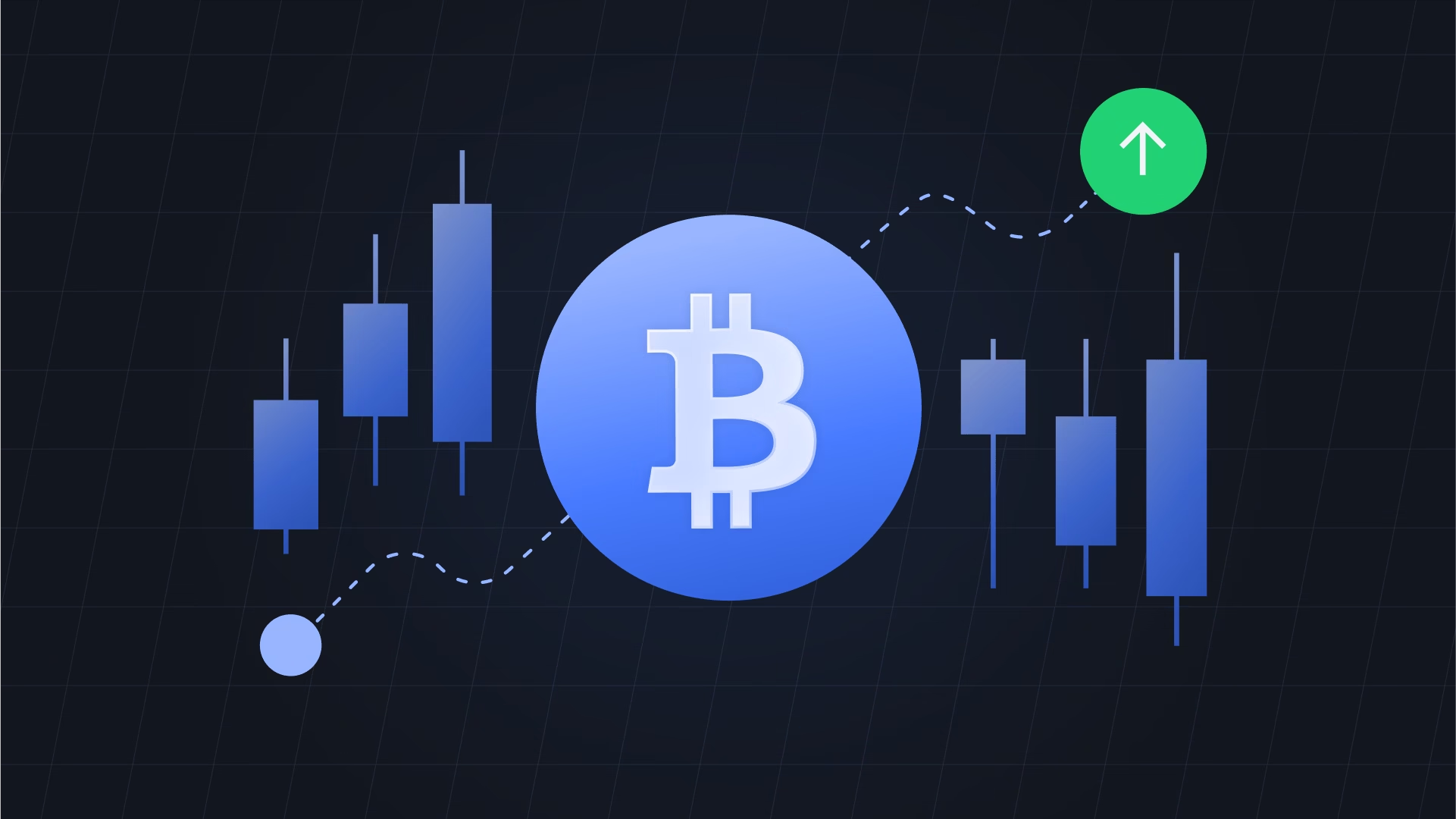
Brazil is taking an unconventional step at the intersection of culture and finance. A newly approved orchestral initiative will transform bitcoin price music into a live performance, using real-time market data to guide melody, rhythm, and harmony during a concert scheduled to take place in Brasília.
The project, approved under Brazil’s federal cultural incentive framework, will convert live Bitcoin price movements into orchestral sound using algorithmic systems.
According to Brazil’s Federal Register, the initiative has already been cleared to raise approximately 1.09 million reais (about $197,000) through tax-deductible private sponsorships. The fundraising window is set to close on December 31.
While the project does not use blockchain technology itself, it relies heavily on Bitcoin’s live pricing data to create what organizers describe as an immersive auditory interpretation of financial markets.
The experiment places bitcoin price music at the center of a broader debate about how governments classify, fund, and legitimize crypto-adjacent innovation.
At the core of the project is an algorithm designed to translate numerical market data into musical notation in real time. During the performance, the orchestra will respond directly to Bitcoin’s price fluctuations, with shifts in value shaping the structure of the music as it unfolds on stage.
According to the project description released by Brazilian authorities, the system monitors Bitcoin’s price movements and associated technical data throughout the concert. These inputs directly influence the composition, affecting melody, tempo, and harmonic progression as the musicians perform live.
Organizers argue that this approach allows audiences to experience market volatility in a new sensory form, effectively turning bitcoin price music into a bridge between abstract financial systems and human perception.
By blending orchestral instrumentation with algorithm-driven composition, the initiative combines elements of music, mathematics, economics, and physics into a single performance framework.
Crucially, officials confirmed that the project complies with Brazil’s Rouanet Law, the country’s long-standing cultural incentive mechanism. The approval followed a technical review process that classified the initiative under the “Instrumental Music” category — a designation that enables sponsors to deduct their contributions from taxes.
The decision highlights how Brazil’s cultural institutions are increasingly open to experimental forms of art, even when they draw inspiration from volatile and controversial assets like Bitcoin.
The approval has sparked discussion across Brazil’s crypto and arts communities. Some participants questioned whether a project rooted in cryptocurrency market data should qualify for public tax incentives, particularly at a time when regulators worldwide remain cautious about crypto-related risks.
In response, Brazilian officials emphasized that the classification of the initiative as “Instrumental Music” was central to its approval and that the evaluation focused on artistic merit rather than financial speculation. They also noted that the authorization merely allows fundraising to proceed, rather than representing direct government expenditure.
Sources familiar with the process said the approval confirms that the project met all formal requirements of the Rouanet Law and completed the necessary technical assessments. As a result, private firms and individual donors are permitted to sponsor the initiative while receiving tax deductions.
Industry analysts observing the debate argue that the controversy reflects a broader global tension. As bitcoin price music and other data-driven art forms gain attention, policymakers are increasingly forced to decide how far cultural funding frameworks should stretch in accommodating crypto-inspired experimentation.
Brazil’s orchestral experiment is not without precedent. Similar projects have emerged internationally, particularly in the field of programmable digital art that responds dynamically to Bitcoin’s price changes.
In 2020, San Francisco–based artist Matt Kane launched Right Place & Right Time, a digital artwork designed to adapt its appearance based on Bitcoin’s market value. The piece was released via Async Art, a blockchain platform known for programmable and interactive digital works.
Kane structured the artwork as a central “Master” image composed of multiple layers, each responding independently to price movements. Changes in Bitcoin’s value influenced visual attributes such as size, rotation, and spatial positioning over time, creating a continuously evolving piece tied directly to market behavior.
Another frequently cited figure in the field is Refik Anadol, an artist known for using artificial intelligence, algorithms, and large datasets to create immersive installations. His work demonstrates how environmental data, historical records, and real-time information can be transformed into evolving visual experiences.
Together, these examples illustrate a growing artistic movement that treats data — including cryptocurrency prices — as a raw creative material. Brazil’s orchestral project extends this logic into the physical world, using live performance to interpret bitcoin price music rather than digital visuals.
Beyond its artistic ambition, the project highlights how Bitcoin continues to influence public discourse in unexpected ways. While regulators often frame cryptocurrencies in terms of risk, compliance, and market stability, Brazil’s initiative reflects a parallel narrative: Bitcoin as cultural data.
As the fundraising period approaches its December deadline and preparations move forward in Brasília, Brazil’s experiment will be closely watched — not just as a concert, but as a signal of how nations might reinterpret crypto’s role in society.
Whether celebrated as innovation or criticized as misapplied policy, one thing is clear: bitcoin price music has entered the public stage, and its resonance now extends far beyond the charts.



Copyright © 2025 - The Bit Gazette.


