


- Trending
- Comments
- Latest

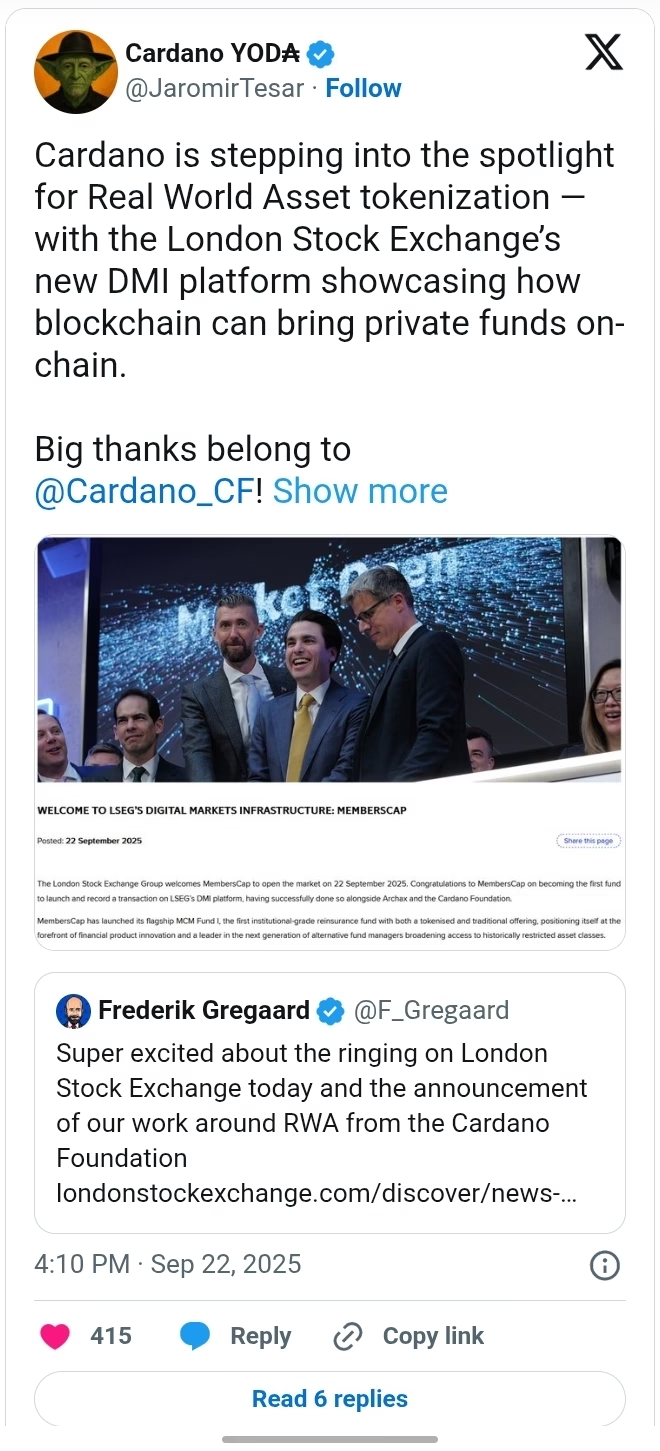
Cardano RWA tokenization has taken a major step forward following a partnership with the London Stock Exchange Group (LSEG). The collaboration has produced the first institutional-grade reinsurance fund to be tokenized on the Cardano blockchain, opening new opportunities for qualified investors.
Members Capital Management (MembersCap) marked the occasion by launching the MCM Fund I, officially recognized by LSEG in a market-opening ceremony. The fund’s tokenization was executed on Cardano, with Archax, a regulated digital asset exchange, overseeing the process.
“This move allows qualified investors to access reinsurance-backed products through the Cardano platform,” — Frederik Gregaard, CEO, Cardano Foundation.
The milestone strengthens Cardano RWA tokenization as a trusted infrastructure for institutional assets, combining blockchain resilience with compliance-driven frameworks.
The introduction of the MCM Fund I through Cardano RWA tokenization offers a gateway for investors to access traditionally complex reinsurance products in a streamlined and digital format. Tokenization brings transparency, efficiency, and accessibility to an asset class previously limited to a small circle of institutional players.
By leveraging blockchain, investors gain exposure to reinsurance-backed instruments with added benefits such as automated settlement and immutable record-keeping. For Cardano, the collaboration underlines its ability to compete with other networks seeking to dominate real-world asset tokenization.
“Cardano’s security, compliance, and resilience make it a strong candidate for tokenizing institutional-grade assets,” — Cardano Foundation, in a project statement.
Beyond the MembersCap initiative, Cardano RWA tokenization has been expanding through partnerships led by EMURGO, the commercial arm of Cardano. Earlier in the year, EMURGO worked with Kinka to mint gold-backed tokens on the blockchain, further diversifying its real-world asset offerings.
Additional collaborations include projects with Haus, OpenEden, and DigiFT. These ventures target tokenized products such as private credit, U.S. government bonds, and insurance factoring. Collectively, they reinforce Cardano’s role in shaping the future of real-world asset tokenization by broadening investor access to a range of traditionally illiquid markets.
As global financial institutions increasingly explore blockchain-based solutions, Cardano RWA tokenization stands out for its institutional focus. While competitors such as Ethereum and Polygon have established footprints in tokenization, Cardano’s compliance-first approach and focus on resilience provide it with a distinct position.
The LSEG collaboration signals that regulated institutions are beginning to view Cardano as a credible venue for asset tokenization. For policymakers and investors alike, it highlights how blockchain can bridge traditional finance with digital innovation.
By focusing on reinsurance, gold-backed tokens, and government bonds, Cardano is not just testing tokenization but operationalizing it in sectors with real institutional demand. This positions the blockchain to play a central role in the coming wave of asset digitalization.



Copyright © 2025 - The Bit Gazette.