

- Trending
- Comments
- Latest

Chinese-speaking criminal syndicates have transformed pig-butchering romance scams into a fully industrialized, cross-border business, commoditizing fraud at a scale that rivals legitimate tech startups, according to new research from cybersecurity firm Infoblox and international law enforcement agencies.
Once the work of loosely organized online fraudsters, pig-butchering romance scams have, over nearly a decade, evolved into a sprawling ecosystem where every component of deception is sold as a service—from fake dating profiles and scripted love stories to counterfeit trading platforms and crypto laundering pipelines.
“These groups didn’t just refine scams; they professionalized them,” Infoblox said in a report published last Thursday. “They now operate a plug-and-play criminal economy capable of launching, managing, and scaling pig-butchering romance scams across borders.”
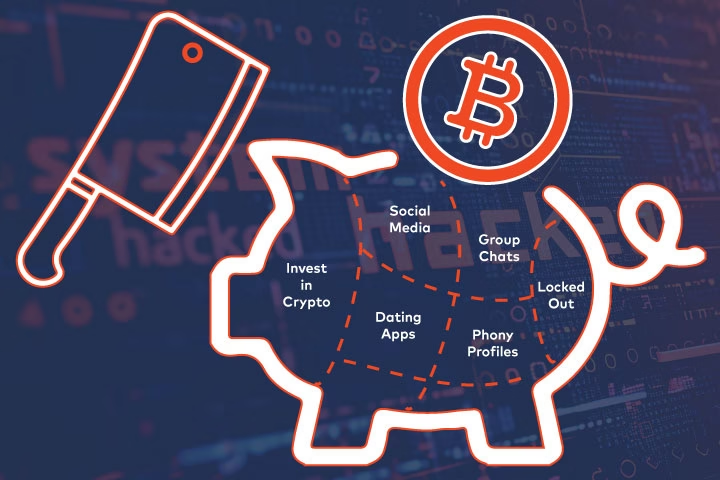
The term pig-butchering romance scams refers to long-con fraud schemes where victims are emotionally groomed before being coaxed into fake investment opportunities, often involving cryptocurrency or forex trading. The “pig” is slowly fattened with trust before being financially “slaughtered.”
Infoblox researchers say Chinese criminal syndicates have been building dedicated scam centers across Southeast Asia since at least 2016. These operations are often housed inside special economic zones that provide regulatory blind spots and weak enforcement, shielding operators from prosecution.
According to the report, pig-butchering romance scams are now delivered through a crime-as-a-service model, allowing operators with minimal technical skill to buy everything needed to run campaigns.

“They have established sophisticated global money laundering and human trafficking networks dedicated to staffing these operations with tens of thousands of slave workers,” Infoblox wrote. “These workers are forced to run pig-butchering romance scams from Cambodia, Laos, Myanmar, the Philippines, and beyond.”
One of the most disturbing aspects of the pig-butchering romance scams ecosystem is its reliance on human trafficking. Scam compounds reportedly house thousands of workers who were lured with promises of legitimate sales or tech jobs, only to have their passports seized upon arrival.
INTERPOL has repeatedly warned that many pig-butchering romance scams are “human trafficking–enabled fraud operations conducted on an industrial scale.” High-profile hubs such as the Golden Triangle Special Economic Zone (GTSEZ) are believed to function as safe havens for criminal syndicates.
Infoblox described these zones as self-contained fraud factories, complete with call centers, data servers, financial coordination teams, and dormitories for forced workers. Inside, scam operators rely on pig-butchering-as-a-service (PBaaS) platforms that offer ready-made applications, scripts, and infrastructure.
At the core of this ecosystem are specialized vendors that sell tools designed specifically for pig-butchering romance scams. Infoblox highlighted a crimeware-as-a-service operation known as Penguin, which openly advertises fraud kits, scam templates, and massive datasets of stolen personal information.
Penguin reportedly sells pre-registered accounts for platforms such as X, Tinder, Instagram, Facebook, YouTube, Snapchat, and even OpenAI’s ChatGPT. Prices start as low as $0.10 per account, rising with age and perceived authenticity—critical factors for romance-based scams.

The group also markets a proprietary Social Customer Relationship Management tool, SCRM AI, which enables automated, large-scale engagement with victims. This software allows scammers to manage hundreds of conversations simultaneously, making pig-butchering romance scams far more scalable than traditional fraud.
To complete the illusion, operators purchase ready-made trading platforms designed to mimic real financial services. Many fake sites claim to integrate with legitimate tools like MetaTrader, displaying real-time market data while routing deposits directly to wallets controlled by criminals.
“The admin panel offers everything needed to run a pig-butchering operation,” Infoblox noted. “User management, agent oversight, profitability metrics, and full chat histories.”
Stolen funds are often laundered through cryptocurrency, complicating recovery efforts. Investigators say scammers rely on peer-to-peer payment systems and crypto-friendly processors to move funds across borders quickly, a tactic commonly used in pig-butchering romance scams.
Researchers also found that pig-butchering romance scams are increasingly targeting smartphones. Criminal developers distribute malicious Android APKs and exploit limited Apple testing programs to bypass app store safeguards.
Some fake investment apps even appear briefly on legitimate marketplaces, disguised as news or utility tools, before being removed. Entry-level scam websites can cost as little as $50, while full-service packages—including mobile apps, hosting, admin access, and shell companies—can start around $2,500.

“These syndicates are running fraud operations with the efficiency of SaaS companies,” said Infoblox investigators Maël Le Touz and John Wòjcik. “Pig-butchering romance scams are no longer improvised crimes—they are products.”
Law enforcement agencies warn that pig-butchering romance scams now represent one of the fastest-growing categories of financial crime worldwide. Victims span all demographics, with losses often reaching life-altering sums due to the emotional manipulation involved.
Despite periodic crackdowns, the report suggests that enforcement struggles to keep pace with the syndicates’ adaptability. As long as safe havens exist and the tools remain cheap, researchers warn that pig-butchering romance scams will continue to expand.
For victims and policymakers alike, the findings underline a harsh reality: this is no longer just online fraud—it is a global shadow economy built on deception, exploitation, and industrial-scale crime.



Copyright © 2025 - The Bit Gazette.