





- Trending
- Comments
- Latest


The debate over CZ net worth intensified after Changpeng Zhao, founder of Binance, publicly challenged a recent billionaire ranking that estimated his personal fortune at approximately $110 billion.
The dispute began after Forbes released an updated list of global billionaires that placed Zhao, widely known as CZ, at number 17. The estimate positioned him ahead of Bill Gates and above Zhang Yiming, the founder of ByteDance.
Zhao responded by questioning the logic behind the valuation, arguing that the reported CZ net worth figure does not align with the financial fundamentals of the companies involved.
His comments quickly drew attention within the cryptocurrency industry, where analysts have long debated the difficulty of accurately measuring wealth tied to digital asset businesses.
The CZ net worth discussion also raises broader questions about how financial publications calculate the fortunes of founders whose wealth is heavily linked to private equity stakes and volatile cryptocurrency holdings.
At the center of the dispute is the method used to estimate CZ net worth, which Zhao says lacks transparency and internal consistency.
According to Zhao, the comparison between companies included in the ranking illustrates the problem. He pointed out that ByteDance reportedly generates about $150 billion in annual revenue, yet its founder Zhang Yiming is estimated to have a personal fortune of $69 billion.
By contrast, Zhao noted that Binance generates significantly less annual revenue — roughly $5 billion — yet the Forbes ranking places the CZ net worth figure at $110 billion.
The disparity, he suggested, raises questions about how financial analysts calculate the value of cryptocurrency-related businesses and their founders.
Zhao also explained that he initially noticed the discrepancy without reading the full Forbes report.
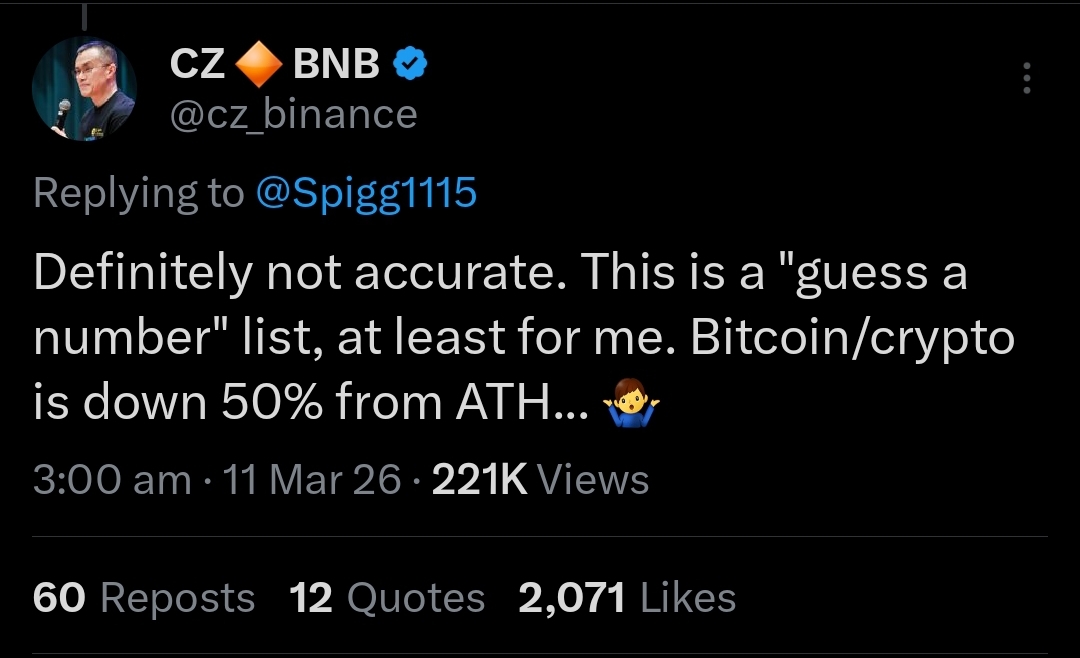
He said he was able to spot what he believed was a valuation error simply by looking at a chart that accompanied the ranking.
The comments have fueled renewed debate over how CZ net worth estimates are derived, particularly when they rely on approximations of exchange ownership stakes and digital asset reserves.
The controversy surrounding CZ net worth estimates also expanded into broader discussions about cultural attitudes toward wealth disclosure.
After Zhao disputed the ranking, crypto media outlet BlockTempo suggested that his response might reflect a cultural tendency among Chinese business leaders to downplay or conceal personal wealth.
Zhao rejected that interpretation, stating that his criticism was based on inconsistencies in the financial logic behind the valuation rather than cultural considerations.
The CZ net worth discussion therefore shifted from a simple dispute over personal wealth to a larger conversation about how financial data is interpreted and communicated in the digital asset industry.
Observers say the exchange highlights the challenges faced by traditional financial media when attempting to measure the wealth of technology entrepreneurs whose businesses operate largely within decentralized ecosystems.
The broader context surrounding the CZ net worth debate is the sharp volatility currently affecting the cryptocurrency market.
Industry data shows that many digital assets have declined by more than 50% during 2026, creating significant fluctuations in the value of crypto-related businesses.
Because wealth estimates for exchange founders often depend on token holdings and equity stakes in privately held companies, these market swings can dramatically alter net worth calculations.
This volatility makes the CZ net worth figure particularly difficult to determine with precision.
Analysts say billionaire rankings that involve cryptocurrency entrepreneurs often rely on estimated exchange ownership and approximations of token reserves — variables that can shift rapidly with market conditions.
As a result, even widely cited figures for CZ net worth may change substantially depending on how analysts value the underlying assets.
Despite the disagreement, the discussion has brought renewed attention to the challenges of evaluating wealth in the cryptocurrency industry.



Copyright © 2025 - The Bit Gazette.

