






- Trending
- Comments
- Latest

Decentralized messaging platforms are experiencing measurable adoption growth in regions experiencing government-imposed communication restrictions, according to blockchain analytics data from 2024-2025.
Users in Eastern Europe, the Middle East, and parts of Asia have increased downloads of privacy-focused, censorship-resistant applications during periods of political unrest and internet shutdowns.
Unlike centralized services such as WhatsApp or Telegram, these blockchain-based platforms operate across distributed networks, making them resistant to government takedowns or mass surveillance.
The trend, observed throughout 2024 and into 2025, highlights a growing demand for privacy-focused alternatives to traditional messaging apps.
These platforms, unlike centralized services, operate without a single controlling authority, making them more resistant to shutdowns, surveillance, or censorship.
In regions facing government-imposed internet blackouts or content moderation crackdowns, decentralized messaging tools are becoming essential.
Analysts note that this shift reflects broader concerns about digital rights, freedom of expression, and the reliability of centralized tech infrastructure during crises.
“Whenever there’s instability or restrictions on communication, people naturally seek tools that cannot be easily controlled.” Marta Belcher, President, Filecoin Foundation.
Decentralized messaging platforms rely on distributed networks rather than centralized servers. This means messages are routed through multiple nodes, often encrypted and stored across a blockchain or peer-to-peer system.
As a result, no single entity can easily block access or monitor conversations at scale.
Popular protocols and applications in this space leverage technologies such as end-to-end encryption, blockchain verification, and distributed storage.
These features ensure that users retain control over their data while minimizing the risk of censorship.
Unlike traditional apps like WhatsApp or Telegram, which can be restricted by governments or corporate policies, decentralized platforms are designed to remain operational even under extreme conditions.
“Decentralization ensures that communication remains open, even when centralized systems fail or are deliberately shut down.” Dietrich Ayala, Executive Director, Protocol Labs.
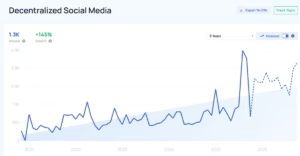
Data from blockchain analytics firms and decentralized application developers shows that usage of these platforms often spikes during periods of unrest.
Countries experiencing protests, political instability, or regulatory crackdowns tend to see the highest growth rates.
For example, regions in Eastern Europe, the Middle East, and parts of Asia have recorded increased downloads and user activity on decentralized messaging apps during periods of heightened tension.
In some cases, these tools have served as critical lifelines for activists, journalists, and everyday citizens.
Experts say this pattern mirrors earlier trends seen with VPN adoption and encrypted messaging apps.
However, decentralized tools go a step further by removing reliance on centralized infrastructure altogether.
Despite their advantages, decentralized messaging platforms still face significant challenges.
Usability remains a major barrier, as many applications require technical knowledge that average users may lack. Additionally, scalability issues and slower transaction speeds can hinder widespread adoption.
There are also concerns about misuse. Critics argue that censorship-resistant platforms could be exploited for illicit activities or the spread of misinformation, raising questions about regulation and accountability.
Governments and policymakers are beginning to take notice. While some view decentralized technologies as tools for empowerment, others see them as potential threats to national security and regulatory frameworks.
Nevertheless, industry leaders remain optimistic about the long-term trajectory of decentralized communication.
As technology improves and user interfaces become more accessible, adoption is expected to grow beyond crisis-driven use cases.
The broader implication is clear: the global communication landscape is evolving. In a world where trust in centralized systems is increasingly questioned, decentralized messaging is emerging as a viable alternative.



Copyright © 2025 - The Bit Gazette.