




- Trending
- Comments
- Latest

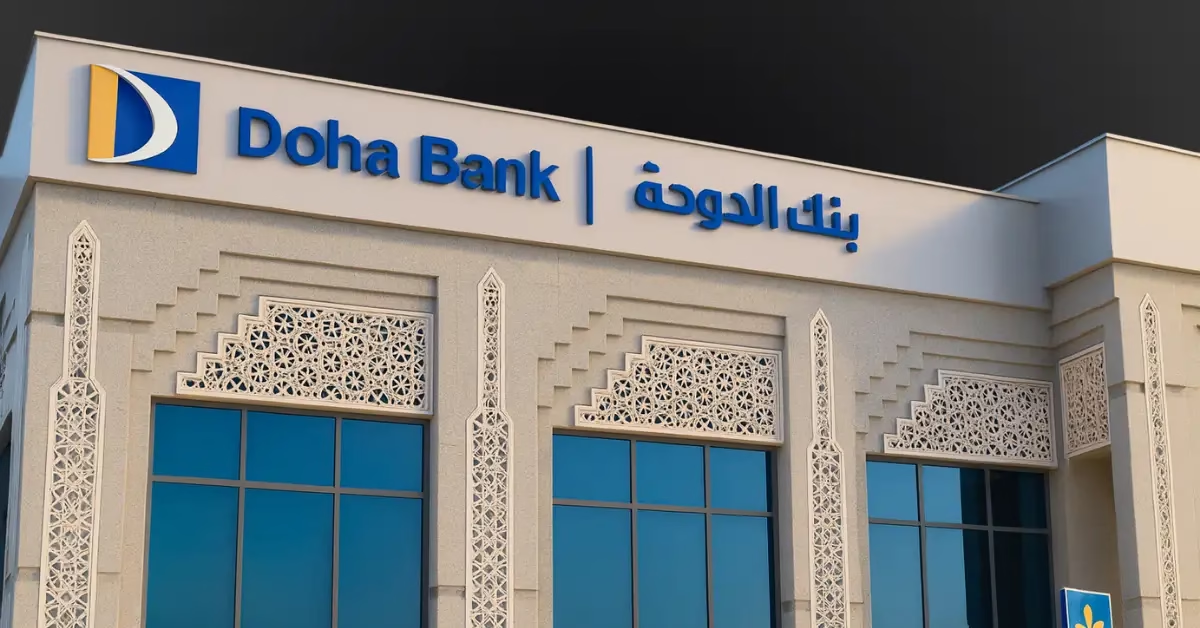
Doha Bank raised $150 million through a digitally native US dollar bond that settled instantly on Euroclear’s distributed ledger platform, marking one of the Middle East’s first major debt issuances to achieve same-day settlement.
The floating-rate notes, arranged by Standard Chartered and listed on the London Stock Exchange, were issued, allocated, and settled in real time—eliminating the typical one-to-two-day settlement period for traditional bonds. The transaction signals growing institutional adoption of blockchain-based infrastructure in regulated capital markets.
Standard Chartered acted as sole global coordinator and sole arranger, overseeing the structuring, execution, and distribution of the bond.
The bank emphasized that institutional demand for regulated digital issuance is accelerating as investors seek operational efficiency without sacrificing legal certainty.
Deals like this show that regulated digital infrastructure is no longer a pilot—it’s live, said Salman Ansari, Global Head of Capital Markets at Standard Chartered.
He added that the digital bond demonstrates how distributed ledger technology can deliver measurable gains while maintaining compatibility with existing capital markets frameworks.
Euroclear’s D-FMI platform handled issuance and settlement, operating as a permissioned distributed ledger fully integrated with existing post-trade and custody systems.
Citi served as issuing and paying agent, reinforcing the transaction’s alignment with established institutional processes.
According to Euroclear, the digital bond proves that same-day settlement can be achieved without dismantling traditional market structures.
Equally important, integration with traditional secondary-market services and trading venues ensures that investors retain access to liquidity, said Sebastien Danloy, Chief Business Officer at Euroclear.
Doha Bank said the bond supports its broader funding strategy by diversifying capital sources and expanding its global investor base.
The issuance ranks among Qatar’s earliest digitally native US dollar bonds and reflects a wider regional push to modernize financial infrastructure.
Sheikh Abdulrahman Bin Fahad Al-Thani, Group Chief Executive of Doha Bank, said the bond underscores how digital infrastructure can enhance efficiency and market access while strengthening Qatar’s role as a regional financial hub.
He added that the transaction aligns with Qatar Central Bank initiatives aimed at boosting the resilience and competitiveness of domestic capital markets.
The Doha Bank also reflects a broader industry preference for permissioned distributed ledger systems over public blockchains for tokenized debt.
Regulated platforms allow issuers to benefit from instant settlement, automated recordkeeping, and transparency—while preserving legal finality and controlled access required by institutional investors.
This balance between innovation and compliance is increasingly viewed as critical as the bond issuance scales beyond experimental volumes.
The momentum behind the bond mirrors parallel developments across global finance.
Payment giants and financial infrastructure providers are racing to control how money and assets settle in an always-on environment.
Recent reports of Mastercard’s talks to acquire crypto infrastructure firm Zerohash, alongside Stripe’s purchase of stablecoin firm Bridge, underline a broader competition for settlement rails.
As markets move toward 24/7 settlement, the digital bond is emerging as a cornerstone instrument—efficient, programmable, and institutionally acceptable.
Doha Bank’s $150 million digital bond is more than a regional first—it is a signal that capital markets are entering a transformative phase.
While the technology promises speed and efficiency, it also challenges long-standing settlement models, forcing institutions to adapt or risk falling behind.
For now, the message is clear: the digital bond is no longer theoretical. It is live, regulated, and rapidly reshaping the future of global finance.



Copyright © 2025 - The Bit Gazette.