






- Trending
- Comments
- Latest


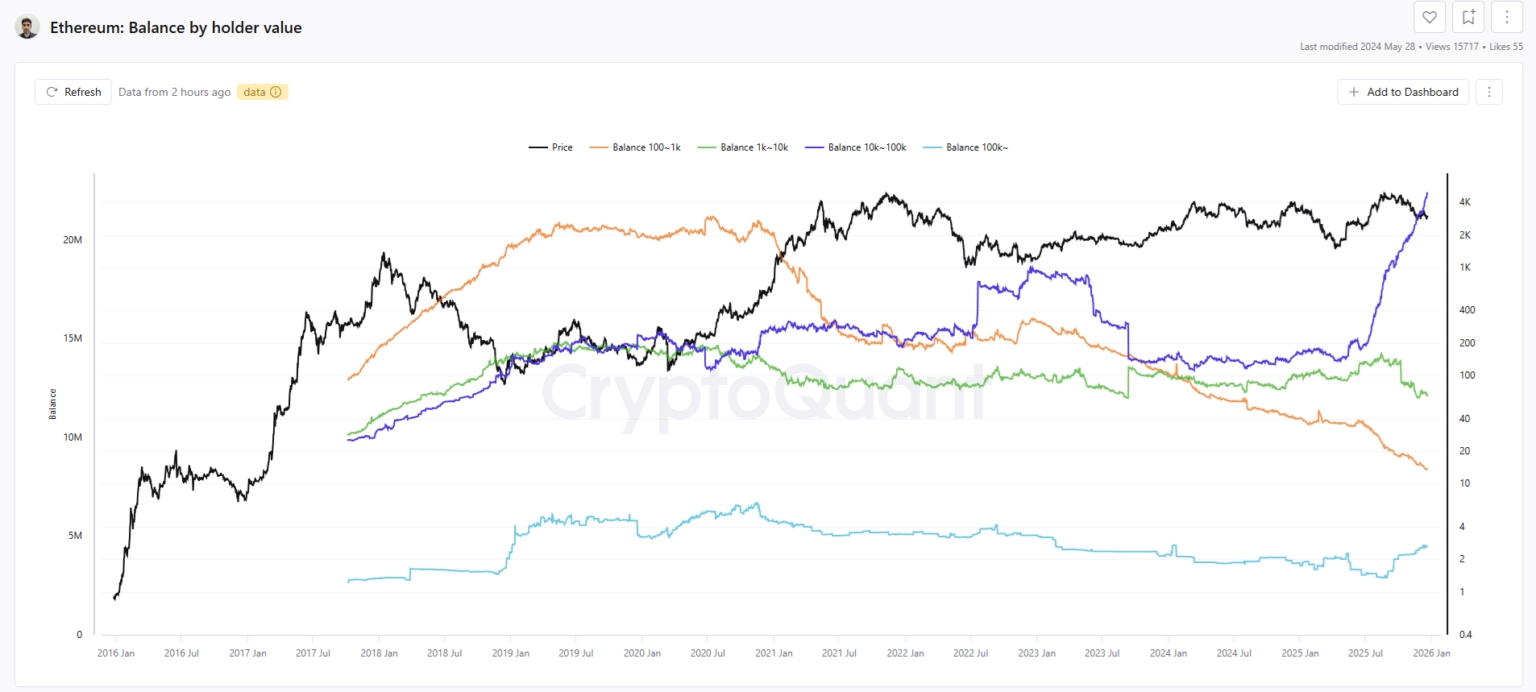
Ethereum whale wallets now control more than 22 million ETH, a record high reached through aggressive accumulation during 2025’s prolonged price weakness, as retail investors steadily exited the asset.
Wallets holding between 10,000 and 100,000 ETH led the buying throughout the second half of the year, according to on-chain data, even as broader market sentiment remained near multi-month lows and ETH traded below $3,000 for extended periods.
A major driver behind the Ethereum inflow narrative is the steady migration of ETH off centralized exchanges and into self-custodial wallets.
This structural shift suggests reduced immediate selling pressure and a preference for long-term storage rather than short-term speculation.
According to data from Glassnode, Ethereum has continued to see declining exchange balances throughout 2025.
When assets move off exchanges, it typically reflects strategic accumulation rather than speculative trading, Glassnode analysts noted in a recent market update.
Meanwhile, retail participation continued to fade. Wallets holding 100 to 1,000 ETH have been shrinking consistently since 2024, underscoring a widening gap between institutional-scale holders and everyday investors.
The Ethereum inflow into whale wallets expanded at a much faster pace than any other cohort, with large-scale holders now controlling more than 22 million ETH.
While the very largest wallets—often associated with exchanges or treasuries—hold approximately 4.47 million ETH, analysts suggest these balances are less indicative of market sentiment.
Instead, newer whale wallets buying close to their realized price have attracted attention.
These whales accumulated ETH without immediate profits, reinforcing the view that the Ethereum inflow reflects expectations of a future breakout rather than preparation for a prolonged bear market.
Smart money tends to accumulate when volatility is high and conviction is low, said crypto market analyst Alex Krüger. That’s exactly what we’re seeing with Ethereum inflow patterns in 2025.
Another critical takeaway from the Ethereum inflow data is its impact on price structure. Whale accumulation has consistently occurred below $3,000, establishing strong on-chain support near the $2,800 level.
Notably, the Seven Siblings wallets—widely tracked for their historical accuracy in timing accumulation—became active again in November, reinforcing confidence in ETH’s valuation at these levels.
Unlike previous cycles, this Ethereum inflow did not coincide with hype-driven rallies. Instead, whales entered during periods of market panic, cautious derivatives positioning, and historically low retail sentiment.
Perhaps most striking is that Ethereum inflow into whale wallets continued even as ETF investors reduced exposure.
This divergence suggests that crypto-native capital remains confident in Ethereum’s long-term relevance, despite short-term macro uncertainty.
Ethereum’s role in decentralized finance remains dominant. The network still secures over 95% of liquidity for protocols such as Sky (formerly MakerDAO), according to DeFiLlama.
Stablecoins—one of the fastest-growing sectors in 2025—continue to rely heavily on Ethereum infrastructure.
Ethereum remains the settlement layer of choice for serious DeFi activity, said Ryan Rasmussen, Head of Research at Bitwise. That foundational demand is what keeps long-term holders accumulating.
As retail exits and whales extend silent accumulation, Ethereum inflow has become one of the clearest indicators of shifting market dynamics.
While risks remain, the behavior of large-scale holders suggests growing confidence in Ethereum’s strategic importance beyond price speculation.
If history repeats, this quiet buildup could precede the next major phase for ETH—making Ethereum inflow one of the most critical metrics to watch heading into 2026.



Copyright © 2025 - The Bit Gazette.

